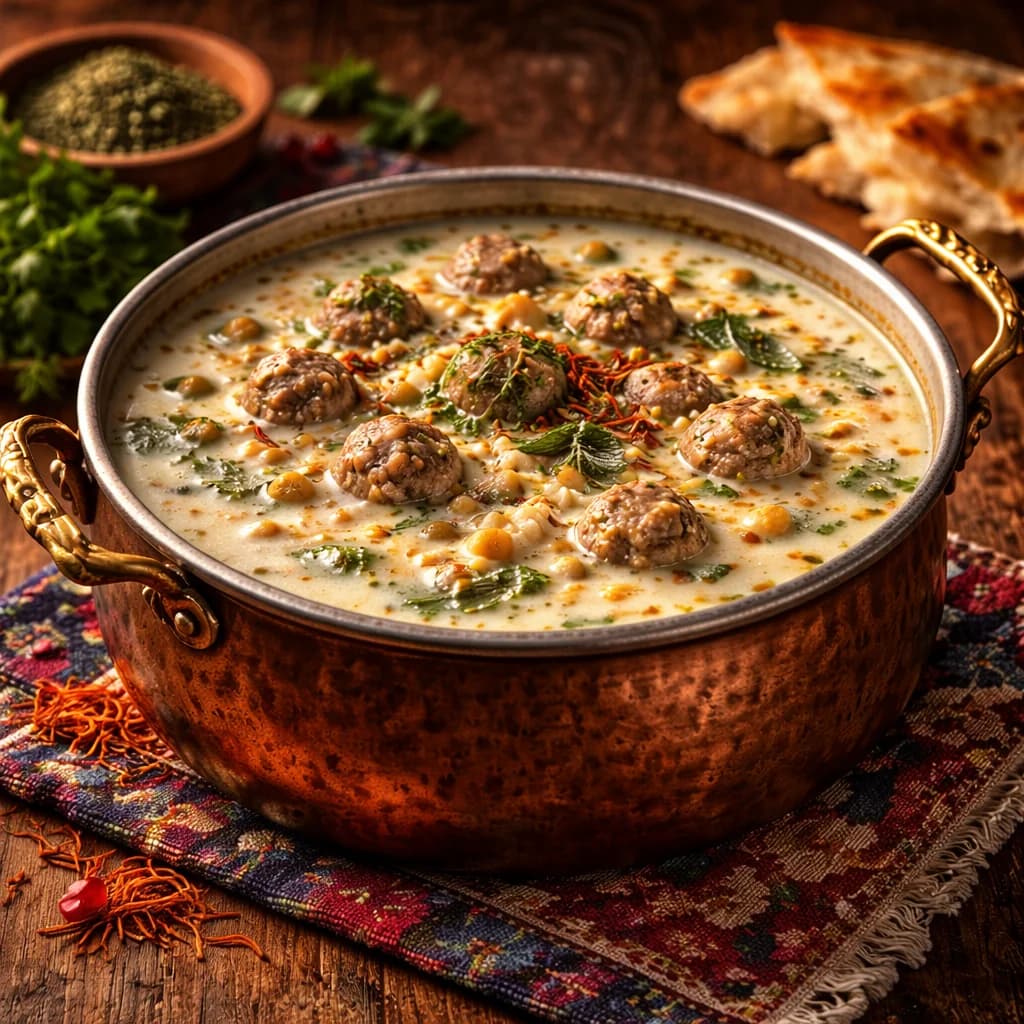

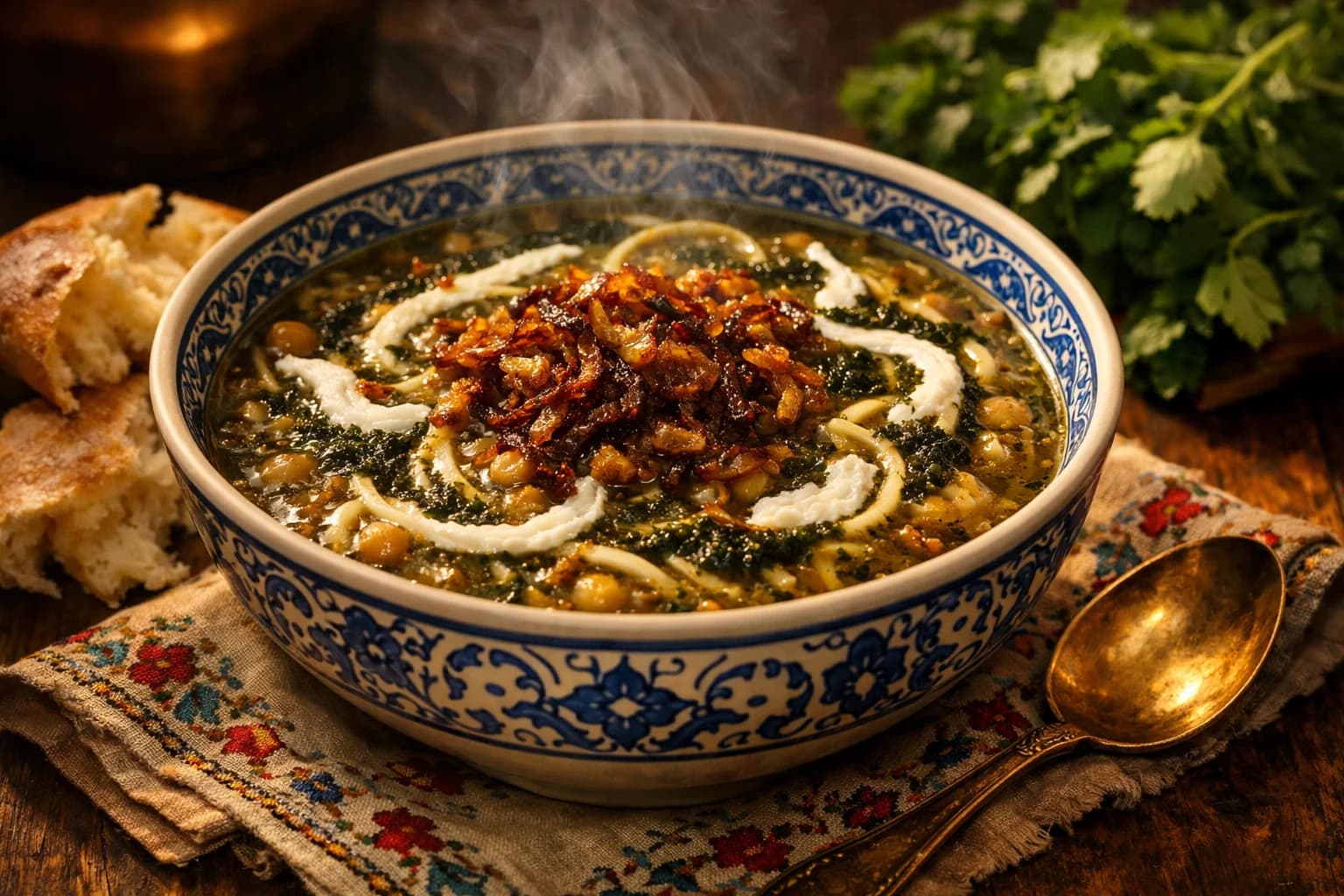
Ash Reshteh (Persian Noodle and Herb Soup)

Ash Reshteh (Persian Noodle and Herb Soup)

آش رشته

The queen of Persian soups—a thick, hearty pottage of noodles, legumes, and an abundance of fresh herbs, crowned with swirls of tangy kashk, deeply caramelized onions, and fragrant fried mint in butter. This ancient dish is deeply woven into Persian culture: served at Nowruz to symbolize good fortune, prepared as nazri (religious charity food) for blessings, and made whenever someone embarks on a new journey. The name 'reshteh' means thread or noodle, and symbolically represents the threads of life and destiny.

soupPrep: 45 minCook: 120 minintermediateServes 10

Cultural Note

Ash reshteh is one of the most culturally significant dishes in Persian cuisine. It's prepared for Nowruz (Persian New Year) because 'reshteh' (noodle/thread) symbolizes the threads of life and good fortune in the year ahead. It's also traditional nazri food—prepared as a religious offering and shared with neighbors, the poor, and passersby to gain blessings. When someone embarks on a new journey, new job, or new home, ash reshteh is made to wish them well. The dish represents community, generosity, and hope. Traditionally prepared in enormous pots and shared widely, making ash reshteh is as much a social act as a culinary one.

Critical Moments

  • Soaking legumes overnight
  • Cooking beans until fully tender before adding noodles
  • Using abundant fresh herbs (don't skimp)
  • Achieving proper thick pottage consistency
  • Frying onions until truly crispy (not just golden)
  • Frying mint briefly in butter (don't burn)
1
PREP5 min

Soak the legumes (night before)

The night before, place chickpeas, white beans, and kidney beans (if using) in separate bowls. Cover each with plenty of cold water—at least three times their volume. Soak for at least 8 hours or overnight. The beans will roughly double in size.

Beans covered with water; will swell overnight
TouchDried beans, hard

Critical Step

Soaking is essential for even cooking and digestibility. Unsoaked beans take much longer and cook unevenly. Chickpeas especially need long soaking.

If short on time, use the quick-soak method: cover beans with water, bring to boil, remove from heat, cover, and let sit 1 hour. Or use canned beans (add later in cooking).
2
PREP25 min

Prepare the herbs

Wash all herbs thoroughly in several changes of water—they can be very sandy. Drain well and chop finely. Combine all chopped herbs in a large bowl. You should have roughly 700g of chopped herbs total.

Mountain of finely chopped green herbs
SmellIntensely herbaceous—the kitchen fills with fragrance
TouchFinely chopped, relatively dry

Critical Step

The abundance of fresh herbs is what defines ash reshteh. Don't skimp—the soup should be intensely green and herbaceous. Thorough washing prevents gritty soup.

This is the most time-consuming step. Wash herbs in batches, spin dry, then chop. Can be done a day ahead—store chopped herbs in sealed bag in refrigerator.
3
COOK12 min

Start the soup base

Drain the soaked beans and rinse well. In a large stockpot, heat 60ml oil over medium heat. Add the 2 diced onions and cook for 8-10 minutes until softened and lightly golden. Add garlic and turmeric, cook 1 minute until fragrant.

Onions are golden and soft; turmeric has colored everything yellow
Medium165°C / 325°F
SmellSautéing onions with turmeric
SoundSizzling
TouchOnions are soft
4
COOK10 min

Add legumes and water

Add the drained chickpeas, white beans, kidney beans (if using), and lentils to the pot. Add 2500ml water or stock. Bring to a boil, then reduce heat to a gentle simmer. Skim any foam that rises to the surface.

Beans simmering in broth; foam skimmed from surface
Bring to boil, then gentle simmer
SmellCooking legumes
SoundGentle bubbling
Skim the foam for clearer broth. The lentils cook faster than the other beans but adding them all together works fine.
5
COOK55 min

Simmer the legumes

Simmer uncovered for 45-60 minutes until the chickpeas and beans are tender but not falling apart. Stir occasionally and add more water if needed—the soup should remain brothy at this stage. Season with salt halfway through.

Beans are tender when pierced with a fork; lentils have broken down somewhat
LowGentle simmer
SmellCooking legumes—earthy, comforting
SoundGentle bubbling
TouchChickpeas should be tender when bitten

Critical Step

The beans must be fully tender before adding the noodles—they won't soften much more after that. Undercooked chickpeas are unpleasant. Test by eating one.

Checkpoint: Bite a chickpea—it should be creamy throughout, not chalky
While waiting: Prepare the toppings while the beans cook
6
COOK25 min

Add the herbs

Add all the chopped herbs to the pot. Stir well to incorporate. The soup will become intensely green. Continue simmering for 20-25 minutes, allowing the herbs to cook down and meld with the broth.

Soup is deeply green; herbs have wilted and integrated
LowGentle simmer
SmellHerbaceous, earthy, complex
SoundBubbling
TouchSoup has thickened slightly from herb fibers
The soup should look almost impossibly green at this point. This is correct.
7
COOK15 min

Add the noodles

Add the reshteh noodles, breaking them into roughly 10cm lengths if very long. Stir gently to prevent sticking. Cook for 10-15 minutes until noodles are tender but not mushy. The soup will thicken significantly.

Noodles are tender and have absorbed some broth; soup has thickened to pottage consistency
Medium-LowActive simmer
SmellNoodles cooking in herbed broth
SoundThicker bubbling
TouchNoodles are tender when bitten

Critical Step

The noodles continue to absorb liquid as they sit. Slightly undercook if not serving immediately. Overcooked noodles become mushy and fall apart.

Stir gently and frequently—the noodles and thick soup tend to stick to the bottom. Add more water if too thick.

Common Mistakes

  • Overcooking noodles (mushy)
  • Not stirring (noodles stick and burn)
  • Soup too thick (add water as needed)
8
COOK5 min

Adjust consistency and seasoning

The soup should be thick like a pottage—spoonable but not gluey. Add water to thin if needed, or simmer longer to thicken. Taste and adjust salt generously—ash needs assertive seasoning. Add pepper.

Thick, spoonable consistency; intensely green with visible beans and noodles
SmellComplex, herbaceous, savory
SoundThick bubbling
TouchCoats a spoon thickly

Critical Step

Proper consistency is essential. Too thin is watery; too thick is gluey. The soup should be thick enough that toppings float on top rather than sinking.

Ash reshteh thickens significantly as it sits. If making ahead, it will need thinning with water when reheated.
9
TOPPING20 min

Fry the crispy onion topping

While the soup simmers, heat 60ml oil in a large skillet over medium-high heat. Add the 2 thinly sliced onions. Fry, stirring frequently, for 15-20 minutes until deeply golden brown and crispy. Remove to paper towels and season with a pinch of salt.

Onions are deep golden-brown, reduced significantly, and crispy
Medium-High175°C / 350°F
SmellDeeply caramelized onions—sweet and nutty
SoundSizzling that diminishes as moisture evaporates
TouchCrispy when cooled

Critical Step

The crispy fried onions are an essential topping—their sweet, caramelized flavor contrasts beautifully with the tangy kashk. Don't undercook—they should be truly crispy.

The onions continue darkening after removal. Take them out when deep golden, not dark brown. They crisp further as they cool.
10
TOPPING2 min

Fry the mint in butter

In a small skillet, melt the butter over medium heat. When foaming subsides, add the dried mint. Swirl for 30-45 seconds until intensely fragrant and the mint has infused the butter. Remove from heat immediately—mint burns quickly.

Golden butter flecked with dark green mint; aromatic steam rising
Medium150°C / 300°F
SmellIntoxicating mint-butter aroma
SoundGentle sizzling
TouchLiquid butter with mint pieces

Critical Step

The fried mint in butter is a signature Persian finishing technique. The aroma when it's drizzled over the soup is extraordinary. Don't burn the mint.

Work quickly—mint goes from fragrant to burnt in seconds. Have your serving bowls ready.
11
TOPPING2 min

Prepare the kashk

If the kashk is very thick, thin it slightly with a tablespoon or two of water to make it drizzleable. Warm it gently if cold. It should be pourable but still creamy.

Pourable, creamy white kashk
SmellTangy, slightly funky kashk
TouchThick but pourable
Kashk should be thick enough to create visible swirls on top of the soup, not sink in.
12
FINISH5 min

Serve with traditional toppings

Ladle the hot soup into wide bowls. For each bowl: drizzle kashk in a decorative swirl pattern, add a generous mound of crispy fried onions in the center, and drizzle the mint butter over everything. Serve immediately with additional kashk on the side.
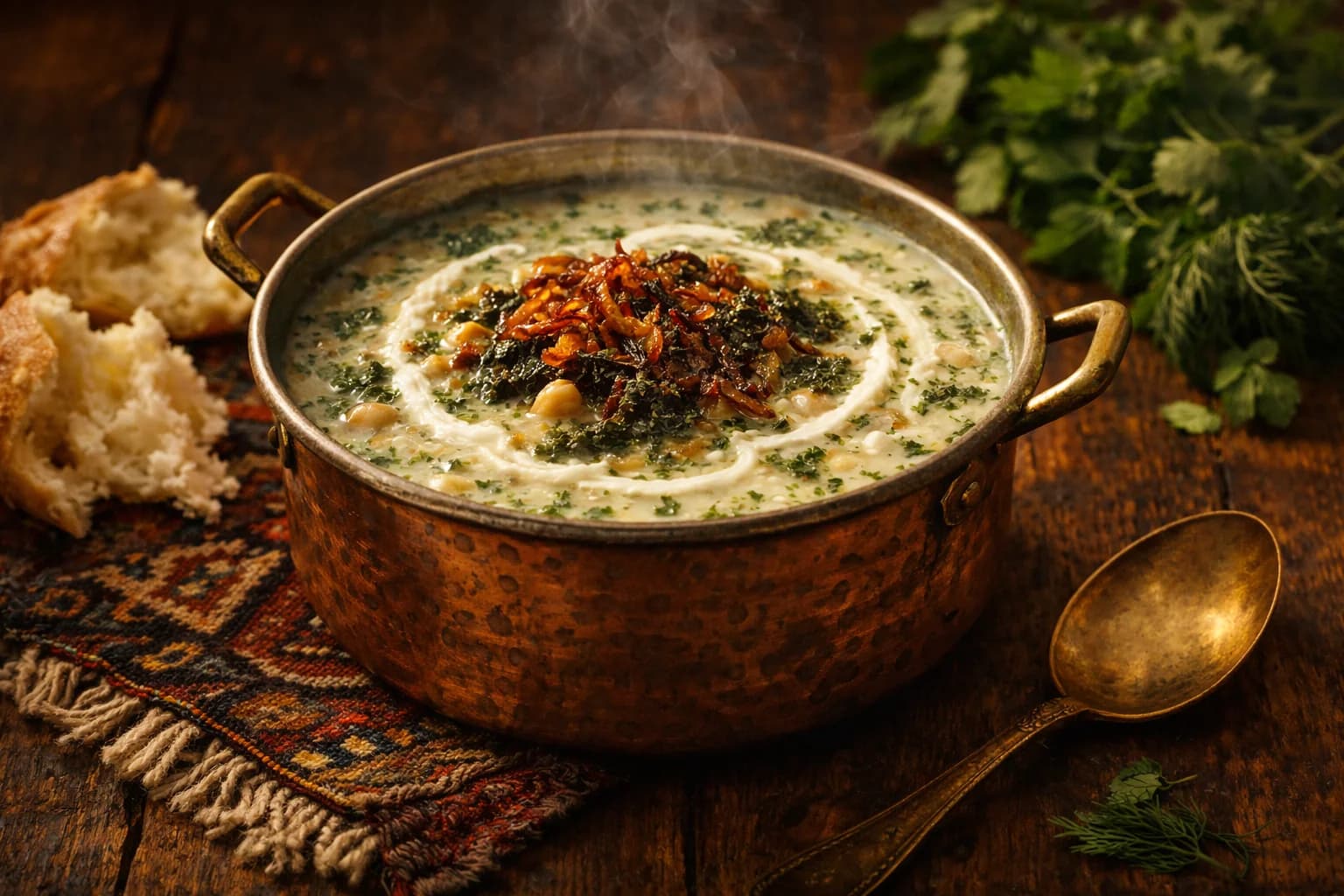
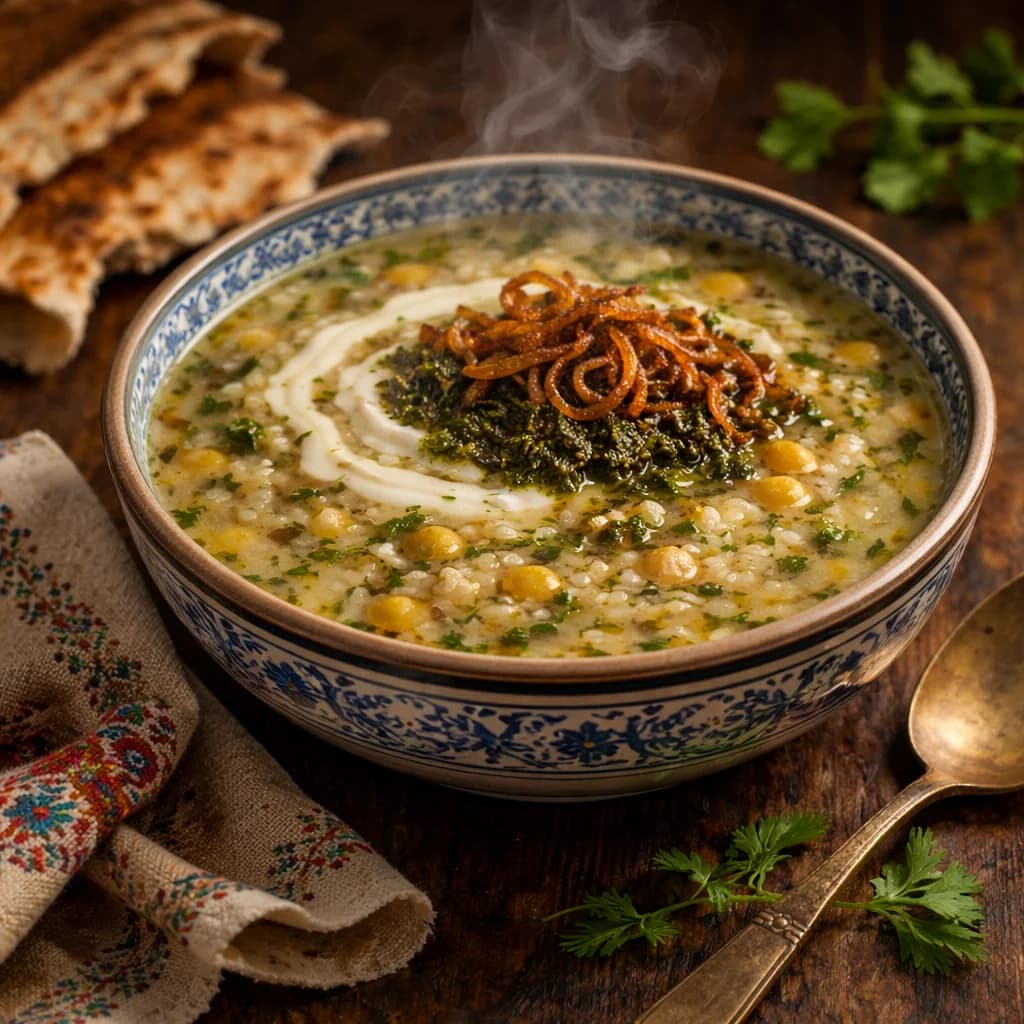
Stunning presentation: dark green soup with white kashk swirls, golden-brown crispy onions piled in center, green-flecked mint butter glistening
SmellMint butter hitting warm soup—the signature aroma
SoundGentle sizzle as mint butter meets soup
TouchCreamy soup, crunchy onions, silky kashk
The toppings are not optional—they are integral to the dish. Each bite should include soup, kashk, onion, and mint butter. Offer extra kashk at the table.

Extras

Equipment

large stockpotlarge skilletsmall skilletstandard

Make Ahead

  • The soup base (without noodles) can be made 2-3 days ahead and refrigerated.
  • Add noodles when reheating.
  • The complete soup (with noodles) keeps 3-4 days and actually improves in flavor.
  • Toppings must be made fresh.
  • Soup freezes well for 3 months without noodles.

Reheat gently, adding water as needed—the soup thickens significantly when cold.

Add fresh noodles if frozen without, or just reheat if noodles are already in.

Always add fresh toppings.

Serve With

🍚Not typically served with rice—it's a complete meal

Sides

  • Fresh bread (lavash, sangak)
  • Sabzi khordan
  • Torshi (pickles)
  • Additional kashk on the side

Drinks

  • Doogh (essential pairing)
  • Black tea after the meal

Substitutions

reshteh noodlesLinguine or fettuccine broken into pieces works. Lo mein noodles are similar. The authentic flat Persian noodles are available at Middle Eastern groceries and worth seeking out.
kashkNo perfect substitute. Greek yogurt mixed with sour cream approximates tanginess. Tahini thinned with lemon juice provides tangy creaminess for vegan version.
fresh herbsFrozen Persian herb mix (sabzi ash) is available at Persian groceries and works well. Dried herbs don't work for this dish—freshness is essential.
dried beansCanned beans work for convenience. Add them later in cooking since they're already cooked.

Scaling

Traditionally made in large batches—this is a communal dish. Scales up easily; scales down less gracefully due to the variety of ingredients. Leftovers keep well and improve overnight as flavors meld. Freezes excellently without the toppings.

Source

Traditional · Traditional Persian cuisine

One of the oldest and most beloved dishes in Persian cuisine, with roots going back centuries. Essential for Nowruz celebrations and religious occasions. Often prepared in large quantities for sharing with neighbors and those in need.

Related Recipes