
Dolmeh Bademjan (Persian Stuffed Eggplant)

Dolmeh Bademjan (Persian Stuffed Eggplant)

دلمه بادمجان

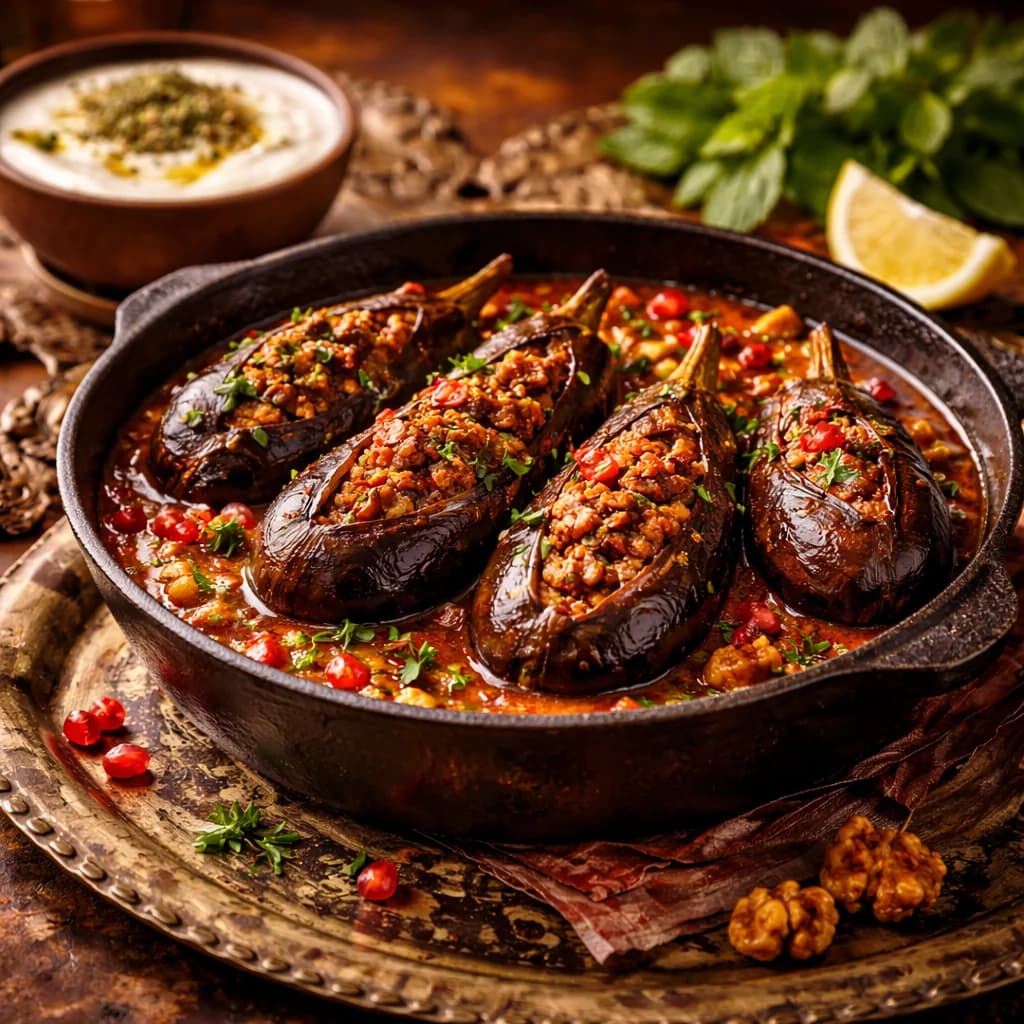
Small, tender eggplants hollowed and filled with an aromatic mixture of rice, herbs, split peas, and meat, then braised until the eggplant becomes silky and yielding. These elegant parcels showcase the Persian mastery of eggplant—the vegetable absorbs the sweet-sour braising liquid while the filling cooks to aromatic perfection inside. More refined than cabbage dolmeh and more substantial than grape leaves, stuffed eggplants are a centerpiece dish worthy of special occasions.

dolmehPrep: 50 minCook: 75 minintermediateServes 6

Cultural Note

Dolmeh bademjan showcases the Persian mastery of eggplant, which holds a special place in Iranian cuisine. The dish requires more technique than stuffed cabbage—hollowing eggplants without breaking them, briefly frying to soften, and careful braising—but the result is extraordinarily elegant. These stuffed eggplants are often served at special occasions and celebrations. The small, slender eggplants (similar to Italian or Japanese varieties) are preferred because they're easier to hollow, cook more evenly, and have fewer seeds than large globe eggplants. Like all Persian dolmeh, the sweet-sour braising sauce is essential.

Critical Moments

  • Hollowing eggplants without piercing
  • Salting and draining to remove bitterness
  • Light frying only (not fully cooking)
  • Leaving room for rice expansion when stuffing
  • Low, slow braising until rice is fully cooked
1
PREP20 min

Prepare the eggplants

Wash the eggplants and cut off the stems, leaving the cap intact. Using an apple corer or a small sharp knife, hollow out the center of each eggplant, leaving about 1cm walls and keeping the bottom intact. Work carefully to avoid piercing the skin. Reserve the scooped-out flesh for another use.

Hollow eggplant shells with intact walls and closed bottom
SmellFresh eggplant
SoundScooping sounds
TouchFirm eggplant walls

Critical Step

The eggplants must be hollowed without piercing—holes allow filling to escape and sauce to flood in. Leave adequate wall thickness (1cm) so they don't collapse during cooking.

An apple corer works well for small eggplants. For globe eggplants, cut a lid from the top and scoop with a spoon. Work slowly and carefully.

Common Mistakes

  • Piercing through the skin (filling escapes)
  • Walls too thin (collapse during cooking)
  • Walls too thick (won't cook through evenly)
2
PREP25 min

Salt and drain the eggplants

Sprinkle salt generously inside each hollowed eggplant and on the exterior. Place upside down in a colander and let drain for 20-30 minutes. This draws out bitter juices and helps the eggplant absorb less oil when frying. Rinse briefly and pat dry.

Beads of moisture on eggplant surface; slightly softened texture
SmellSlightly less raw eggplant smell
TouchEggplants feel slightly softer
Salting removes bitterness and reduces oil absorption. Don't skip this step, especially with larger eggplants which can be more bitter.
3
PREP15 min

Lightly fry the eggplants

Heat 60ml oil in a large skillet over medium-high heat. Fry the eggplants in batches, turning to brown lightly on all sides, about 2-3 minutes per batch. They should be lightly golden and slightly softened but not fully cooked. Transfer to a plate lined with paper towels.

Lightly golden exterior; eggplants slightly softened
Medium-High175°C / 350°F
SmellFrying eggplant—earthy, slightly smoky
SoundSizzling
TouchSlightly softened but still holding shape

Critical Step

A brief fry softens the eggplants for easier stuffing and develops flavor, but don't fully cook them—they'll finish braising. Overbrowning makes them too soft and prone to falling apart.

Work in batches to avoid crowding, which causes steaming instead of browning. The eggplants should be golden, not dark brown.

Common Mistakes

  • Crowding the pan (steams instead of fries)
  • Cooking too long (eggplants fall apart)
  • Not enough oil (uneven browning)
4
PREP18 min

Prepare the split peas

Rinse the split peas and simmer in water for 15-18 minutes until partially cooked. Drain and set aside.

Split peas are slightly tender but hold their shape
MediumSimmer
SmellCooking legumes
SoundSimmering
TouchPartially cooked
5
PREP15 min

Make the filling

Heat 30ml oil in a skillet over medium heat. Add the diced onions and cook for 8-10 minutes until softened and lightly golden. Add turmeric and cook 1 minute. Transfer to a large mixing bowl. Add the rinsed rice (raw), partially cooked split peas, ground meat (if using), all the chopped herbs, cinnamon, advieh (if using), 1 tsp salt, and pepper. Mix thoroughly.

Uniform, fragrant, colorful filling
SmellHerbaceous, warmly spiced
TouchWell-combined

Critical Step

Thorough mixing ensures consistent flavor. The rice is raw—it cooks during braising.

6
PREP12 min

Stuff the eggplants

Carefully fill each hollowed eggplant with the filling mixture using a small spoon. Fill to about 1cm below the top—the rice will expand. Don't pack too tightly. If you cut lids, replace them; otherwise the filling will be exposed (this is fine).

Eggplants filled to near the top, not overflowing
SmellHerby filling
TouchFirmly but not tightly packed

Critical Step

Leave room for rice expansion—overfilled eggplants will split. Fill firmly but don't force more filling than fits comfortably.

A small spoon or your finger helps push filling into the narrow cavity. Tap the bottom of each eggplant gently to settle the filling.
7
COOK5 min

Prepare the sauce

In a bowl, whisk together the tomato paste, crushed tomatoes, pomegranate molasses, lemon juice, sugar, bloomed saffron (if using), and 400ml water. Taste and adjust the sweet-sour balance.

Reddish-brown sauce with golden saffron threads
SmellTangy, sweet, tomatoey, aromatic saffron
TouchPourable consistency

Critical Step

The sweet-sour sauce is essential to Persian dolmeh. It should be assertively flavored—tastes will mellow during cooking. The saffron adds elegance.

8
COOK5 min

Arrange eggplants in pot

Drizzle a little oil in the bottom of a large heavy pot or Dutch oven. Arrange the stuffed eggplants in a single layer, packing them snugly so they support each other. They can be placed on their sides or standing up, depending on the shape of your pot and eggplants.

Eggplants arranged snugly in pot
A wide, shallow pot works best for a single layer. If needed, add a second layer. Snug arrangement prevents eggplants from moving and splitting during cooking.
9
COOK70 min

Braise the stuffed eggplants

Pour the sauce over and around the eggplants—it should come about halfway up. Add more water if needed. Cover tightly. Bring to a gentle boil, then reduce to a low simmer. Cook for 60-75 minutes until the eggplants are very tender when pierced and the rice inside is fully cooked.

Eggplants are very tender, slightly collapsed; sauce has thickened
LowGentle simmer
SmellSweet-sour, deeply aromatic, eggplant cooking
SoundGentle simmering
TouchEggplant pierces easily with fork

Critical Step

Low, slow cooking allows the rice inside to cook through while the eggplant becomes silky. The sauce should reduce to a glossy glaze.

Check occasionally and add a little water if sauce reduces too much. Baste the exposed tops once or twice.
Checkpoint: After 55 minutes, carefully pierce one eggplant to check rice is cooked—no hard center. The eggplant flesh should be completely tender.
10
FINISH15 min

Rest and serve

Remove from heat and let rest for 10-15 minutes with the lid on. Carefully transfer the stuffed eggplants to a serving platter—they're very soft and delicate. Spoon the reduced sauce over and around them. Serve warm with rice.

Glossy, tender stuffed eggplants on platter, glazed with sauce
SmellRich, sweet-sour, complex
TouchSilky eggplant, flavorful filling
Use two spoons or a large spatula to transfer—the eggplants are very soft. The sauce should be thick and glossy—reduce further if needed.

Resting Required

10 min - Allows eggplants to firm up slightly; easier to handle
Extras

Equipment

apple corer or small knifelarge pot with lidlarge mixing bowlstandard

Make Ahead

  • Excellent make-ahead—flavor improves overnight.
  • Refrigerate in cooking liquid for up to 4 days.
  • Can be frozen for up to 2 months.

Reheat gently in sauce on stovetop or in microwave.

Handle carefully—eggplants are delicate when warm.

Serve With

🍚Chelow with saffron, Zereshk polo (festive)

Sides

  • Plain yogurt or mast-o-khiar
  • Torshi (pickled vegetables)
  • Salad Shirazi
  • Sabzi khordan

Drinks

  • Doogh
  • Black tea

Substitutions

small eggplantsItalian eggplants or Japanese eggplants are ideal. Globe eggplants work but require different technique (see variation). Chinese eggplants are also excellent.
pomegranate molassesGrape molasses or substitute 2 tbsp brown sugar + 2 tbsp balsamic vinegar + 1 tbsp lemon juice.
split peasYellow lentils work but cook faster—add uncooked to filling. Some families omit legumes entirely.
saffronOptional but adds elegance. Can omit or substitute a pinch of turmeric in the sauce.

Scaling

Allow 2 small eggplants per person. Scale the filling proportionally. Choose similar-sized eggplants for even cooking. Leftovers reheat well and flavor improves overnight.

Source

Traditional · Traditional Persian cuisine

A refined dish that showcases the Persian love of eggplant. Typically made with small, slender Italian or Japanese eggplants that are easier to hollow and cook more evenly. A celebration of summer when small eggplants are abundant.

Related Recipes

Dolmeh Barg Mo (Persian Stuffed Grape Leaves)

Dolmeh Barg Mo (Persian Stuffed Grape Leaves)

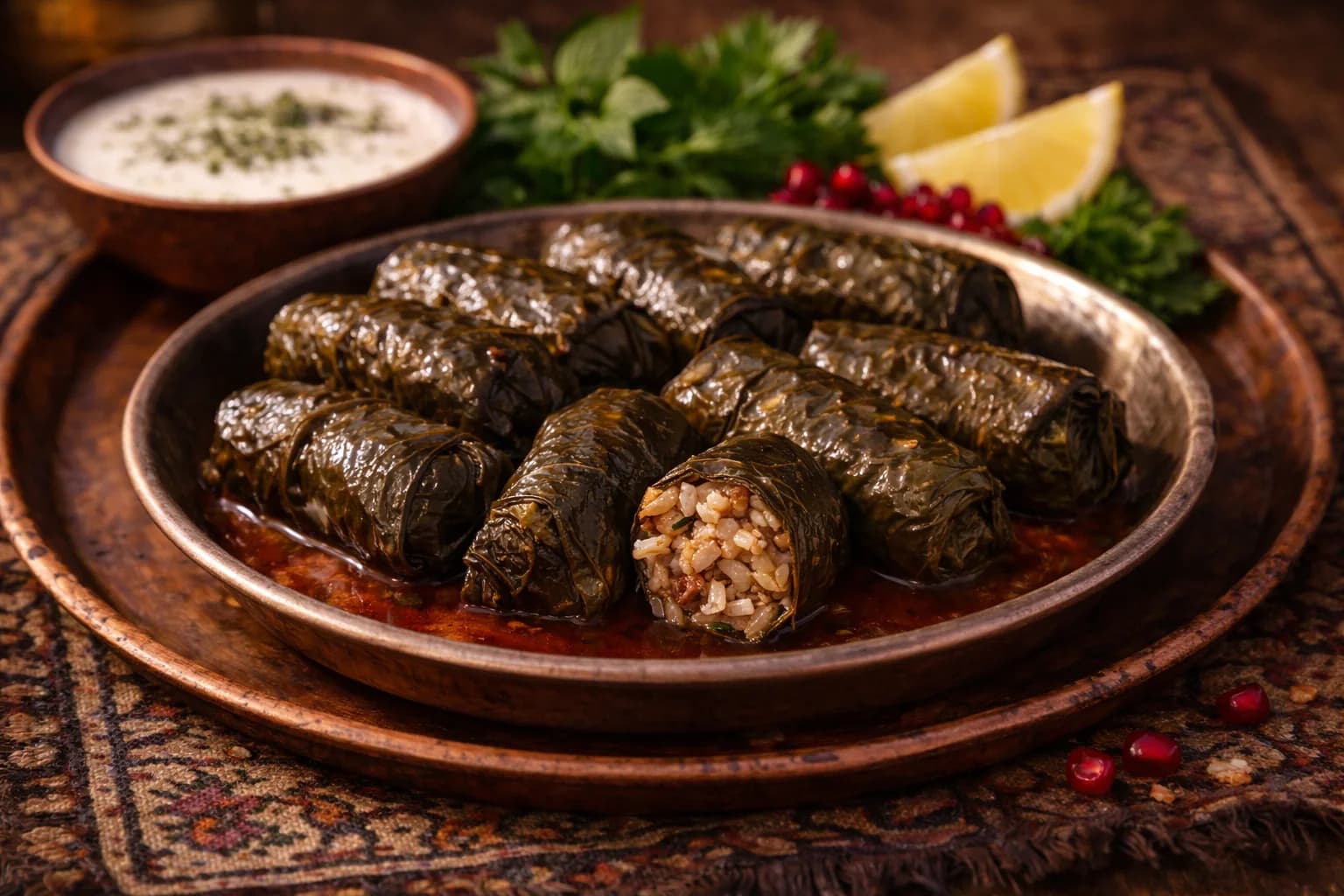
Tender grape leaves wrapped around a fragrant filling of rice, split peas, herbs, and often ground meat—tiny parcels of Persian flavor that burst with sweet-sour complexity. Unlike their Greek or Turkish cousins, Persian dolmeh are distinctively flavored with an abundance of fresh herbs, warm spices, and a sweet-sour braising liquid that penetrates each roll. Traditionally made in large batches for special occasions, each painstakingly rolled leaf represents love and patience. The result is utterly addictive—tender, tangy, aromatic, and impossible to eat just one.

Dolmeh Barg Kalam (Persian Stuffed Cabbage Leaves)

Dolmeh Barg Kalam (Persian Stuffed Cabbage Leaves)

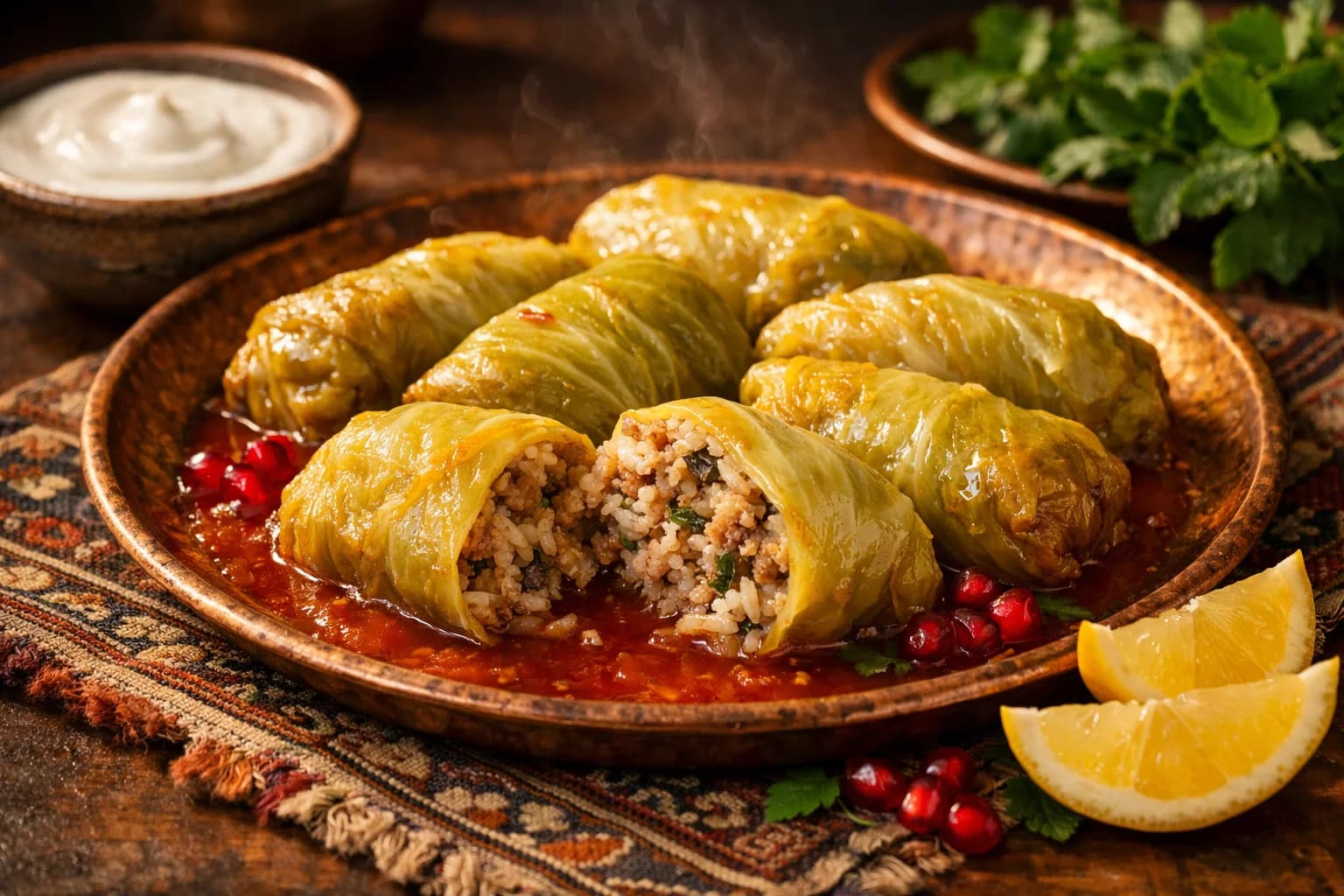
Large, tender cabbage leaves wrapped around an aromatic filling of rice, herbs, split peas, and meat, then braised in a sweet-sour tomato sauce until meltingly soft. These generous parcels are easier to roll than grape leaves and yield larger, more substantial portions—perfect for a hearty main course. The cabbage becomes silky and sweet during cooking, its mild flavor absorbing the tangy braising liquid beautifully. A beloved winter comfort food when cabbages are at their peak.

Dolmeh Felfel (Persian Stuffed Bell Peppers)

Dolmeh Felfel (Persian Stuffed Bell Peppers)

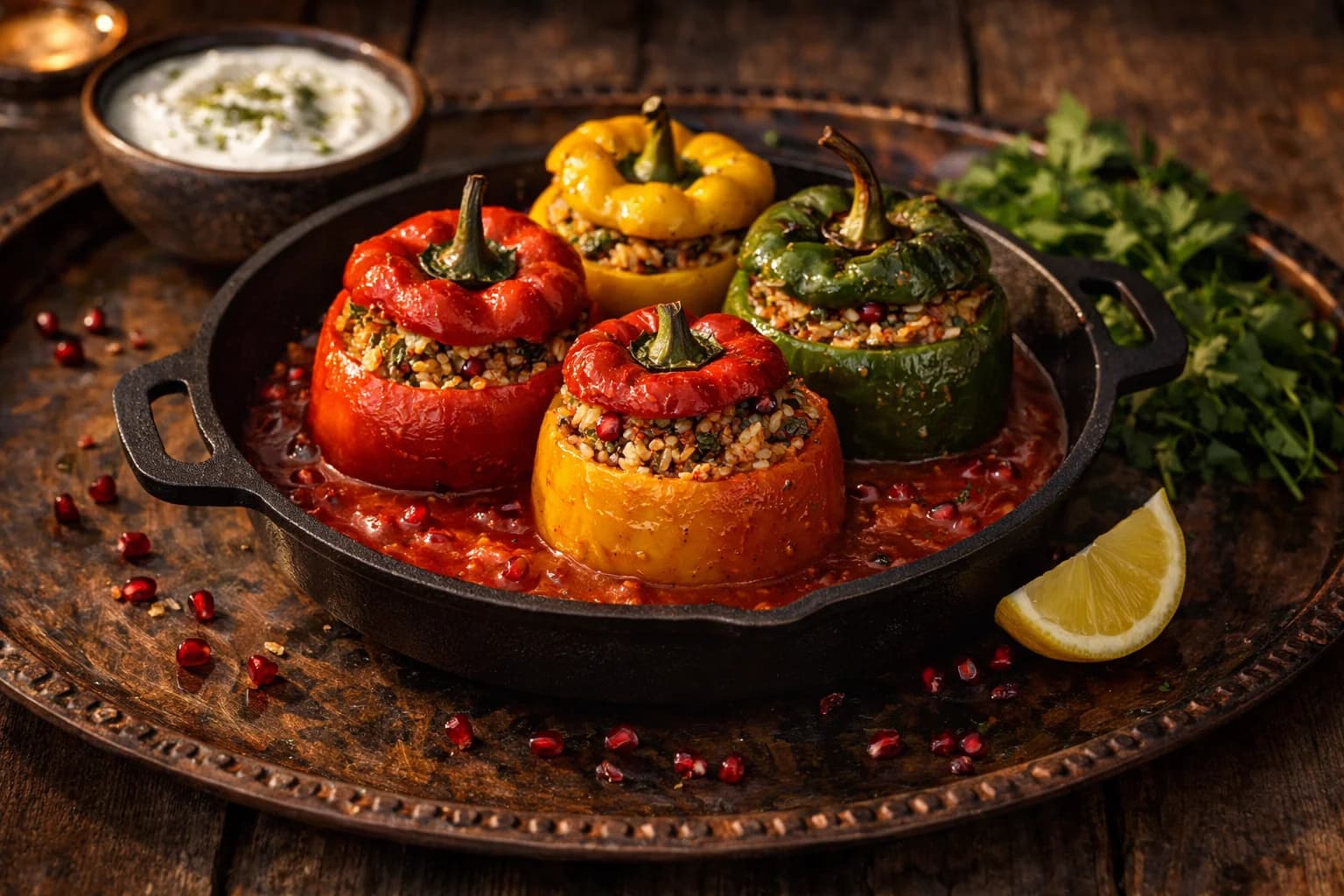
Sweet bell peppers hollowed and filled with an aromatic mixture of rice, herbs, split peas, and meat, then braised in a tangy tomato sauce until tender and deeply flavored. These colorful stuffed peppers are larger and more substantial than grape leaf dolmeh, making them perfect as a main course. The peppers become silky-soft during cooking, their natural sweetness playing against the tangy sauce and savory filling. A beautiful centerpiece dish that's impressive yet comforting.