
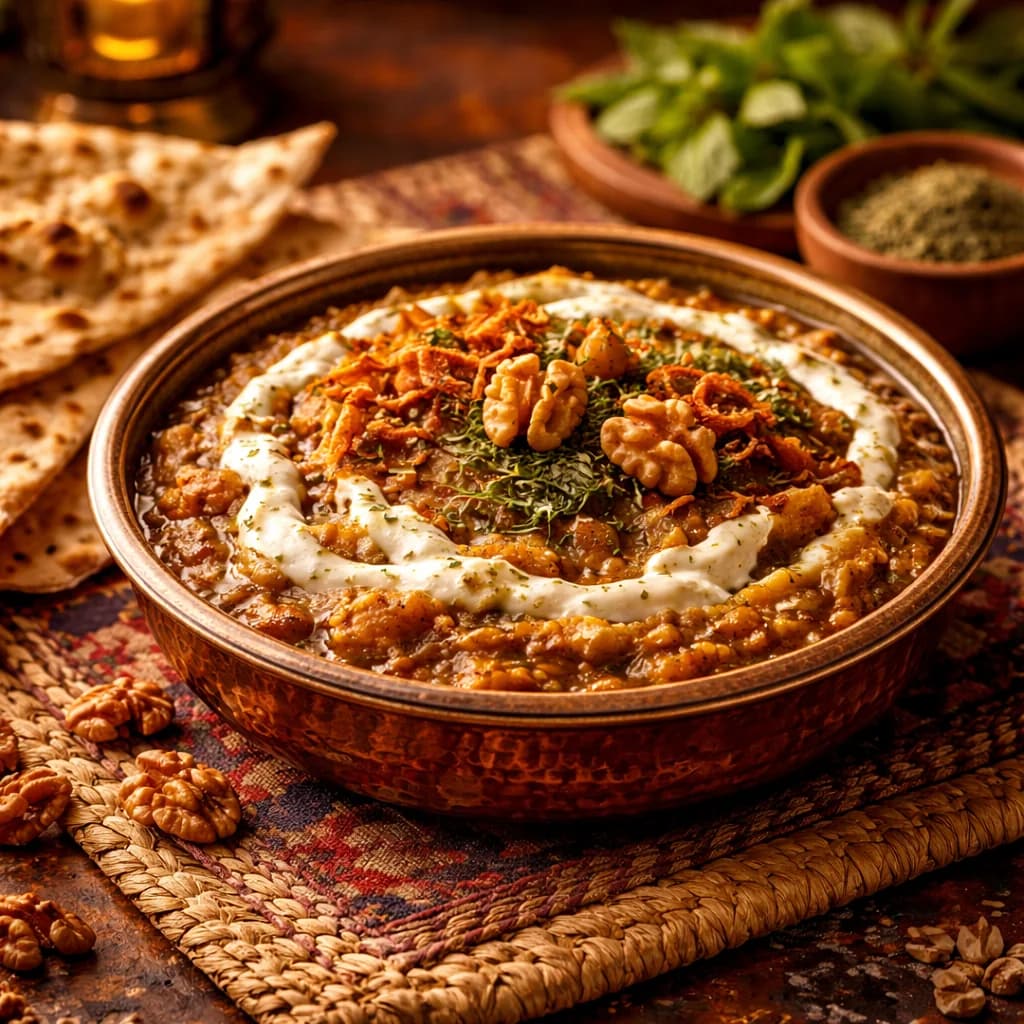
Kashk-e Bademjan (Eggplant with Kashk)

Kashk-e Bademjan (Eggplant with Kashk)

کشک بادمجان

A velvety, tangy eggplant dip crowned with crispy fried onions, toasted walnuts, and fragrant dried mint—Persian mezze at its most elegant. The star ingredient is kashk, a fermented whey product that adds a distinctive tangy, slightly funky depth unlike anything else. Silky roasted eggplant is combined with sautéed onions, garlic, and generous swirls of kashk, then topped with a dramatic garnish of deeply caramelized onions. Complex, addictive, and uniquely Persian.

appetizerPrep: 20 minCook: 65 mineasyServes 8

Cultural Note

Kashk-e bademjan is one of the most beloved appetizers in Persian cuisine, appearing at virtually every party, gathering, and holiday table. Kashk—fermented whey—is an ancient dairy product with roots in nomadic Persian culture, where it was a way to preserve milk. Its tangy, slightly funky flavor is unique and irreplaceable. The dish exemplifies Persian layering of flavors and textures: silky eggplant, tangy kashk, sweet caramelized onions, crunchy walnuts, and aromatic fried mint. The dramatic garnish of crispy onions and mint-infused butter drizzled over the top is essential—it's not just decoration but integral to the flavor.

Critical Moments

  • Roasting eggplant until completely soft
  • Deeply caramelizing the base onions
  • Not overheating the kashk
  • Frying topping onions until deeply crispy (not burnt)
  • Frying mint in butter briefly (doesn't burn)
1
PREP50 min

Roast the eggplants

Preheat oven to 220°C/425°F. Prick eggplants several times with a fork. Place on a foil-lined sheet pan. Roast for 45-55 minutes, turning halfway, until completely collapsed, very soft, and the skin is charred and wrinkled. For extra smokiness, char directly over a gas flame for a few minutes before or after oven roasting.

Eggplants completely collapsed; skin charred and wrinkled; very soft when pressed
High220°C / 425°F
SmellRoasted eggplant—sweet and slightly smoky
TouchUtterly soft throughout

Critical Step

Properly roasted eggplant is sweet, silky, and easily mashed. Undercooked eggplant is bitter and fibrous. The eggplant must be completely soft—no firm areas.

For maximum smokiness (traditional), char over direct flame. Otherwise, roast at high heat until completely collapsed.
While waiting: Prepare onions and toppings while eggplant roasts
2
PREP20 min

Cool, peel, and mash the eggplant

Transfer roasted eggplants to a colander. Let cool 10 minutes. Peel off and discard the charred skin. Let flesh drain for 10 minutes, pressing gently. Transfer to a bowl and mash with a fork until mostly smooth but with some texture remaining.

Pale, soft eggplant flesh; some texture visible
SmellConcentrated roasted eggplant
TouchSoft, easily mashed
Draining removes bitter liquid and prevents a watery final dish. Some charred bits mixed in add flavor.
3
COOK18 min

Caramelize the base onions

Heat 50ml oil in a large skillet over medium heat. Add the 2 finely diced onions. Cook, stirring occasionally, for 15-18 minutes until deeply golden and caramelized. They should be much darker than just softened—aim for deep golden-brown.

Onions are deep golden-brown, reduced in volume, sweet-smelling
Medium165°C / 325°F
SmellSweet caramelized onions
SoundGentle sizzling
TouchSoft and jammy

Critical Step

Deeply caramelized onions add essential sweetness that balances the tangy kashk. Under-caramelized onions won't provide the same depth of flavor.

Patience is key. True caramelization takes 15-20 minutes. Stir occasionally but let the onions sit long enough to develop color.
4
COOK2 min

Add garlic and turmeric

Add minced garlic and turmeric to the caramelized onions. Cook for 1-2 minutes until fragrant. Don't let the garlic brown.

Garlic fragrant; mixture is golden from turmeric
Medium165°C / 325°F
SmellFragrant garlic with turmeric
SoundSizzling
TouchGarlic softened
Turmeric should bloom in the oil briefly, becoming fragrant
5
COOK7 min

Add eggplant and combine

Add the mashed eggplant to the onion mixture. Stir well to combine. Cook for 5-7 minutes, stirring frequently, to allow flavors to meld and any excess moisture to evaporate. Season with salt and pepper.

Uniform mixture of eggplant and caramelized onions; slightly thickened
Medium165°C / 325°F
SmellEggplant with sweet onions and garlic
SoundGentle bubbling
TouchCohesive, thick enough to mound
The mixture should be thick and cohesive, not watery. If too wet, cook a few more minutes to evaporate liquid.
6
COOK5 min

Add the kashk

Reduce heat to medium-low. Add about 120ml of the kashk to the eggplant mixture (reserve 60ml for drizzling). Stir gently to incorporate. Cook for 3-4 minutes, stirring, until the kashk is warmed through and the mixture is creamy and well combined. Taste and adjust seasoning—kashk is salty, so you may need less salt than expected.

Creamy, pale mixture with visible swirls of kashk; rich and glossy
Medium-Low150°C / 300°F
SmellTangy kashk with roasted eggplant—distinctive and appetizing
SoundGentle bubbling
TouchCreamy, thick, spoonable

Critical Step

Kashk should be warmed but not boiled vigorously—excessive heat can cause it to separate. The kashk adds the signature tangy, creamy character to the dish.

Taste before adding more salt—kashk is quite salty. You can always add more kashk to taste.
7
GARNISH15 min

Fry the crispy onion topping

While the base cooks, heat 50ml oil in a small skillet over medium-high heat. Add the thinly sliced onion. Fry, stirring frequently, for 12-15 minutes until deeply golden and crispy. Watch carefully near the end—they go from golden to burnt quickly. Remove with a slotted spoon to a paper towel-lined plate. Season lightly with salt.

Deep golden-brown, crispy onion strands; significantly reduced in volume
Medium-High180°C / 350°F
SmellDeeply caramelized, almost nutty fried onions
SoundActive sizzling that reduces as moisture evaporates
TouchCrispy when cooled—they crisp further as they cool

Critical Step

The crispy fried onions are an essential garnish, providing textural contrast and sweet depth. They should be deeply golden and crispy, not pale and soft.

The onions continue to darken after removal from oil. Take them out when deep golden, not dark brown. Spread on paper towels to stay crispy.

Common Mistakes

  • Not cooking long enough (soft, not crispy)
  • Cooking too long (burnt, bitter)
  • Crowding the pan (steaming instead of frying)
8
GARNISH4 min

Toast the walnuts

In a dry small pan over medium heat, toast the chopped walnuts for 3-4 minutes, stirring frequently, until fragrant and lightly golden. Remove immediately to prevent burning.

Walnuts are lightly golden and fragrant
Medium165°C / 325°F
SmellToasted walnut aroma
TouchCrisp
Toast nuts right before serving—they lose their crunch if they sit too long
9
GARNISH2 min

Fry the mint in butter

In a small pan, melt the butter over medium heat. When foaming subsides, add the dried mint. Swirl for 30 seconds until the mint is fragrant and the butter is infused. Remove from heat immediately—mint burns quickly.

Butter is golden with green mint flecks; bubbling has subsided
Medium150°C / 300°F
SmellIncredible aroma of mint-infused butter
SoundInitial bubbling, then quiet
TouchLiquid butter with mint pieces

Critical Step

The mint butter is the finishing drizzle that brings everything together—the aroma when it hits the dish is intoxicating. Don't skip this step.

Work quickly—mint burns in seconds. Swirl and remove from heat as soon as it's fragrant.

Common Mistakes

  • Burning the mint (bitter, acrid)
  • Skipping this step (missing essential flavor)
10
FINISH3 min

Assemble and garnish

Transfer the kashk-eggplant mixture to a shallow serving bowl or plate, spreading it evenly. Drizzle the reserved kashk in a decorative pattern over the top. Scatter the crispy fried onions generously over the surface. Sprinkle the toasted walnuts. Finally, drizzle the mint butter over everything.

Beautiful contrast of colors and textures: pale creamy base, white kashk swirls, dark crispy onions, golden walnuts, green-flecked mint butter
SmellMint butter hitting warm eggplant—the signature aroma
TouchMultiple textures visible—creamy, crispy, crunchy
The garnish is not optional—it's integral to the dish. Each element adds essential flavor and texture.
11
FINISH

Serve

Serve immediately or at room temperature with plenty of fresh bread for scooping. Kashk-e bademjan is traditionally part of a mezze spread but can also be served as a standalone appetizer.
Stunning presentation with dramatic toppings; bread arranged alongside
Each scoop should include some creamy base, kashk, crispy onions, and walnuts. The mint butter ties it all together.

Extras

Equipment

sheet panlarge skilletsmall skilletmixing bowlstandard

Make Ahead

  • The eggplant-kashk base can be made 2-3 days ahead and refrigerated.
  • Reheat gently or bring to room temperature.
  • The crispy onion topping and mint butter should be made fresh just before serving for best texture.

Reheat base gently in a pan or microwave.

Add fresh toppings.

Can also be served at room temperature.

Serve With

🍚Chelow (served alongside for a larger meal)

Sides

  • Fresh bread—lavash, sangak, barbari (essential)
  • Sabzi khordan
  • Torshi
  • Mirza ghasemi
  • Borani esfenaj
  • Other appetizers for a mezze spread

Drinks

  • Doogh
  • Black tea
  • Wine (non-traditional but excellent)

Substitutions

kashkKashk is unique and has no perfect substitute. In a pinch, thick Greek yogurt mixed with a little sour cream and lemon juice approximates the tanginess. Some use labne. The flavor will be different but the dish is still delicious.
eggplantItalian or globe eggplant preferred. Japanese eggplant works but has less flesh. No substitute for eggplant—it's the star.
dried mintFresh mint doesn't work the same way when fried. Dried mint is essential for the garnish. Available at any Middle Eastern grocery.
walnutsCan substitute toasted pine nuts or omit. Walnuts are traditional.

Scaling

Scales easily for larger gatherings. The dish is typically served in a shallow bowl as part of an appetizer spread. For a crowd, make a double batch—it disappears quickly. Leftovers keep well.

Source

Traditional · Traditional Persian cuisine

A beloved appetizer found throughout Iran, showcasing the unique flavor of kashk—a traditional fermented dairy product. Often served at parties and gatherings as part of a mezze spread.

Related Recipes

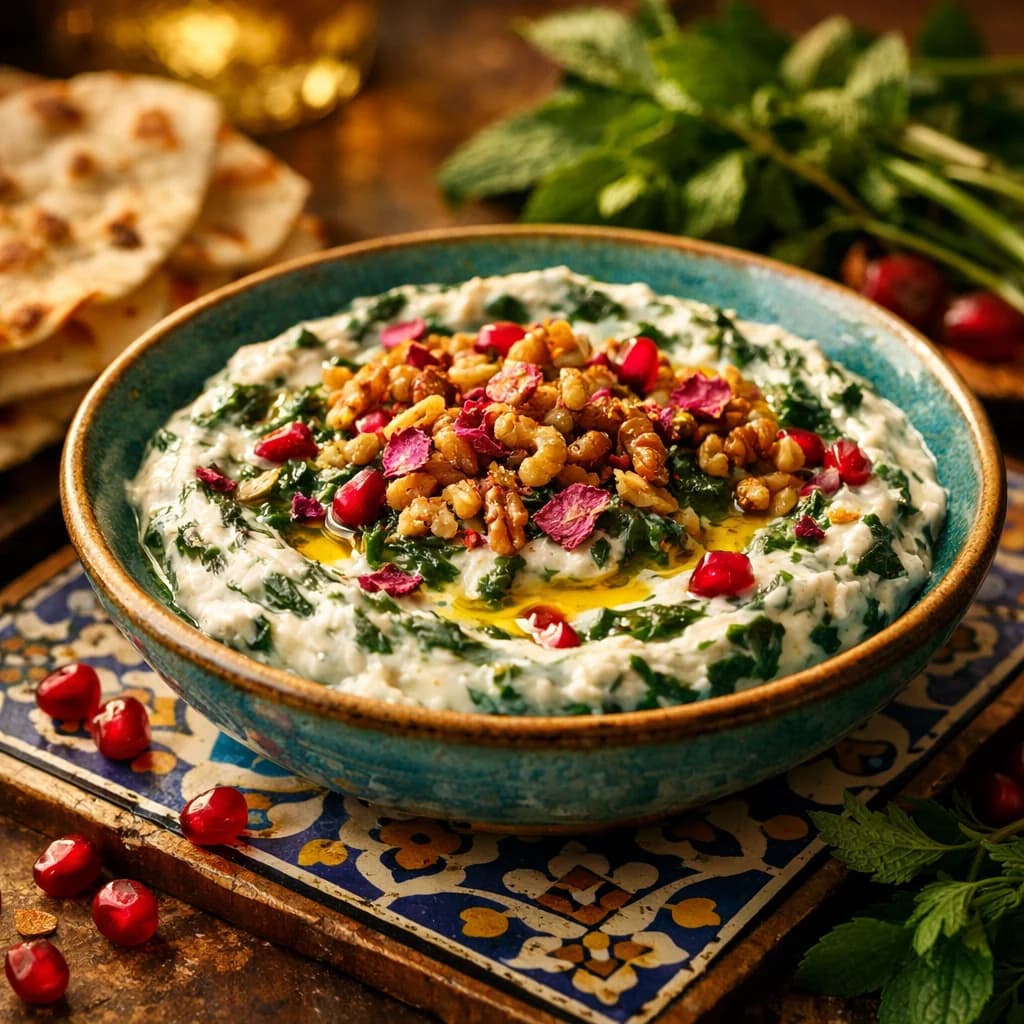
Borani Esfenaj (Persian Spinach Yogurt Dip)

Borani Esfenaj (Persian Spinach Yogurt Dip)

A vibrant, verdant dip of garlicky sautéed spinach folded into thick, tangy yogurt—cool, creamy, and deeply satisfying. The spinach is cooked with generous garlic until silky, then combined with yogurt and crowned with toasted walnuts, sometimes dried rose petals, and a drizzle of olive oil. Named after the legendary Persian queen Pourandokht (Buran), borani represents the elegant simplicity of Persian mezze—humble ingredients elevated through technique and balance.

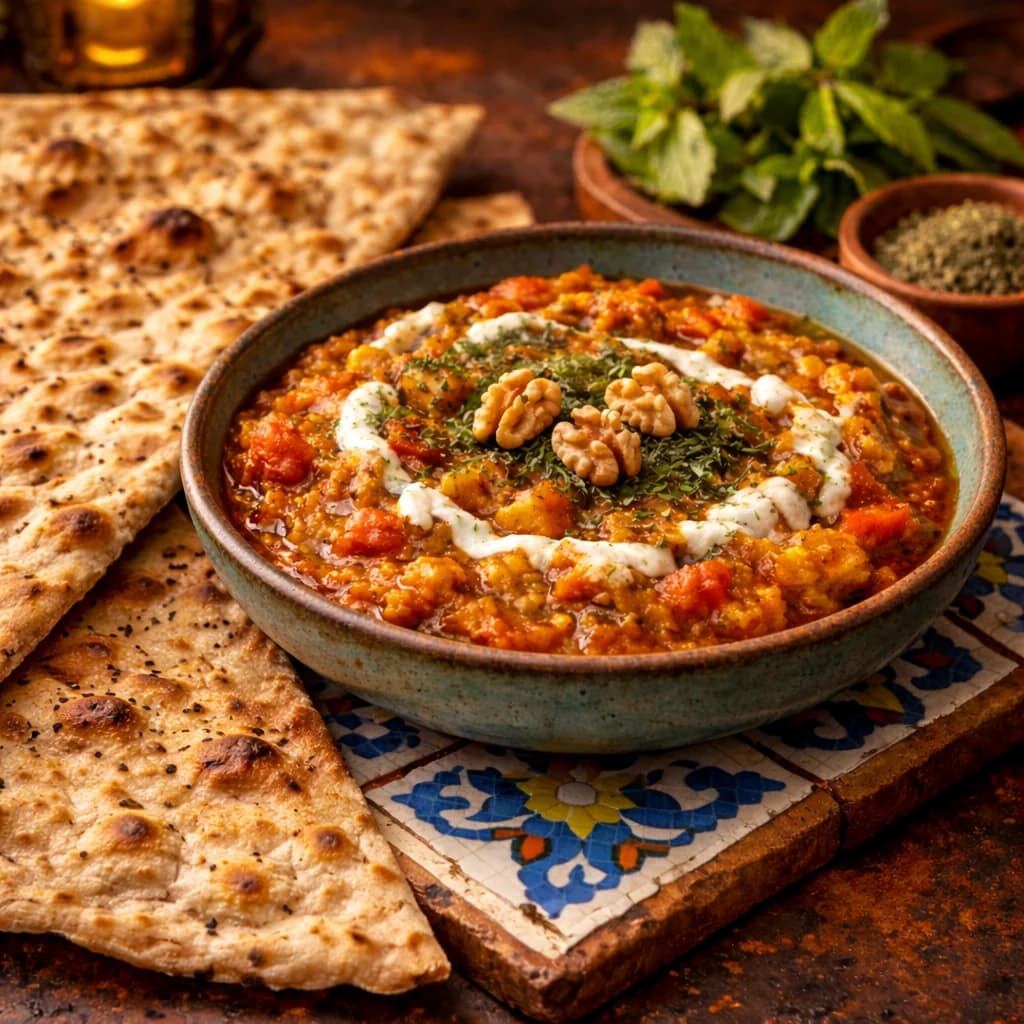
Mirza Ghasemi (Smoky Eggplant with Tomato and Garlic)

Mirza Ghasemi (Smoky Eggplant with Tomato and Garlic)

A magnificent smoky eggplant dish from the lush Caspian region—fire-charred eggplant mashed with tomatoes, an audacious amount of garlic, and eggs that are gently stirred in to create a rich, creamy texture. The name honors Mirza Ghasemi, a 19th-century nobleman from Gilan, and the dish captures the bold, garlicky, smoky flavors beloved in northern Persian cuisine. Served with warm bread, it's utterly addictive.

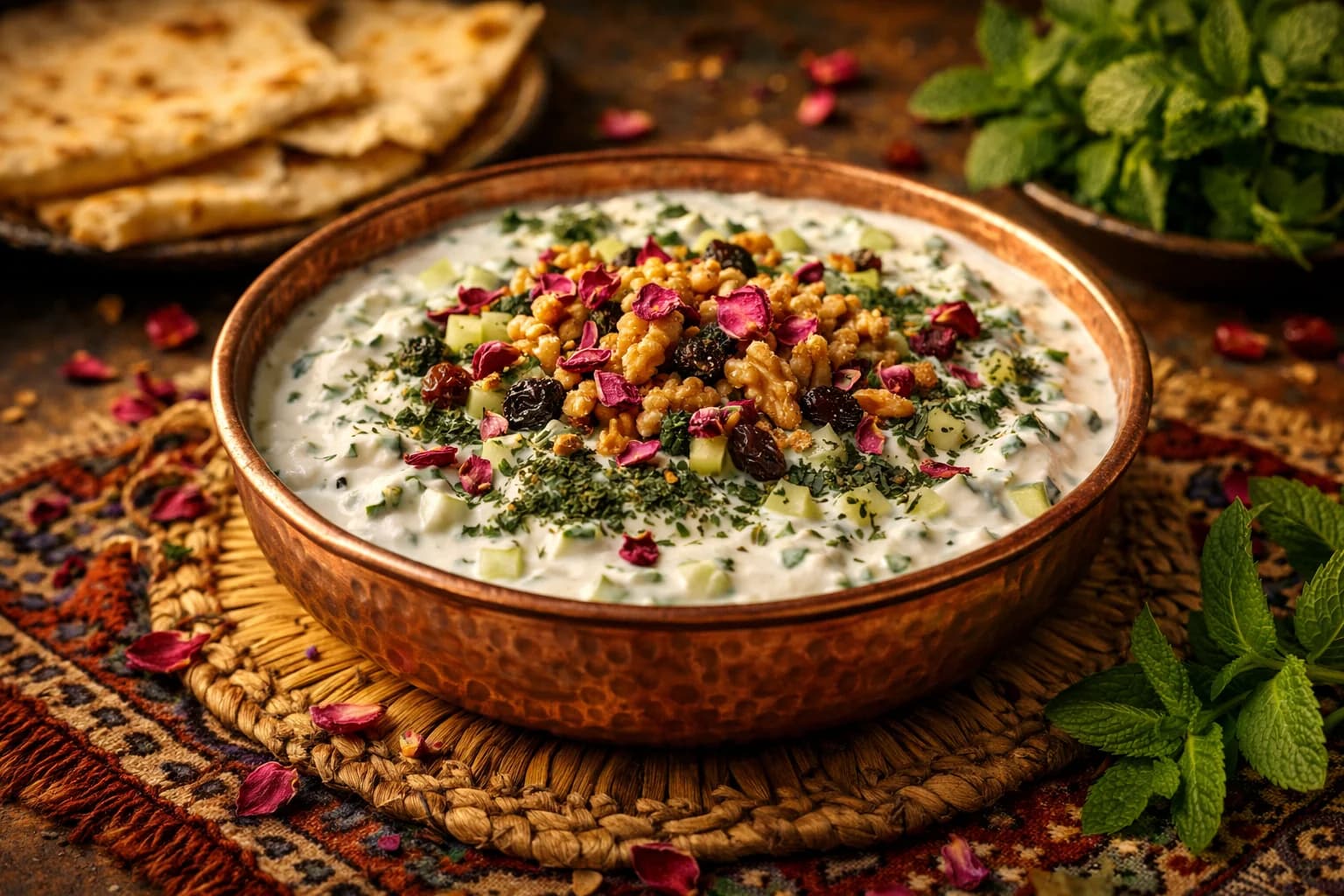
Mast-o-Khiar (Persian Cucumber Yogurt)

Mast-o-Khiar (Persian Cucumber Yogurt)

The essential Persian yogurt dip—cool, creamy yogurt studded with crisp cucumber, fragrant dried mint, and often enriched with walnuts, raisins, and rose petals. Unlike Greek tzatziki, Persian mast-o-khiar is thicker, more aromatic, and often includes surprising sweet elements that create a uniquely Persian flavor profile. Found at every Persian table from simple family dinners to elaborate celebrations, this refreshing dip is the perfect cooling counterpoint to rich stews and smoky kebabs.