
Critical Moments
- •Rice parboiled slightly less than normal
- •Rice cooled before mixing with yogurt
- •Firm pressing when layering
- •Resting before unmolding
Wash and soak the rice
Place rice in a large bowl. Fill with cold water, swirl vigorously, and drain. Repeat 5-6 times until water runs mostly clear. Dissolve 2 tbsp salt in 2L lukewarm water, add rice, and soak for at least 2 hours (up to 4 hours). Longer soaking helps tahchin hold together better.
Critical Step
Extended soaking is especially important for tahchin—it allows the rice to absorb the yogurt mixture evenly and helps the grains bind together in the final cake.
Bloom the saffron generously
Grind saffron threads with a pinch of sugar using mortar and pestle until fully powdered. Transfer to a small bowl, add 6 tbsp hot (not boiling) water. Cover and steep for at least 30 minutes, preferably 1 hour. Tahchin requires generous saffron for its signature golden color.
Critical Step
Tahchin's visual impact depends on deep golden color throughout. Skimping on saffron results in a pale, unimpressive dish. This is not the place to economize.
Prepare the chicken
Heat oil in a skillet over medium-high heat. Add sliced onion and cook until golden, about 8 minutes. Season chicken with turmeric, salt, and pepper. Add chicken to skillet, pour in 125ml water. Cover and cook for 20-25 minutes until chicken is cooked through and tender.
Shred the chicken
Remove chicken from skillet and let cool slightly. Shred into bite-sized pieces using two forks or your hands. Mix shredded chicken with the cooked onions and 2 tbsp of the bloomed saffron water. Set aside.
Parboil the rice
Bring 3L water with 2 tbsp salt to a rolling boil. Drain soaked rice and add to boiling water. Boil for 5-6 minutes only—slightly less than for regular polo. Rice should be al dente with a noticeable firm core. It will finish cooking in the oven.
Critical Step
Slightly undercooking the rice is crucial for tahchin. It will absorb the yogurt mixture and continue cooking in the oven. Overcooked parboiled rice results in mushy tahchin.
Drain and cool the rice
Immediately drain rice into a fine-mesh strainer. Rinse briefly with cool (not cold) water to stop cooking. Spread rice on a sheet pan or large platter to cool for 10 minutes—it should be warm but not hot when mixed with the yogurt.
Critical Step
Hot rice will curdle the egg yolks in the yogurt mixture. Cooling is essential for a smooth, properly bound tahchin.
Prepare the yogurt-saffron mixture
In a large bowl, whisk together yogurt, egg yolks, remaining saffron water (reserve 2 tbsp for finishing), 60g melted butter, 1 tsp salt, and pepper until completely smooth and uniform in color.
Critical Step
This mixture binds the rice and creates tahchin's signature texture and flavor. It must be perfectly smooth—lumps of egg yolk will cook unevenly.
Common Mistakes
- •Mixture not smooth (uneven binding)
- •Not enough saffron (pale tahchin)
- •Forgetting salt (bland rice layer)
Combine rice with yogurt mixture
Add the cooled parboiled rice to the yogurt mixture. Fold gently but thoroughly until every grain is coated. The mixture should be uniformly golden. Avoid crushing the rice grains.
Critical Step
Even coating ensures the tahchin binds together properly and has uniform color. Uncoated patches will be dry and fall apart.
Common Mistakes
- •Mixing too roughly (broken rice)
- •Uneven coating (dry spots)
- •Rice too hot (curdled eggs)
Prepare the baking pan
Preheat oven to 180°C/350°F. Generously brush a 9-inch round baking pan (or 9x13 rectangular pan) with remaining melted butter, coating bottom and sides completely. The butter creates the crispy crust.
Critical Step
Generous butter coating is essential—it creates the crispy, golden crust and allows the tahchin to release cleanly. Too little butter means sticking and tearing.
Layer the tahchin
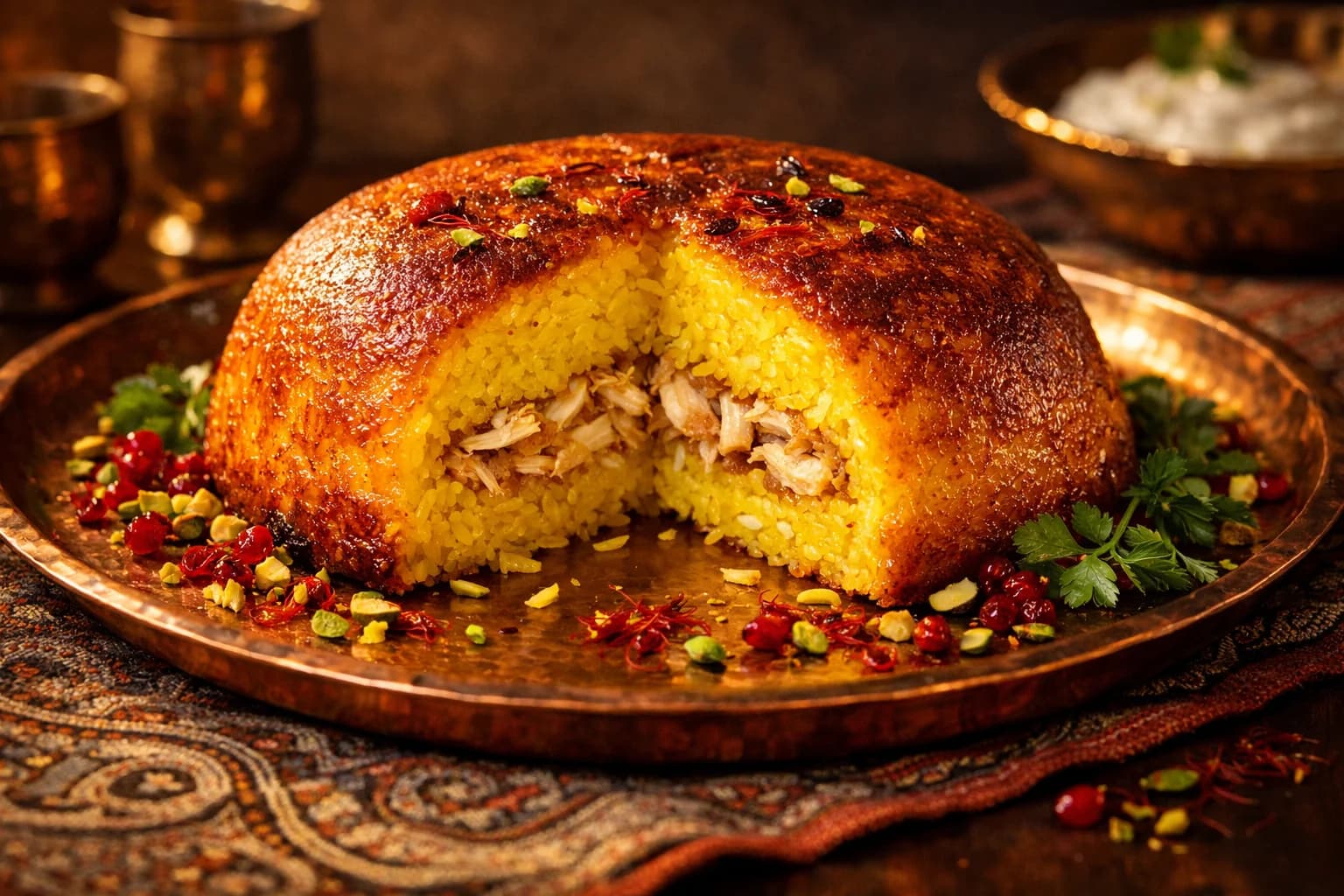
Spread half of the rice-yogurt mixture evenly in the prepared pan, pressing firmly to create a compact layer. Arrange the saffron chicken evenly over the rice, leaving a 1cm border around the edges. Top with remaining rice mixture, pressing firmly and smoothing the top. The edges should be sealed with rice—no chicken should be visible.
Critical Step
Firm pressing is essential—loose tahchin falls apart when unmolded. Sealing the edges traps the chicken inside and creates clean presentation. This is where 'arranged on the bottom' technique matters most.
Common Mistakes
- •Not pressing firmly enough (falls apart)
- •Chicken touching edges (exposed when unmolded)
- •Uneven layers (cooks unevenly)
Final butter drizzle and cover
Drizzle any remaining melted butter over the top of the tahchin. Cover pan tightly with aluminum foil, sealing the edges well.
Bake covered
Place tahchin in preheated oven. Bake covered for 1 hour. The rice will steam and cook through while the bottom begins to form a crust.
Bake uncovered for crust
Remove foil. Continue baking uncovered for 25-35 more minutes until the top is golden brown and the edges are visibly crispy and pulling away from the pan sides.
Critical Step
This uncovered phase develops the crispy crust all around. Underbaking means soggy tahchin; overbaking means dry, burnt crust. Watch carefully in the final 10 minutes.
Rest before unmolding
Remove tahchin from oven. Let rest for 10-15 minutes. This is essential—it allows the tahchin to contract and firm up for clean unmolding. Don't skip this step.
Critical Step
A hot tahchin is fragile and will crack or fall apart. The resting period lets it set and contract from the pan sides. This is the difference between a perfect unmold and a disaster.
Common Mistakes
- •Unmolding too soon (falls apart)
- •Waiting too long (sticks as it cools completely)
Unmold the tahchin
Run a thin knife or offset spatula around the edges to release any stuck spots. Place a large serving platter upside down over the pan. Holding both firmly, flip confidently in one smooth motion. Tap the bottom of the pan gently, then lift it straight up. The tahchin should release as a golden dome.
Critical Step
This is the moment of truth. Confidence matters—a hesitant flip can cause cracks. If it sticks, don't force it—place pan briefly on a wet towel to create steam that helps release.
Garnish and serve
Drizzle reserved saffron water over the top for extra color. If using barberry garnish: quickly sauté cleaned barberries in butter with sugar as for zereshk polo, and scatter decoratively over the tahchin. Add toasted almonds and pistachios. Serve immediately, cutting into wedges at the table.
Resting Required
15 min - Essential for tahchin to set and release cleanly from pan