
Critical Moments
- •Selecting small, firm eggplants
- •Thorough salting and drying
- •Blanching to right tenderness (not mushy)
- •Creating textured (not smooth) stuffing
- •Complete submersion in vinegar
- •Adequate aging time (minimum 3-4 weeks)
Select and prepare the eggplants
Choose small, firm eggplants with tight, glossy skin—no soft spots or blemishes. Remove the stems but leave the green cap attached. Wash and dry thoroughly. Make a lengthwise slit in each eggplant, cutting about three-quarters through but not all the way—you're creating a pocket for stuffing while keeping the eggplant intact.
Critical Step
The eggplants must be small enough to pickle through (large eggplants won't work) and firm enough to hold their shape. The pocket must be deep enough for stuffing but not cut all the way through.
Common Mistakes
- •Using eggplants that are too large (won't pickle through)
- •Cutting all the way through (eggplant falls apart)
Salt the eggplants
Generously salt the inside of each eggplant pocket with about half of the total salt. Place in a colander and let drain for 1-2 hours. This removes bitterness and excess moisture. Rinse briefly and squeeze gently to remove water. Pat dry thoroughly.
Critical Step
Salting removes bitterness and excess moisture—essential for good texture and flavor. Wet eggplants will make the pickle watery and can cause spoilage.
Blanch the eggplants
Bring a large pot of salted water to boil. Add the eggplants and blanch for 5-7 minutes until slightly softened but still holding their shape—they should bend but not be mushy. Drain immediately and spread on clean towels to cool and dry completely.
Critical Step
Blanching partially cooks the eggplant, making it tender enough to absorb the pickling liquid and flavors. Overblanching creates mushy torshi; underblanching leaves raw, tough eggplant.
Make the stuffing
While the eggplants cool, prepare the stuffing: pound the garlic cloves to a paste using a mortar and pestle (or mince very finely). Crush or coarsely chop the walnuts—they should have texture, not be a paste. Combine the garlic, walnuts, all chopped fresh herbs, golpar, nigella seeds, crushed coriander seeds, remaining salt, chili flakes (if using), and turmeric (if using). Mix thoroughly.
Critical Step
The stuffing should have texture—don't make it into a smooth paste. The walnut pieces and herb bits provide important texture contrast in the finished torshi.
Stuff the eggplants
Open each eggplant pocket gently. Spoon 1-2 tablespoons of stuffing into each pocket, pressing it in firmly. The eggplant should be well-filled but still able to close somewhat. Don't overstuff—leave room for the pickling liquid to penetrate.
Pack into jars
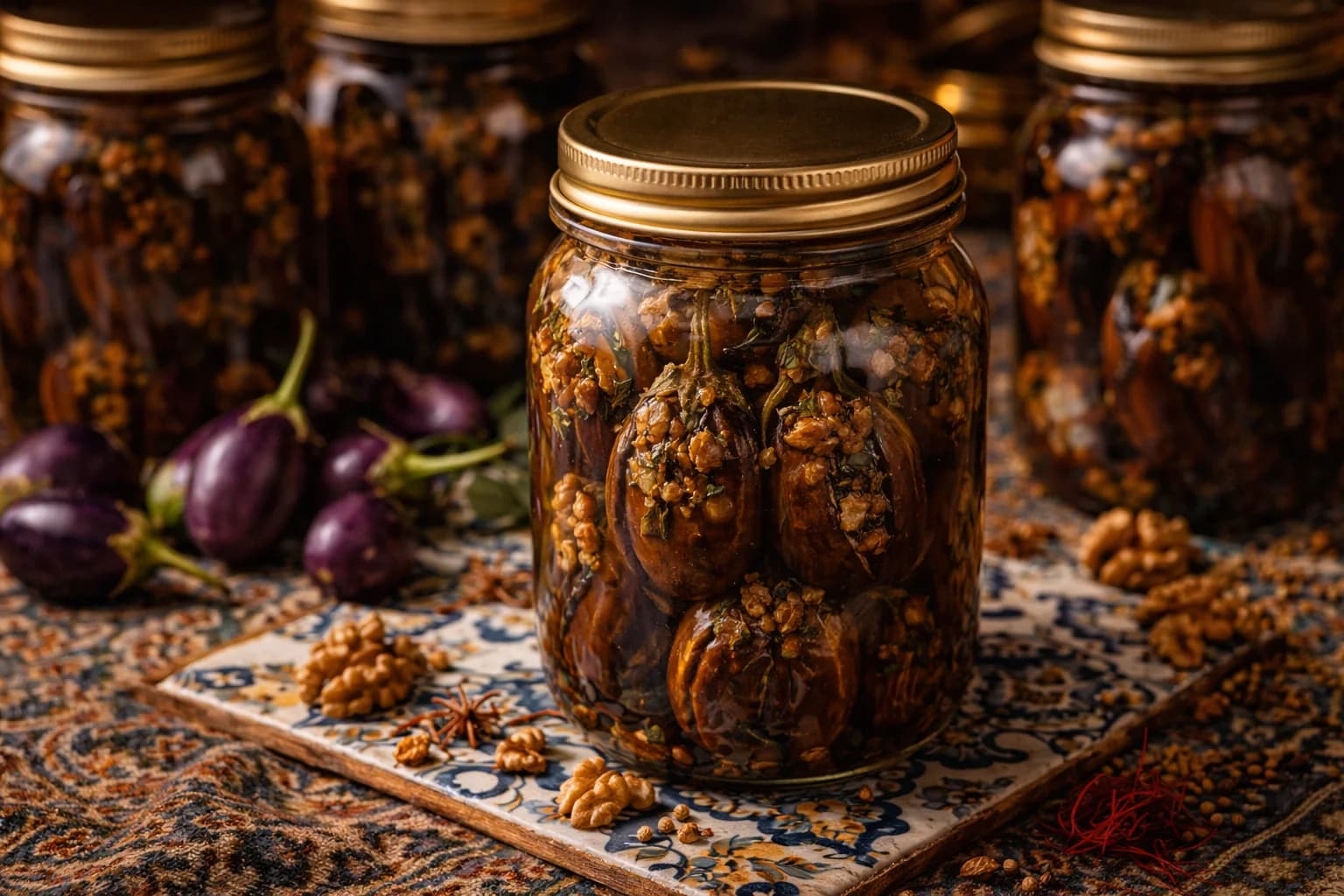
Arrange the stuffed eggplants in clean, sterilized glass jars, packing them fairly tightly in layers. If there's leftover stuffing, tuck it between the eggplants. Leave about 3cm headspace at the top of each jar.
Add vinegar
Pour vinegar over the stuffed eggplants, making sure to completely cover them by at least 2cm. Press down gently to release air bubbles. The eggplants and all stuffing must be completely submerged.
Critical Step
Complete submersion is essential for preservation. Any exposed portions can mold. The vinegar will be absorbed over time, so use plenty.
Common Mistakes
- •Not using enough vinegar
- •Leaving air pockets
Seal and age
Wipe jar rims clean. Seal tightly with non-reactive lids. Store in a cool, dark place for a minimum of 3-4 weeks, ideally 2-3 months. The eggplants will soften further, the flavors will meld, and the vinegar will become aromatic and golden.
Critical Step
Aging is essential—fresh torshi bademjan is harsh and the flavors haven't melded. Time transforms it into something magical.
Serve
Once properly aged, the torshi bademjan is ready. Serve whole or halved as an elegant condiment alongside rice and stews. The eggplant should be silky and tender, the stuffing aromatic and mellow. Once opened, refrigerate and use within 2-3 months.
Resting Required
30240 min - Minimum 3-4 weeks; best at 2-3 months for full flavor development