
Torshi Bademjan (Persian Stuffed Pickled Eggplant)

Torshi Bademjan (Persian Stuffed Pickled Eggplant)

ترشی بادمجان

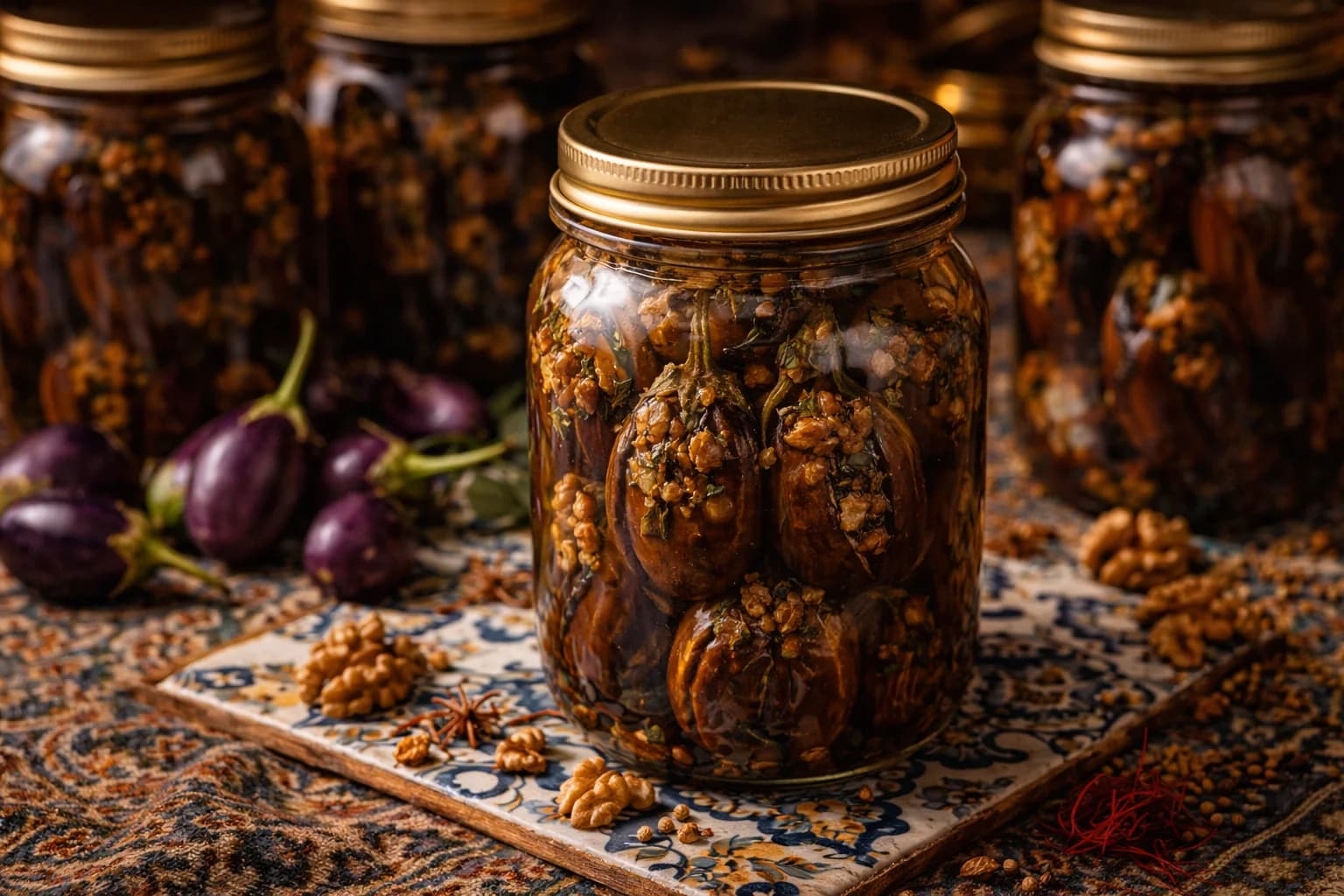
Small eggplants stuffed with an aromatic blend of garlic, walnuts, herbs, and spices, then pickled in spiced vinegar until tender and intensely flavorful—torshi bademjan is the most elegant and labor-intensive of Persian pickles. Each little eggplant is a treasure chest of flavors: the silky, tangy flesh yielding to a fragrant filling of crushed walnuts, golden garlic, fresh herbs, and the distinctive warmth of golpar. This is a showpiece pickle, brought out for special occasions and honored guests. The preparation is a labor of love, but the result—after weeks of patient aging—is extraordinary.

pickleVorbereitung: 90 MinKochen: 20 MinintermediateFür 24

Kultureller Hinweis

Torshi bademjan occupies a place of honor among Persian pickles—it's more labor-intensive than torshi liteh and more elegant in presentation. The stuffed eggplant tradition reflects the Persian love for this vegetable (Persia is one of the places where eggplant was first cultivated) and the sophisticated approach to pickling. Making torshi bademjan is often a communal activity, with family members gathering to stuff dozens of eggplants together. The combination of walnuts, garlic, and herbs stuffed into tender eggplant creates a pickle that's almost a dish in itself—served as a prized condiment alongside rice and kebabs, or eaten as a flavorful bite between courses. Well-made torshi bademjan is a point of family pride, and a jar makes a treasured gift.

Kritische Momente

  • Selecting small, firm eggplants
  • Thorough salting and drying
  • Blanching to right tenderness (not mushy)
  • Creating textured (not smooth) stuffing
  • Complete submersion in vinegar
  • Adequate aging time (minimum 3-4 weeks)
1
VORBEREITUNG20 Min

Select and prepare the eggplants

Choose small, firm eggplants with tight, glossy skin—no soft spots or blemishes. Remove the stems but leave the green cap attached. Wash and dry thoroughly. Make a lengthwise slit in each eggplant, cutting about three-quarters through but not all the way—you're creating a pocket for stuffing while keeping the eggplant intact.

Small eggplants with lengthwise pocket; still intact
GeruchFresh eggplant
TexturFirm, glossy skin

Kritischer Schritt

The eggplants must be small enough to pickle through (large eggplants won't work) and firm enough to hold their shape. The pocket must be deep enough for stuffing but not cut all the way through.

Italian or Japanese eggplants are ideal—8-12cm long. Avoid large globe eggplants. The green cap should stay attached for a beautiful presentation.

Häufige Fehler

  • Using eggplants that are too large (won't pickle through)
  • Cutting all the way through (eggplant falls apart)
2
VORBEREITUNG90 Min

Salt the eggplants

Generously salt the inside of each eggplant pocket with about half of the total salt. Place in a colander and let drain for 1-2 hours. This removes bitterness and excess moisture. Rinse briefly and squeeze gently to remove water. Pat dry thoroughly.

Eggplants have released brown liquid; slightly softened
GeruchSlight bitterness released
TexturSlightly wilted, less spongy

Kritischer Schritt

Salting removes bitterness and excess moisture—essential for good texture and flavor. Wet eggplants will make the pickle watery and can cause spoilage.

Don't skip the salting—bitter eggplant makes bitter torshi. Squeeze gently when rinsing; don't crush the eggplants.
3
KOCHEN15 Min

Blanch the eggplants

Bring a large pot of salted water to boil. Add the eggplants and blanch for 5-7 minutes until slightly softened but still holding their shape—they should bend but not be mushy. Drain immediately and spread on clean towels to cool and dry completely.

Eggplants are slightly translucent, bendable, but intact
HighBoiling water
GeruchCooking eggplant
KlangBoiling water
TexturSoftened but not mushy; holds shape

Kritischer Schritt

Blanching partially cooks the eggplant, making it tender enough to absorb the pickling liquid and flavors. Overblanching creates mushy torshi; underblanching leaves raw, tough eggplant.

Work in batches to avoid overcrowding. The eggplants will continue to soften during pickling, so err on the side of slightly underdone.
Kontrollpunkt: The eggplant should bend easily but not fall apart when lifted. If too firm, blanch another minute.
4
VORBEREITUNG15 Min

Make the stuffing

While the eggplants cool, prepare the stuffing: pound the garlic cloves to a paste using a mortar and pestle (or mince very finely). Crush or coarsely chop the walnuts—they should have texture, not be a paste. Combine the garlic, walnuts, all chopped fresh herbs, golpar, nigella seeds, crushed coriander seeds, remaining salt, chili flakes (if using), and turmeric (if using). Mix thoroughly.

Chunky green and golden stuffing with visible walnut pieces
GeruchPungent garlic, aromatic herbs, distinctive golpar
KlangPounding, chopping
TexturChunky, paste-like mixture with walnut pieces

Kritischer Schritt

The stuffing should have texture—don't make it into a smooth paste. The walnut pieces and herb bits provide important texture contrast in the finished torshi.

The garlic can be pounded to a paste, but walnuts should remain chunky. The stuffing should be intensely flavored—it will mellow during pickling.
5
VORBEREITUNG25 Min

Stuff the eggplants

Open each eggplant pocket gently. Spoon 1-2 tablespoons of stuffing into each pocket, pressing it in firmly. The eggplant should be well-filled but still able to close somewhat. Don't overstuff—leave room for the pickling liquid to penetrate.

Each eggplant has a generous amount of green-golden stuffing visible
GeruchGarlic and herbs
TexturFirm, filled eggplants
Use a small spoon to push stuffing deep into the pocket. Some stuffing peeking out is fine and looks beautiful. Work gently—the blanched eggplants are delicate.
6
VORBEREITUNG10 Min

Pack into jars

Arrange the stuffed eggplants in clean, sterilized glass jars, packing them fairly tightly in layers. If there's leftover stuffing, tuck it between the eggplants. Leave about 3cm headspace at the top of each jar.

Neat rows of stuffed eggplants, green caps visible, stuffing peeking out
GeruchGarlic, herbs
TexturTightly but gently packed
Pack tightly enough that the eggplants don't float but gently enough that they don't crush. Alternate directions for efficient packing.
7
VORBEREITUNG5 Min

Add vinegar

Pour vinegar over the stuffed eggplants, making sure to completely cover them by at least 2cm. Press down gently to release air bubbles. The eggplants and all stuffing must be completely submerged.

Eggplants fully submerged in clear vinegar
GeruchSharp vinegar
KlangBubbles rising

Kritischer Schritt

Complete submersion is essential for preservation. Any exposed portions can mold. The vinegar will be absorbed over time, so use plenty.

If eggplants float, place a small weight or grape leaf on top to keep them submerged. Check after a day and add more vinegar if needed—the eggplants absorb it.

Häufige Fehler

  • Not using enough vinegar
  • Leaving air pockets
8
FERTIGSTELLEN30240 Min

Seal and age

Wipe jar rims clean. Seal tightly with non-reactive lids. Store in a cool, dark place for a minimum of 3-4 weeks, ideally 2-3 months. The eggplants will soften further, the flavors will meld, and the vinegar will become aromatic and golden.

Progression: pale vinegar → golden; eggplant becomes more translucent
GeruchInitially sharp, becoming complex and aromatic
TexturEggplant becomes silky-soft; stuffing mellows

Kritischer Schritt

Aging is essential—fresh torshi bademjan is harsh and the flavors haven't melded. Time transforms it into something magical.

Check after 1 week to ensure eggplants are still submerged—add more vinegar if needed. Label with the date. The torshi improves for months.
9
FERTIGSTELLEN0

Serve

Once properly aged, the torshi bademjan is ready. Serve whole or halved as an elegant condiment alongside rice and stews. The eggplant should be silky and tender, the stuffing aromatic and mellow. Once opened, refrigerate and use within 2-3 months.

Golden-tinged eggplants with aromatic stuffing; silky texture
GeruchComplex—tangy, garlicky, herbal, nutty
TexturSilky-soft eggplant, slightly crunchy walnuts, mellow garlic
Present the whole stuffed eggplants on a small dish—they're beautiful. The pickling liquid is also delicious; use it as a flavoring.

Ruhezeit Erforderlich

30240 Min - Minimum 3-4 weeks; best at 2-3 months for full flavor development

Extras

Ausstattung

large pot for blanchinglarge glass jars with lidsmortar and pestle or food processorparing knifeStandard

Im Voraus Zubereiten

  • Torshi bademjan must be made ahead—it requires aging.
  • Make in summer when small eggplants are available.
  • Unopened jars keep for 1+ years.
  • Once opened, refrigerate and use within 2-3 months.

N/A—served cold or at room temperature

Servieren Mit

Beilagen

  • Elegant condiment for special meals
  • Alongside rice and khoresh
  • With kebabs
  • Part of a meze spread

Getränke

  • Persian tea
  • Doogh

Ersatzstoffe

small eggplantsItalian or Japanese eggplants are ideal. Baby Indian eggplants work but may be smaller. Don't use large globe eggplants whole—they won't pickle through.
walnutsAlmonds or hazelnuts can substitute, though flavor differs. Walnuts are traditional and provide the best texture.
fresh herbsDried herbs can substitute if fresh unavailable (use 1/3 the amount). Fresh is strongly preferred for this recipe.
golparEssential for authentic flavor. Angelica seeds are closest substitute. The unique tangy flavor cannot be replicated.

Skalierung

This recipe makes about 24 stuffed eggplants (approximately 2 liters). Scale based on eggplant availability. Small Italian or Japanese eggplants work best—they should be no longer than 10-12cm. The stuffing ratio is flexible; make extra if you like more filling. Torshi bademjan keeps for over a year.

Quelle

Traditionell · Traditional Persian cuisine

Torshi bademjan is considered the queen of Persian pickles—more refined and labor-intensive than mixed vegetable torshi. The stuffed eggplant tradition likely dates back centuries, combining Persia's love of eggplant with the ancient art of pickling. Each region and family has variations in the stuffing mixture.

Ähnliche Rezepte

Torshi Felfel (Persian Pickled Peppers)

Torshi Felfel (Persian Pickled Peppers)

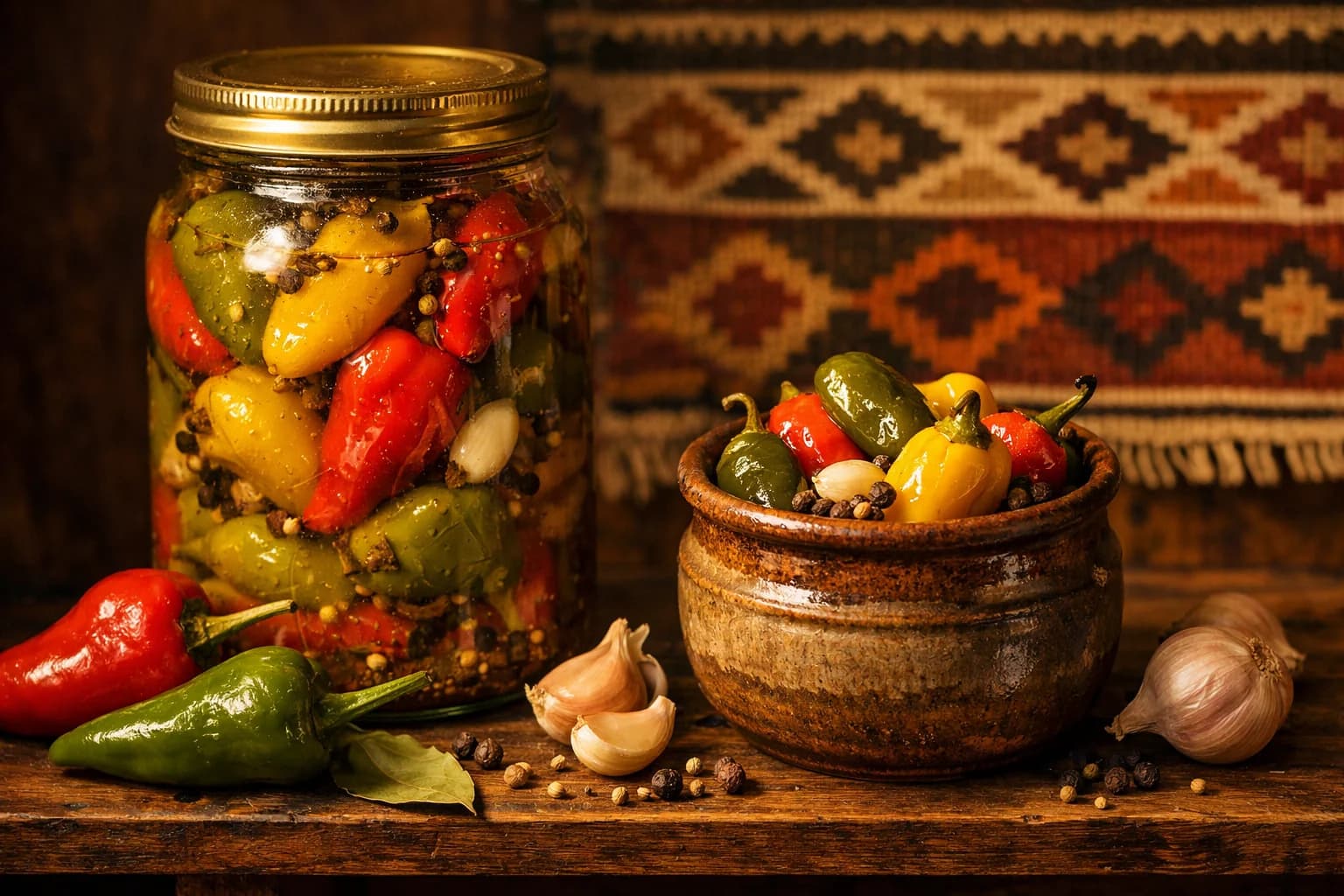
Vibrant, tangy, and versatile—torshi felfel transforms sweet or hot peppers into crunchy, flavor-packed pickles that brighten any meal. This straightforward pickle showcases peppers in all their glory, from mild bell peppers to fiery serranos, preserved with vinegar, garlic, and Persian spices. The peppers retain their satisfying crunch while absorbing the tangy, aromatic brine. Whether you prefer mild or spicy, whole or sliced, torshi felfel is one of the quickest and most rewarding Persian pickles to make—ready in just a few weeks and perfect alongside rice, kebabs, and stews.

Torshi Liteh (Persian Mixed Vegetable Pickle)

Torshi Liteh (Persian Mixed Vegetable Pickle)

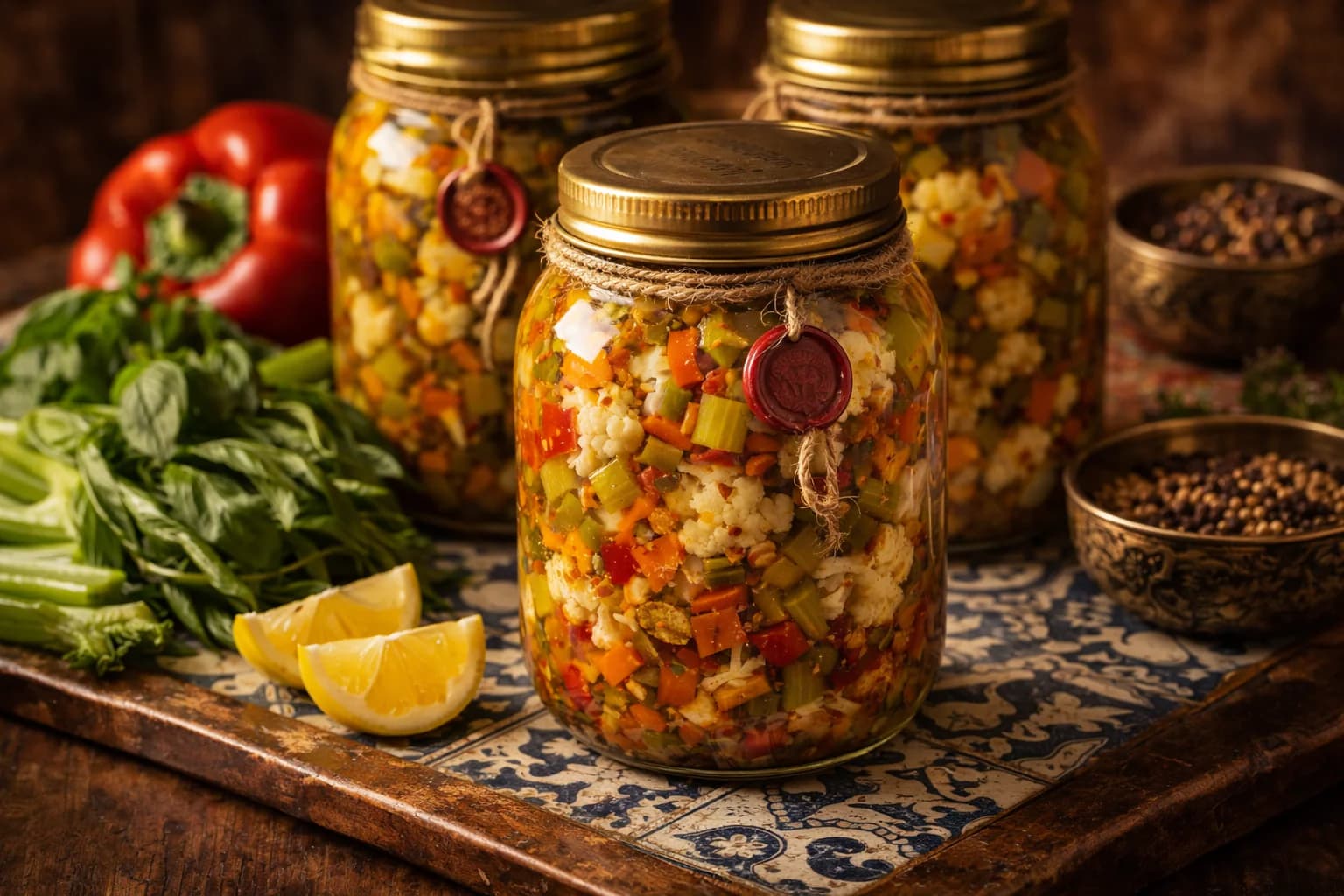
The crown jewel of Persian pickles—a vibrant, chunky medley of vegetables transformed by weeks of soaking in spiced vinegar into something magnificently tangy, aromatic, and complex. Torshi liteh features a colorful array of cauliflower, carrots, celery, peppers, eggplant, and herbs, all infused with the warmth of golpar (Persian hogweed), nigella seeds, and garlic. This isn't a quick pickle but a fermented treasure that improves with age, the flavors melding and deepening over months. A spoonful of torshi liteh alongside rice and stew is essential to the Persian table—its bright acidity cuts through richness and awakens the palate.

Torshi Sir (Persian Pickled Garlic)

Torshi Sir (Persian Pickled Garlic)

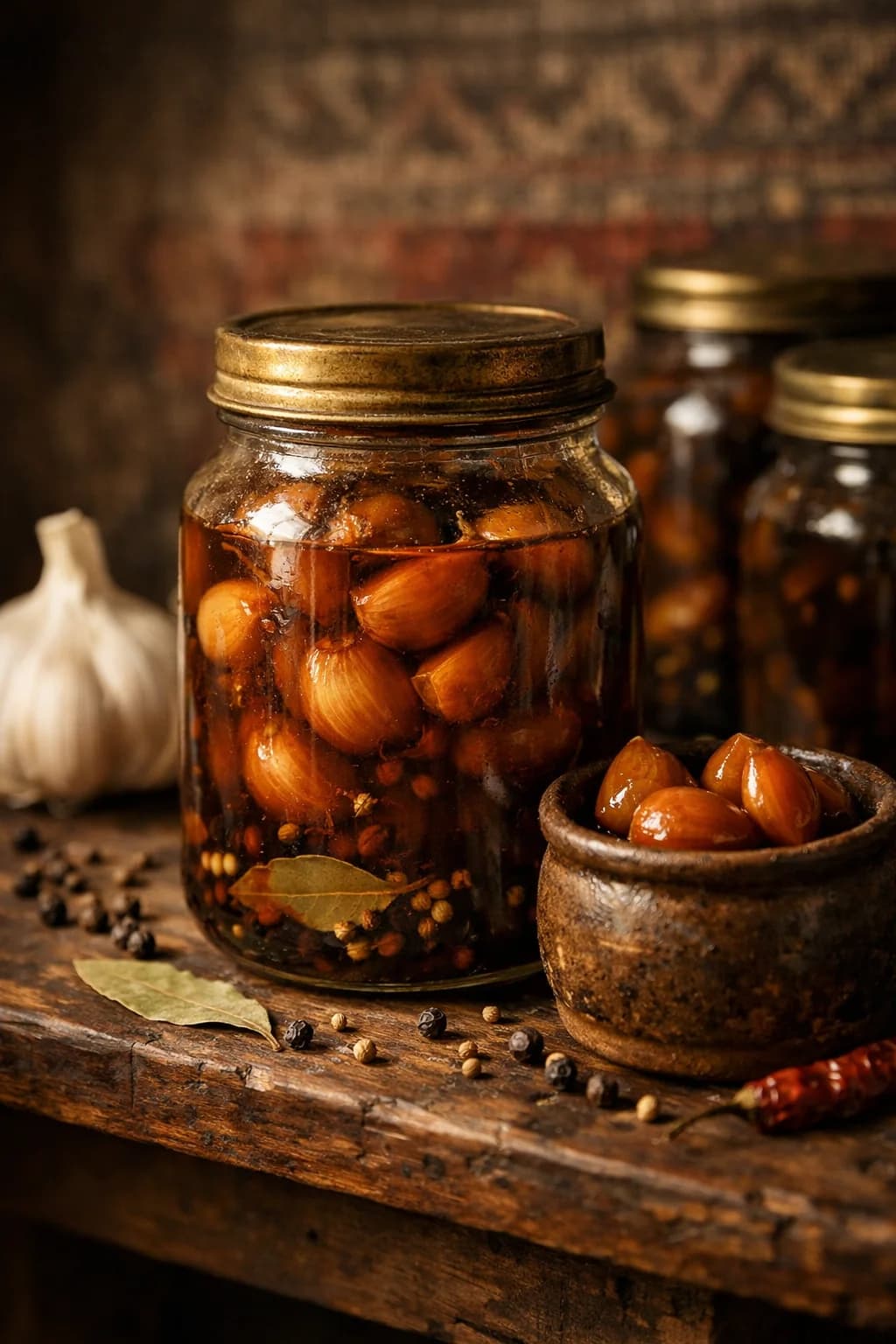
Whole garlic cloves slowly transformed over months into tender, mellow, golden nuggets—torshi sir takes garlic's assertive pungency and gentles it into something almost sweet, deeply savory, and utterly addictive. Pickled in vinegar with Persian spices, the garlic mellows dramatically while absorbing complex flavors. What begins as sharp and biting becomes soft, tangy, and beautifully nuanced. Aged torshi sir is a prized condiment, eaten whole alongside rice and kebabs, or minced into dishes for its unique fermented depth. This is a patience project—minimum three months, ideally a year—but the result is extraordinary.