
Faloodeh Shirazi (Persian Rose Water Sorbet with Noodles)

Faloodeh Shirazi (Persian Rose Water Sorbet with Noodles)

فالوده شیرازی

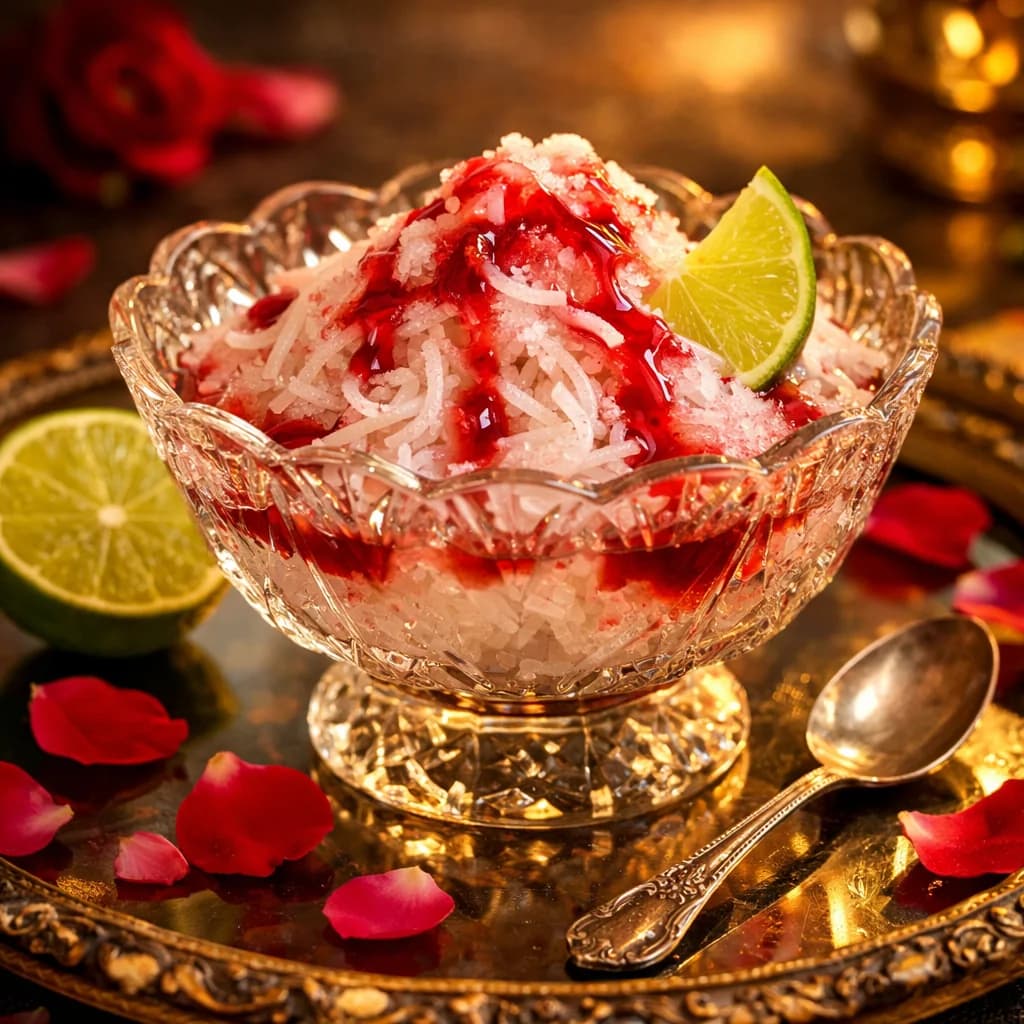
One of the world's oldest frozen desserts—thin, frozen vermicelli noodles suspended in an icy rose water and lime syrup, served semi-frozen with a squeeze of fresh lime and sometimes sour cherry syrup. Dating back over 2,500 years to ancient Persia, faloodeh has a texture unlike any other dessert: crunchy-icy noodles, floral-sweet syrup, and bright citrus. The contrast of textures and the refreshing flavor make it the perfect hot-weather treat, especially when paired with saffron ice cream.

dessertPrep: 20 minCook: 15 mineasyServes 8

Cultural Note- Shiraz

Faloodeh is one of the oldest frozen desserts in human history, dating back to at least 400 BCE in ancient Persia. The word 'faloodeh' may come from 'paloodeh,' meaning 'refined' or 'strained.' In ancient times, snow was collected from mountains and stored in underground ice houses (yakhchāl), then mixed with fruit syrups and thin noodles—the ancestor of all sorbets and frozen treats. The city of Shiraz is particularly famous for its faloodeh, hence 'Faloodeh Shirazi.' Traditionally served with fresh lime juice squeezed over the top (the tartness is essential) and often drizzled with sour cherry syrup for a stunning pink-red contrast. The classic pairing is with bastani sonnati—the contrast of creamy ice cream and icy faloodeh is sublime.

Critical Moments

  • Adding rosewater to cooled (not hot) syrup
  • Not overcooking noodles
  • Cutting noodles into short pieces
  • Stirring during freezing to maintain slushy texture
  • Serving with fresh lime juice (essential)
1
PREP15 min

Make the rose water syrup

In a medium saucepan, combine the sugar and water. Heat over medium heat, stirring until the sugar completely dissolves. Bring to a boil and simmer for 5 minutes—don't stir once boiling. Remove from heat and let cool to room temperature.

Clear syrup; all sugar dissolved; slightly thickened
MediumSimmer for 5 minutes
SmellHot sugar syrup
SoundBubbling
TouchLiquid, slightly viscous when cooled
Don't stir once boiling—this can cause crystallization. A gentle simmer is fine.
2
PREP5 min

Add rosewater and lime

Once the syrup has cooled to room temperature (important—hot syrup dissipates the rosewater fragrance), stir in the rosewater, lime juice, and lime zest if using. Taste—it should be sweet, floral, and tart. Adjust to your preference.

Clear, fragrant syrup
SmellIntense rosewater and lime—refreshing, floral, citrusy
TouchSyrupy but pourable

Critical Step

Adding rosewater to hot syrup destroys its delicate aroma. Room temperature or cooler is essential. The balance of sweet (syrup), floral (rosewater), and tart (lime) defines faloodeh.

Taste and adjust—some prefer more lime for tartness, some more rosewater for floral intensity. The lime really should be noticeable.
3
COOK8 min

Cook the noodles

Bring a large pot of water to boil. Add the rice vermicelli and cook according to package directions until just tender—usually 3-5 minutes for thin rice noodles. They should be soft but not mushy. Drain and rinse immediately under cold water to stop cooking and remove excess starch.

Translucent, soft noodles; not mushy
HighBoiling water
SmellCooking rice noodles
SoundBoiling water
TouchSoft and pliable but not falling apart

Critical Step

Noodles must be cooked properly—overcooked noodles become mushy when frozen and lose the signature chewy-icy texture. Just tender is perfect.

Thin rice vermicelli (the kind used for spring rolls) work best. Korean glass noodles (dangmyeon) are a good substitute with chewier texture.

Common Mistakes

  • Overcooking noodles (mushy faloodeh)
  • Not rinsing (sticky noodles that clump)
4
PREP5 min

Cut the noodles

Using kitchen scissors or a knife, cut the noodles into shorter lengths—about 3-5cm long. This makes the faloodeh easier to eat. Traditional faloodeh has quite short noodle pieces.

Short noodle segments, 3-5cm long
SoundCutting
TouchShort, separate noodle pieces
Don't skip this step—long noodles are difficult to eat and don't freeze as nicely. Traditional faloodeh noodles are quite short.
5
PREP3 min

Combine noodles and syrup

Place the cut noodles in a freezer-safe container or shallow dish. Pour the cooled rose water-lime syrup over the noodles. Stir gently to distribute the noodles evenly throughout the syrup. The noodles should be swimming in syrup.

Noodles evenly distributed in fragrant syrup
SmellRosewater and lime
TouchNoodles floating in syrup
Use a shallow container for faster, more even freezing. The syrup-to-noodle ratio should favor syrup—faloodeh should be quite slushy, not dry.
6
COOK480 min

Freeze with periodic stirring

Cover and freeze for about 6-8 hours, stirring with a fork every 1-2 hours for the first 4-5 hours. This breaks up ice crystals and keeps the texture slushy rather than solid. The noodles will freeze suspended in icy syrup.

Slushy, icy texture with frozen noodles; not a solid block
SmellCold rosewater-lime
SoundCrunchy when stirred
TouchIcy, slushy, with chewy frozen noodles

Critical Step

Periodic stirring prevents the faloodeh from freezing into a solid block. The texture should be icy and slushy, not hard. The noodles should be individually frozen, not welded together.

If you forget to stir and it freezes solid, let it sit at room temperature for 15-20 minutes, then break up with a fork. It won't be quite as perfect but still delicious.

Common Mistakes

  • Not stirring (freezes solid)
  • Freezing too long without breaking up (ice block)
7
FINISH5 min

Break up before serving

Before serving, use a fork to scrape and break up the faloodeh into an icy, slushy texture. It should have a granita-like consistency with distinct chewy noodle pieces throughout.

Slushy, granita-like texture; separate icy noodles visible
SmellCold rosewater-lime fragrance
SoundCrunching ice
TouchIcy, slushy, with chewy noodle pieces
Don't over-process—you want texture, not slush. The noodles should remain distinct and slightly chewy.
8
FINISH5 min

Serve with lime and optional toppings

Spoon the faloodeh into small bowls or glasses. Serve with lime wedges on the side—each person squeezes fresh lime juice over their portion (this is essential, not optional). Optionally, drizzle with sour cherry syrup for beautiful color and sweet-tart contrast. Sprinkle with ground pistachios if desired.

Icy white faloodeh in bowl; pink-red cherry syrup drizzled over; lime wedge on side; green pistachio garnish
SmellFresh lime and rosewater
TouchIcy, crunchy, refreshing

Critical Step

The fresh lime juice squeezed at serving is absolutely essential—it brightens and balances the sweetness. Don't skip this step or serve without lime.

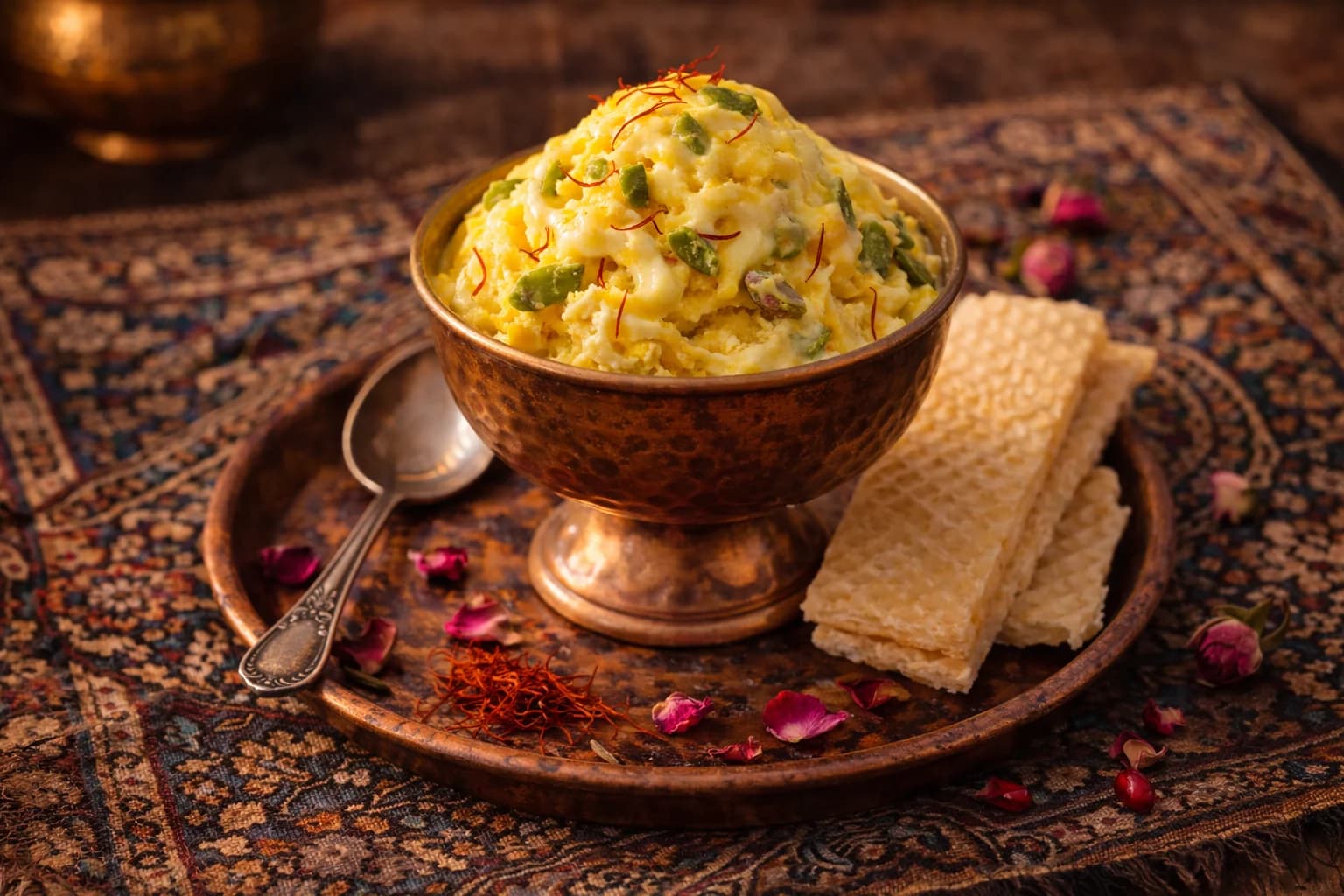
The classic pairing is faloodeh with bastani sonnati—serve them together for the traditional Persian frozen dessert experience.

Resting Required

480 min - Must freeze to proper slushy consistency
Extras

Equipment

medium saucepanlarge pot for noodlesfreezer safe containerforkstandard

Make Ahead

  • Faloodeh keeps frozen for up to 2 weeks.
  • It may freeze more solid over time—simply break up with a fork or let sit at room temperature briefly before serving.

N/A—frozen dessert.

Break up with fork if too solid; let temper slightly at room temperature.

Serve With

Sides

  • Bastani sonnati (essential traditional pairing)
  • Fresh fruit

Drinks

  • Cold water
  • Hot tea (traditional contrast)

Substitutions

rice vermicelliKorean glass noodles (dangmyeon) are excellent and chewier. Very thin rice stick noodles work. Some use thin wheat vermicelli (not traditional but acceptable). The noodles should be very thin.
rosewaterEssential—no substitute. Must be high-quality Persian rosewater. Orange blossom water creates a different but acceptable variation.
limeLemons can substitute but flavor is quite different. Fresh lime is traditional and essential to serve alongside.
sour cherry syrupOptional but traditional topping. Grenadine is not the same but could substitute for color. Some use raspberry syrup.

Scaling

Scales easily. The ratio of syrup to noodles is flexible—some prefer more syrup, some less. Traditional texture is quite icy with distinct frozen noodles. Store in freezer and break apart with a fork before serving.

Source

Traditional · Traditional Persian cuisine, Shiraz origin

One of the oldest desserts in recorded history, with origins in ancient Persia dating to at least 400 BCE. The name is associated with Shiraz, the cultural capital, though it's beloved throughout Iran. Snow or ice was brought from mountains and mixed with fruit syrups—the ancestor of all frozen desserts.

Related Recipes

Bastani Sonnati (Persian Saffron Ice Cream)

Bastani Sonnati (Persian Saffron Ice Cream)

The legendary Persian ice cream—a luxurious frozen cream perfumed with saffron and rosewater, studded with pistachios, and threaded with frozen ribbons of clotted cream. Unlike any Western ice cream, bastani sonnati has a distinctive chewy, stretchy texture from salep (orchid root powder) and an intoxicating fragrance that captures the essence of Persian sweets. Traditionally served pressed between crispy wafers or alongside faloodeh, this golden ice cream is the crown jewel of Persian frozen desserts.

Baklava (Persian-Style Layered Nut Pastry)

Baklava (Persian-Style Layered Nut Pastry)

Delicate layers of paper-thin phyllo pastry filled with fragrant ground nuts, baked to golden crispness, and soaked in a saffron-rosewater syrup—Persian baklava is more refined and aromatic than its regional cousins. The Persian version distinguishes itself with generous saffron, rosewater, and cardamom, and often features a combination of pistachios and almonds rather than walnuts alone. Cut into elegant diamond shapes and decorated with ground pistachios, this is the jewel of Persian pastry-making, served at weddings, Nowruz, and whenever celebration calls for something extraordinary.

Fereni (Persian Rice Flour Pudding)

Fereni (Persian Rice Flour Pudding)

A silky-smooth, pure white pudding made from rice flour, perfumed with rosewater and cardamom, and decorated with a dusting of cinnamon—the most delicate and elegant of Persian desserts. Unlike sholeh zard's golden richness, fereni is subtle, creamy, and light, with a texture like panna cotta or blancmange. Served chilled in small portions, it's the perfect ending to a heavy meal. The contrast of snowy white pudding with cinnamon swirls is visually stunning and distinctly Persian.