

Kritische Momente
- •Reis waschen, bis das Wasser klar ist (5–6 Mal)
- •In Salzwasser einweichen (mindestens 1 Stunde)
- •Vorkochen bis zur genauen al-dente-Stufe (5–7 Minuten, ständig testen)
- •Sofort abgießen, wenn fertig
- •Pyramidenform mit Dampfkanälen aufbauen
- •Deckel in Tuch einwickeln
- •Auf niedrigster Hitze dämpfen (45–50 Minuten, nicht schauen)
- •Vor dem Lösen ruhen lassen (5 Minuten)
Hochwertigen Reis auswählen
Für beste Ergebnisse gereiften Basmatireis verwenden (idealerweise 1–2 Jahre alt). Gereifter Reis hat weniger Feuchtigkeit, nimmt Wasser gleichmäßiger auf und kocht lockerer. Extra-Langkorn-Basmati aus Indien oder Pakistan suchen.
Häufige Fehler
- •Nicht-Basmati-Reis verwenden (verlängert sich nicht richtig)
- •Neuerntereis verwenden (matschigere Ergebnisse)
- •Gebrochenen Reis verwenden (ungleichmäßiges Garen)
Reis gründlich waschen
Reis in eine große Schüssel geben. Mit kaltem Wasser auffüllen, 30 Sekunden kräftig mit der Hand schwenken, dann abgießen. Das Wasser wird sehr trüb/milchig sein. Vorgang 5–6 Mal wiederholen, bis das Wasser fast klar ist. Das entfernt überschüssige Oberflächenstärke.
Kritischer Schritt
Das Waschen entfernt überschüssige Stärke, die sonst den Reis klebrig und matschig machen würde. Persischer Reis muss vollständig einzelne Körner haben – dieser Schritt ist nicht verhandelbar. Zu wenig gewaschener Reis wird niemals die richtige Textur erreichen.
Häufige Fehler
- •Nicht genug waschen (klebriger Reis)
- •Zu grob waschen (gebrochene Körner)
- •Diesen Schritt ganz überspringen
Reis in Salzwasser einweichen
2 EL Salz in 2 L lauwarmem (nicht heißem) Wasser auflösen. Den gewaschenen Reis hinzugeben. Mindestens 1 Stunde, bis zu 3 Stunden einweichen. Das Salz würzt den Reis innerlich und hilft, die Körner langsam zu dehnen und Brüche beim Kochen zu verhindern.
Kritischer Schritt
Einweichen lässt die Körner langsam Wasser aufnehmen und sich vor dem Kochen ausdehnen, was ein Brechen während des kräftigen Vorkochens verhindert. Das Salz dringt für gleichmäßige Würzung in das Korn ein. Nicht eingeweichter Reis gart ungleichmäßig und bricht.
Häufige Fehler
- •Einweichen überspringen (Reis bricht, gart ungleichmäßig)
- •Salz im Einweichwasser vergessen (fader Reis)
- •Heißes Wasser verwenden (äußere Schicht gart vorzeitig)
- •Zu kurz einweichen
Safran aufblühen lassen
Safranfäden mit einer kleinen Prise Zucker im Mörser zu Pulver mahlen. Der Zucker wirkt als Schleifmittel, um die Fäden aufzubrechen. In eine kleine Schüssel geben, 3 EL heißes (nicht kochendes) Wasser hinzufügen. Abdecken und mindestens 30 Minuten ziehen lassen.
Kritischer Schritt
Das Mahlen setzt Safrans Farb- und Aromaverbindungen frei. Ungemahlene Fäden geben Farbe ungleichmäßig und viel langsamer ab. Das Aufblühen extrahiert maximale Farbe und Geschmack aus diesem kostbaren Gewürz.
Kochwasser zum Kochen bringen
Einen großen Topf mit Wasser füllen. Salz hinzufügen – das Wasser sollte deutlich salzig schmecken, wie Meerwasser. Bei hoher Hitze zum starken Kochen bringen.
Kritischer Schritt
Gesalzenes kochendes Wasser würzt den Reis beim Garen. Zu wenig gesalzenes Wasser ergibt faden Reis, den keine spätere Würzung retten kann. Das Salz dringt während dieses kurzen Garvorgangs ein.
Reis vorkochen
Den eingeweichten Reis vorsichtig abgießen. In das kochende Wasser geben. Einmal sehr vorsichtig umrühren, um Ankleben zu verhindern. 5–7 Minuten kochen und ab 4 Minuten häufig testen. Der Reis ist fertig, wenn er al dente ist: außen weich, aber mit einem winzig festen Kern beim Beißen.
Kritischer Schritt
Dies ist das kritischste Timing beim persischen Reis. Zu wenig gegarter Reis ist im Endgericht hart. Zu lang gegarter Reis wird matschig und kann nicht gerettet werden. Die al-dente-Stufe – weich außen, winzig fester Kern – ist unverzichtbar, weil der Reis beim Dämpfen fertig gart.
Häufige Fehler
- •Nicht häufig genug testen
- •Übergaren (matschiger Endreis – nicht zu retten)
- •Untergaren (harter Reis)
- •Zu viel umrühren (bricht Körner)
Sofort abgießen
In dem Moment, wenn der Reis al dente ist, in ein feines Sieb abgießen. Sehr kurz mit lauwarmem Wasser abspülen, um das Garen zu stoppen und Oberflächenstärke abzuwaschen. Vorsichtig schütteln – nicht pressen oder komprimieren.
Kritischer Schritt
Jede Sekunde zählt. Reis gart im heißen Wasser weiter. Sofortiges Abgießen stoppt das Garen im perfekten Moment. Lauwarmes Abspülen (nicht kalt – das schockt das Korn; nicht heiß – das setzt das Garen fort) wäscht überschüssige Stärke für einzelne Körner ab.
Topf für Tahdig vorbereiten
In einem beschichteten Topf (unverzichtbar für das Lösen des Tahdigs) Öl (oder geschmolzene Butter) mit Safranwasser mischen. Schwenken, um den Boden gleichmäßig zu bedecken.
Tahdig-Schicht anlegen
Ca. 2 Tassen des vorgekochten Reises nehmen und in einer kleinen Schüssel mit Safranwasser mischen. Diesen Safranreis gleichmäßig über das Öl im Topfboden verteilen und vorsichtig zu einer flachen, gleichmäßigen Schicht von ca. 1 cm Dicke drücken.
Kritischer Schritt
Diese Schicht wird zum Tahdig. Gleichmäßige Dicke sorgt für gleichmäßiges Knuspern. Zu dick und er knuspert nicht durch; zu dünn und er verbrennt. Der Safran verleiht Farbe und Geschmack der begehrten Kruste.
Restlichen Reis hinzufügen
Den restlichen weißen Reis löffelweise über die Tahdig-Schicht geben und eine Pyramide oder einen Hügel aufbauen. NICHT drücken – der Reis sollte locker und luftig sein. Die Pyramidenform ermöglicht gleichmäßige Dampfzirkulation.
Kritischer Schritt
Die Pyramidenform ist unverzichtbar für gleichmäßiges Dämpfen. Flach gepackter Reis dämpft ungleichmäßig – der Boden wird matschig, während die Oberseite ungar bleibt. Lufttaschen zwischen den Körnern lassen den Dampf eindringen.
Häufige Fehler
- •Reis flach drücken (ungleichmäßiges Dämpfen)
- •Zu fest packen (matschiger Reis)
- •Den Hügel zu breit und flach machen
Dampfkanäle einstechen
Mit dem Stiel eines Holzlöffels oder einem Stäbchen 5–6 Löcher durch den Reishügel bis zur Tahdig-Schicht stechen. Diese Löcher lassen Dampf entweichen und verhindern, dass der Reis wassergesättigt wird.
Kritischer Schritt
Dampfkanäle verhindern, dass sich Kondensation im Reis ansammelt und ihn matschig macht. Sie lassen Dampf gleichmäßig entweichen und sorgen dafür, dass der gesamte Reis gleichmäßig gart.
Mit Butter und Safran beträufeln
Butter schmelzen und mit verbleibendem Safranwasser mischen. Diese Mischung gleichmäßig über die Reispyramide träufeln und durch die Dampfkanäle und über die Oberfläche sickern lassen.
Tahdig-Bildung starten (Hochhitzephase)
Topf bei mittlerer bis hoher Hitze ohne Deckel aufstellen. 3–4 Minuten kochen, bis Dampf vom Reis aufsteigt. Man hört ein leises Zischen vom Boden – das ist der Tahdig, der beginnt, sich zu bilden.
Kritischer Schritt
Diese anfängliche Hochhitzephase setzt die Tahdig-Kruste. Ohne sie entsteht nicht die charakteristische knusprige Unterseite. Das Zischgeräusch zeigt an, dass sich die Kruste bildet.
Deckel einwickeln
Ein sauberes Küchentuch (Baumwolle, kein Frottee) vollständig um den Topfdeckel wickeln und die Ecken oben am Griff zusammenbinden und sichern. Das Tuch muss gesichert sein, damit es nicht nach unten in Richtung Flamme oder Heizelement hängt.
Kritischer Schritt
Das Tuch nimmt Kondensation auf, die sonst zurück auf den Reis tropfen und ihn matschig machen würde. Das ist das persische Geheimnis für luftigen Reis – nasses Tuch, trockener Reis. Ohne es dampft der Reis in seiner eigenen Kondensation.
Häufige Fehler
- •Tuch weglassen (matschiger Reis)
- •Tuch hängt nahe an der Flamme (Brandgefahr!)
- •Synthetisches Tuch verwenden (schmilzt, nimmt nicht auf)
Auf niedrigster Hitze dämpfen
Den eingewickelten Deckel fest auf den Topf legen. Hitze auf die absolute niedrigste Stufe reduzieren. 35–50 Minuten ohne Abheben des Deckels dämpfen. Die Zeit variiert je nach Herd und Topf – ab 35 Minuten auf den Duft achten. Der Reis gart im sanften Dampf fertig, während der Tahdig langsam knusprig wird.
Kritischer Schritt
Diese langsame Dämpfphase ist, wo die Magie geschieht. Der Reis gart zu perfekter Lockerheit fertig, während der Tahdig langsam golden und knusprig wird. Das Abheben des Deckels lässt Dampf entweichen und verlängert die Garzeit um 10 Minuten. Hohe Hitze verbrennt den Tahdig, bevor der Reis durchgart.
Häufige Fehler
- •Deckel abheben (Dampf entweicht, verlängert Garzeit)
- •Hitze zu hoch (verbrennt Tahdig, bevor Reis fertig)
- •Hitze zu niedrig (kein Tahdig bildet sich)
- •Nicht genug Zeit (Reis nicht vollständig gegart)
Vor dem Servieren ruhen lassen
Topf vom Herd nehmen. Deckel aufbehalten und 5 Minuten ruhen lassen. Dies lässt den Tahdig sich leicht von den Topfseiten zusammenziehen und erleichtert das Lösen.
Kritischer Schritt
Das Ruhen lässt den Tahdig sich leicht von den Topfseiten lösen, während er abkühlt. Versucht man, einen noch heißen Tahdig zu lösen, klebt er oft oder bricht.
Reis auflockern und servieren
Deckel abnehmen. Mit einer Gabel (nie einem Löffel – der komprimiert) den weißen Reis vorsichtig auflockern, indem man die Körner anhebt und trennt. Den lockeren Reis auf eine Servierplatte löffeln und dabei den Tahdig auf dem Boden nicht stören.
Tahdig lösen
Einen Teller nehmen, der etwas größer als der Topf ist. Verkehrt herum über die Topföffnung legen. Topf und Teller fest zusammenhalten und in einer entschlossenen Bewegung umdrehen. Einige Male auf den Topfboden klopfen, dann den Topf gerade nach oben anheben. Der Tahdig sollte sich als eine goldene, knusprige Scheibe lösen.
Kritischer Schritt
Das ist der Moment, für den jeder persische Koch lebt. Ein perfekt gelöster Tahdig ist die ultimative Leistung. Entschlossenheit beim Umdrehen ist wichtig – Zögern verursacht Risse.
Häufige Fehler
- •Zögerliches Umdrehen (Tahdig bricht)
- •Nicht ruhen lassen (klebt)
- •Feststeckenden Tahdig mit Gewalt lösen (reißt)
Servieren
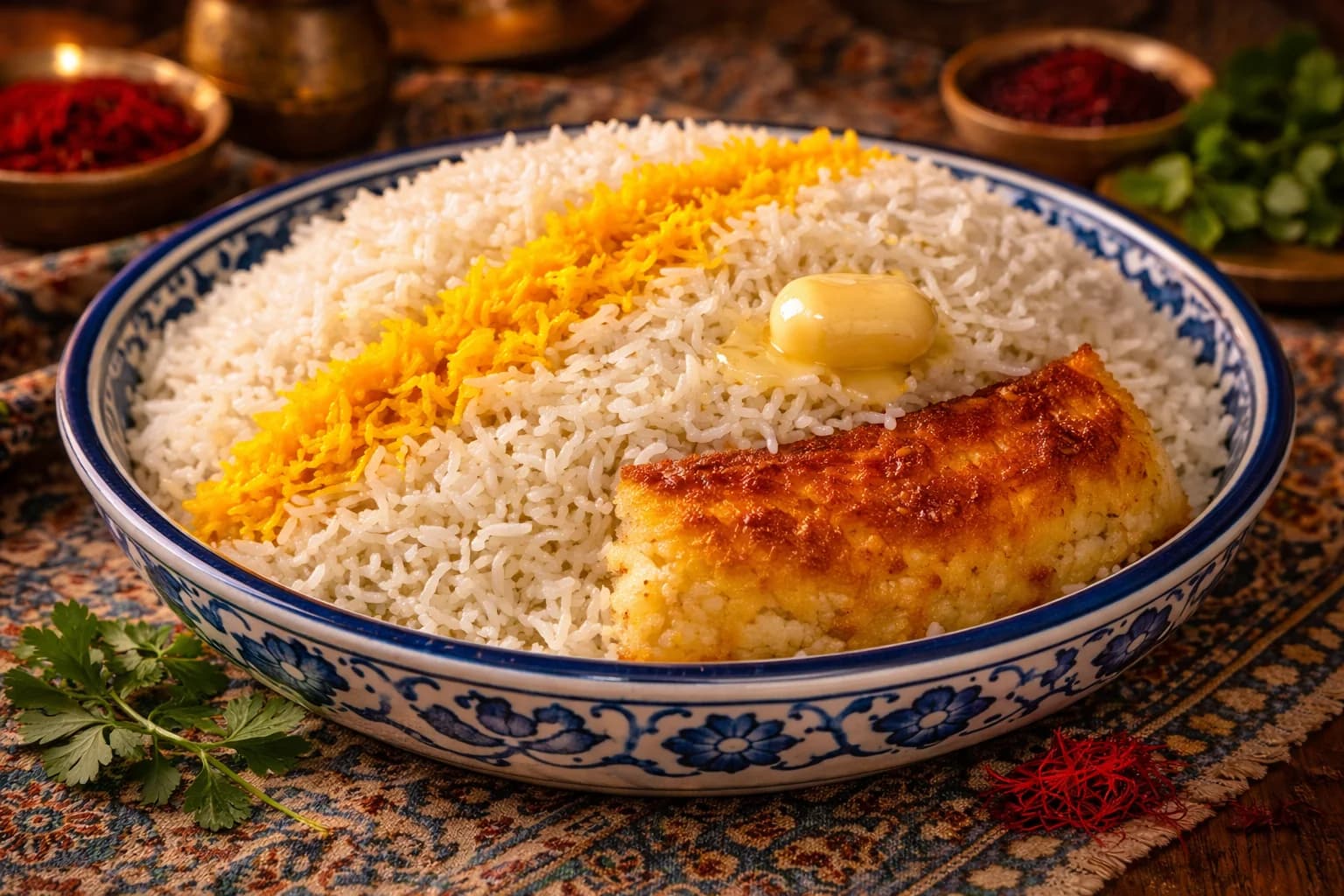
Verbleibendes Safranwasser für goldene Streifen über den Reis träufeln. Den Tahdig in Stücke brechen oder ganz neben dem Reis servieren. Nach persischer Sitte werden die besten Tahdig-Stücke den Ehrengästen angeboten.
Ruhezeit Erforderlich
5 Min - Damit sich der Tahdig von den Topfseiten für sauberes Lösen zusammenzieht