
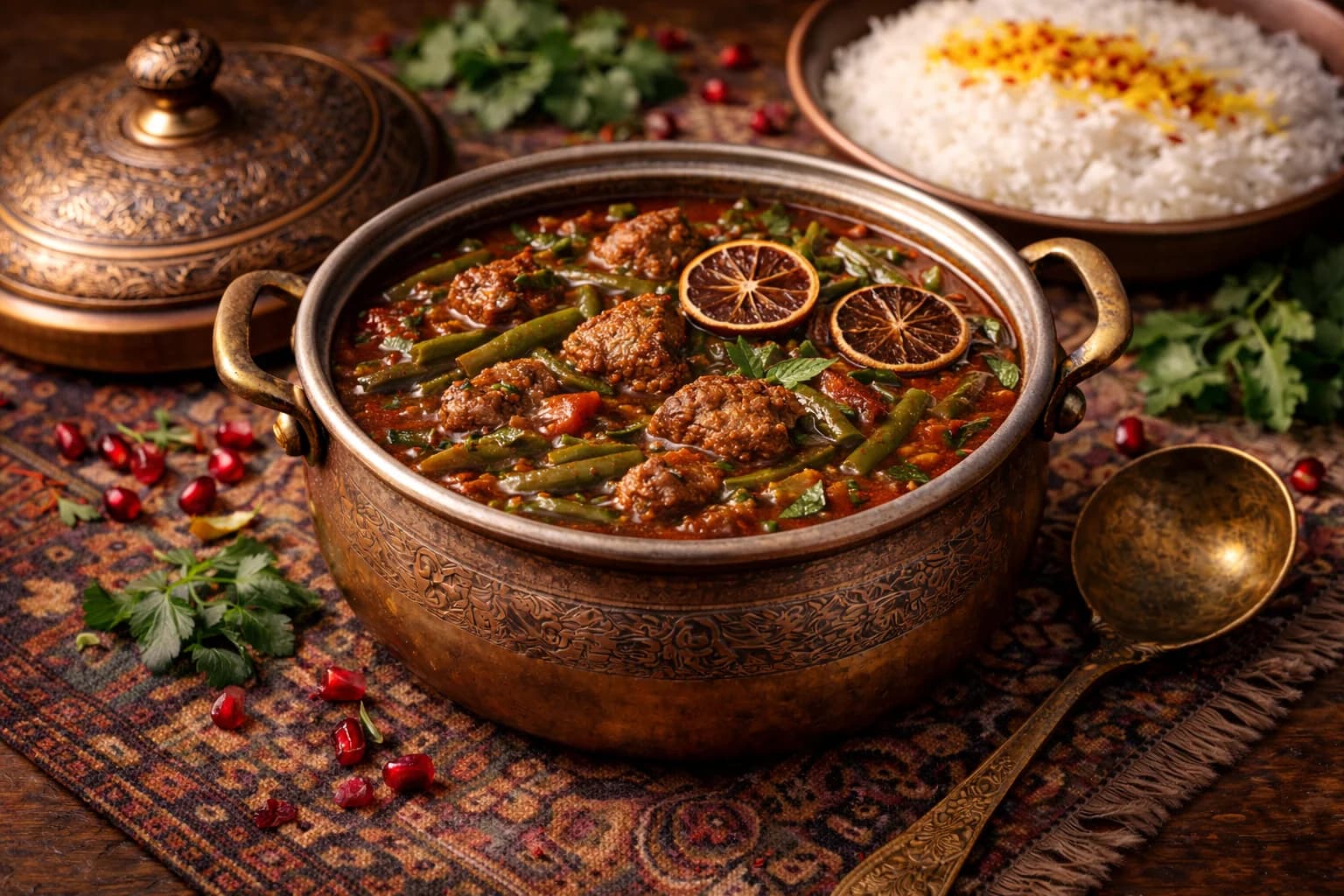
Khoresh-e Loobia Sabz (Persian Green Bean Stew)

Khoresh-e Loobia Sabz (Persian Green Bean Stew)

خورشت لوبیا سبز

A vibrant summer stew where tender green beans simmer in a rich tomato-turmeric sauce alongside succulent lamb, brightened by the distinctive tang of dried Persian limes. This everyday favorite transforms humble green beans into something deeply satisfying—proof that Persian cuisine elevates simple vegetables to star status.

stewPrep: 20 minCook: 105 mineasyServes 6

Cultural Note

Khoresh-e loobia sabz is quintessential Persian summer comfort food. When green beans flood the markets in warm months, this stew appears on tables across Iran. It's one of the first stews many Persian home cooks learn to make—simple enough for beginners yet satisfying enough for the whole family.

Critical Moments

  • Cooking tomato paste to remove raw flavor
  • Adding green beans at the right time (after meat is nearly tender)
  • Cooking beans until fully tender (not al dente)
1
PREP10 min

Prepare the green beans

Wash green beans and trim both ends. Cut on the diagonal into 4cm pieces. The diagonal cut creates more surface area for absorbing the flavorful sauce. Choose beans that snap cleanly when bent—this indicates freshness.

Uniform diagonal pieces, bright green color, clean snapping when cut
SmellFresh, grassy green bean aroma
SoundCrisp snapping when cutting fresh beans
TouchBeans feel firm and snap cleanly, not bendy
Don't cut beans too small—they'll overcook and become mushy. The 4cm length is ideal for maintaining some texture while becoming tender.

Common Mistakes

  • Cutting pieces too small (become mushy)
  • Using limp, bendy beans (less flavor, poor texture)
  • Leaving strings on older beans
Checkpoint: Beans should be uniform in size for even cooking
2
COOK15 min

Brown the onions

Heat oil in a large heavy pot over medium-high heat. Add diced onions and cook, stirring occasionally, until deep golden brown, about 12-15 minutes.

Onions are uniformly deep golden with caramelized edges, reduced significantly
Medium-High190°C / 375°F
SmellSweet, rich caramelized onion aroma
SoundSteady sizzling that softens as onions cook
Well-caramelized onions provide the flavor foundation—don't rush this step
3
COOK8 min

Add garlic, spices and brown the meat

Add minced garlic, turmeric, and cinnamon (if using), stir for 30 seconds until fragrant. Increase heat to high, add meat cubes in a single layer, and brown well on at least two sides, about 6-8 minutes total. Work in batches if needed to avoid crowding.

Meat has deep golden-brown crust; turmeric has colored everything warm yellow
High230°C / 450°F
SmellSearing meat with earthy turmeric and warm cinnamon
SoundStrong sizzling; meat releases when properly seared
TouchMeat releases easily from pot when crust has formed
Good browning develops deep flavor—don't skip or rush this step
4
COOK5 min

Build the tomato base

Reduce heat to medium. Add tomato paste and stir constantly for 2 minutes until darkened slightly. Add grated tomatoes and cook for another 3 minutes, stirring frequently, until tomatoes break down and raw smell disappears.

Tomato paste has darkened from bright red to deeper brick red; mixture is thick and glossy
Medium175°C / 350°F
SmellRaw tomato smell transforms to richer, sweeter aroma
SoundSizzling as tomatoes release moisture

Critical Step

Cooking the tomato paste removes raw, tinny flavors and develops sweetness. Undercooked tomato paste makes the final stew taste harsh and one-dimensional.

Keep stirring to prevent scorching on the pot bottom

Common Mistakes

  • Not cooking tomato paste long enough (harsh flavor)
  • Burning tomato paste (bitter taste)
  • Adding liquid too soon
5
COOK90 min

Add liquid and dried limes

Add water or stock, salt, and pepper. Pierce each dried lime 3-4 times with a sharp knife, then add to the pot. Bring to a boil, then reduce heat to low. Cover and simmer for 1.5 hours until meat is very tender.

Liquid has turned golden-orange from tomato and turmeric; dried limes are softening and sinking
LowGentle simmer ~120°C / 250°F
SmellTangy, distinctive citrus-fermented aroma from dried limes developing
SoundGentle, occasional bubbles
TouchMeat is becoming tender but not yet falling apart
For more intense sourness, break one dried lime open with the back of a spoon halfway through cooking
Checkpoint: After 45 minutes, meat should yield to a fork but still hold its shape
While waiting: This is a good time to prepare rice
6
COOK40 min

Add green beans

Add the prepared green beans to the pot, stirring gently to distribute them in the sauce. The beans should be mostly submerged. Add a splash more water if needed to barely cover the beans. Cover and continue simmering for 35-40 minutes.

Green beans have transformed from bright green to olive-khaki color; beans are fully tender
LowGentle simmer
SmellGreen beans have melded with the tomato-lime sauce
SoundGentle bubbling
TouchBeans are completely tender when pierced—no crunch remaining

Critical Step

Unlike Western preparations, Persian green beans should be fully tender—not al dente. This allows them to absorb the sauce flavors completely. Crunchy green beans are considered undercooked in this context.

Check beans at 30 minutes—cooking time varies based on bean thickness and freshness

Common Mistakes

  • Undercooking beans (should be fully tender, not crunchy)
  • Adding beans too early (become mushy)
  • Not adding enough liquid (beans cook unevenly)
Checkpoint: Beans should be completely tender with no resistance when bitten
7
FINISH10 min

Adjust seasoning and rest

Stir in bloomed saffron if using. Taste the stew and adjust salt, pepper, and sourness. If more tang is desired, add fresh lemon juice or break open another dried lime. The stew should have a pleasant tangy note from the dried limes. Remove from heat, cover, and let rest for 10 minutes.

Sauce has thickened slightly; oil visible on surface (correct and traditional); beans are tender throughout
SmellHarmonious blend of tomato, dried lime tang, and tender meat
TouchSauce coats a spoon; beans hold shape but are fully tender
The dried lime tang should be noticeable but not overwhelming—it's the signature flavor of this stew

Common Mistakes

  • Under-seasoning (stew tastes flat)
  • Not enough sour element (missing the characteristic tang)
  • Over-reducing sauce (too thick)
8
FINISH

Serve

Transfer to a serving dish. Serve hot over chelow (Persian steamed rice) with tahdig. The dried limes can be left in for presentation or removed—some diners enjoy squeezing them for extra sourness.

Rich orange-red sauce studded with olive-green beans and tender meat; dried limes visible
Serve extra dried limes on the side for those who want more tang

Resting Required

10 min - Allows sauce to thicken slightly and flavors to harmonize
Extras

Equipment

large heavy potstandard

Make Ahead

  • Excellent made 1-2 days ahead—flavors improve overnight.
  • Refrigerate up to 4 days.
  • Freezes well for up to 3 months; beans soften further but taste remains excellent.

Reheat gently over low heat, adding a splash of water if too thick.

Microwave works but stovetop preserves texture better.

Serve With

🍚Chelow (plain Persian steamed rice) with tahdig—simple rice showcases the stew

Sides

  • Mast-o-khiar
  • Sabzi khordan (fresh herb platter)
  • Shirazi salad

Drinks

  • Doogh
  • Black tea

Substitutions

dried limeZest of 2 limes + 2 tbsp lime juice, added in last 20 minutes. The unique fermented tang of dried limes is difficult to replicate but this approximates it.
fresh green beansFrozen green beans work in a pinch—add directly without thawing, reduce cooking time by 10 minutes. Fresh is strongly preferred.
lambBeef chuck works well; boneless chicken thighs reduce cooking time to 45 minutes total.

Scaling

Doubles easily with 20-30 minutes extra cooking time. Green bean to meat ratio is flexible based on preference. Freezes well for up to 3 months—beans soften slightly but flavor remains excellent.

Source

Traditional · Traditional home cooking

One of the most popular everyday stews in Iranian households, especially during summer when green beans are in season. Every family has their own variation—some add potatoes, others prefer it brothier.

Related Recipes