
Moments Critiques
- •Laver le riz jusqu'à ce que l'eau soit claire (5 à 6 fois)
- •Faire tremper dans l'eau salée (au moins 1 heure)
- •Précuire jusqu'au stade al dente exact (5 à 7 minutes, tester constamment)
- •Égoutter immédiatement quand c'est prêt
- •Former en pyramide avec canaux de vapeur
- •Envelopper le couvercle dans un torchon
- •Étuver au feu le plus bas (45 à 50 minutes, ne pas regarder)
- •Laisser reposer avant de démouler (5 minutes)
Choisir un riz de qualité
Pour de meilleurs résultats, utiliser du riz basmati vieilli (idéalement 1 à 2 ans). Le riz vieilli contient moins d'humidité, absorbe l'eau plus uniformément et cuit plus aérien. Chercher du basmati extra-long grain d'Inde ou du Pakistan.
Erreurs Courantes
- •Utiliser du riz non-basmati (ne s'allonge pas correctement)
- •Utiliser du riz de nouvelle récolte (résultats plus pâteux)
- •Utiliser du riz cassé (cuisson inégale)
Laver le riz soigneusement
Mettre le riz dans un grand saladier. Remplir d'eau froide, remuer vigoureusement avec la main pendant 30 secondes, puis égoutter. L'eau sera très trouble/laiteuse. Répéter 5 à 6 fois jusqu'à ce que l'eau soit presque claire. Cela élimine l'excès d'amidon de surface.
Étape Critique
Le lavage élimine l'excès d'amidon qui rendrait autrement le riz collant et pâteux. Le riz persan doit avoir des grains totalement individuels – cette étape n'est pas négociable. Un riz insuffisamment lavé n'atteindra jamais la bonne texture.
Erreurs Courantes
- •Ne pas laver suffisamment (riz collant)
- •Laver trop brusquement (grains cassés)
- •Sauter complètement cette étape
Faire tremper le riz dans l'eau salée
Dissoudre 2 c. à s. de sel dans 2 L d'eau tiède (pas chaude). Ajouter le riz lavé. Faire tremper au moins 1 heure, jusqu'à 3 heures. Le sel assaisonne le riz de l'intérieur et aide les grains à s'étendre lentement, prévenant la casse à la cuisson.
Étape Critique
Le trempage permet aux grains d'absorber lentement l'eau et de s'étendre avant la cuisson, ce qui empêche la casse pendant la précuisson vigoureuse. Le sel pénètre dans le grain pour un assaisonnement uniforme. Un riz non trempé cuit de façon inégale et se casse.
Erreurs Courantes
- •Sauter le trempage (le riz se casse, cuisson inégale)
- •Oublier le sel dans l'eau de trempage (riz fade)
- •Utiliser de l'eau chaude (la couche extérieure cuit prématurément)
- •Tremper trop brièvement
Faire infuser le safran
Moudre les filaments de safran avec une petite pincée de sucre au mortier jusqu'à obtenir une poudre. Le sucre agit comme un abrasif pour briser les filaments. Mettre dans un petit bol, ajouter 3 c. à s. d'eau chaude (pas bouillante). Couvrir et laisser infuser au moins 30 minutes.
Étape Critique
Le broyage libère les composés de couleur et d'arôme du safran. Les filaments non broyés libèrent la couleur de manière inégale et beaucoup plus lentement. L'infusion extrait un maximum de couleur et de saveur de cette épice précieuse.
Porter l'eau de cuisson à ébullition
Remplir une grande marmite d'eau. Ajouter le sel – l'eau doit être nettement salée au goût, comme l'eau de mer. Porter à ébullition vive à feu vif.
Étape Critique
L'eau bouillante salée assaisonne le riz pendant la cuisson. Une eau insuffisamment salée donne un riz fade qu'aucun assaisonnement ultérieur ne peut rattraper. Le sel pénètre pendant ce bref temps de cuisson.
Précuire le riz
Égoutter délicatement le riz trempé. Le verser dans l'eau bouillante. Remuer très délicatement une seule fois pour éviter que ça colle. Cuire 5 à 7 minutes en testant fréquemment à partir de 4 minutes. Le riz est prêt quand il est al dente : tendre à l'extérieur, mais avec un minuscule cœur ferme quand on croque.
Étape Critique
C'est le moment le plus critique du riz persan. Un riz sous-cuit sera dur dans le plat final. Un riz trop cuit sera pâteux et ne pourra pas être sauvé. Le stade al dente – tendre à l'extérieur, minuscule cœur ferme – est indispensable car le riz finit de cuire à l'étuvage.
Erreurs Courantes
- •Ne pas tester assez fréquemment
- •Trop cuire (riz pâteux au final – irrattrapable)
- •Sous-cuire (riz dur)
- •Trop remuer (casse les grains)
Égoutter immédiatement
Au moment où le riz est al dente, égoutter dans une passoire fine. Rincer très brièvement à l'eau tiède pour arrêter la cuisson et éliminer l'amidon de surface. Secouer délicatement – ne pas presser ni comprimer.
Étape Critique
Chaque seconde compte. Le riz continue de cuire dans l'eau chaude. Un égouttage immédiat arrête la cuisson au moment parfait. Le rinçage tiède (pas froid – ça choquerait le grain ; pas chaud – ça poursuivrait la cuisson) élimine l'excès d'amidon pour des grains individuels.
Préparer la cocotte pour le tahdig
Dans une cocotte antiadhésive (indispensable pour le démoulage du tahdig), mélanger l'huile (ou le beurre fondu) avec l'eau safranée. Incliner pour couvrir le fond uniformément.
Mettre en place la couche de tahdig
Prendre environ 2 tasses de riz précuit et mélanger avec l'eau safranée dans un petit bol. Étaler ce riz safrané uniformément sur l'huile au fond de la cocotte et presser délicatement en une couche plate et régulière d'environ 1 cm d'épaisseur.
Étape Critique
Cette couche deviendra le tahdig. Une épaisseur uniforme assure un croustillant uniforme. Trop épaisse et elle ne croustille pas à cœur ; trop fine et elle brûle. Le safran donne couleur et saveur à la croûte tant convoitée.
Ajouter le riz restant
Déposer le reste du riz blanc à la cuillère sur la couche de tahdig en formant une pyramide ou un monticule. NE PAS presser – le riz doit rester aérien et léger. La forme en pyramide permet une circulation uniforme de la vapeur.
Étape Critique
La forme en pyramide est indispensable pour un étuvage uniforme. Du riz tassé à plat étuve de façon inégale – le fond devient pâteux tandis que le dessus reste cru. Les poches d'air entre les grains permettent à la vapeur de pénétrer.
Erreurs Courantes
- •Tasser le riz à plat (étuvage inégal)
- •Comprimer trop fermement (riz pâteux)
- •Faire le monticule trop large et plat
Percer les canaux de vapeur
Avec le manche d'une cuillère en bois ou une baguette, percer 5 à 6 trous à travers le monticule de riz jusqu'à la couche de tahdig. Ces trous permettent à la vapeur de s'échapper et empêchent le riz de devenir gorgé d'eau.
Étape Critique
Les canaux de vapeur empêchent la condensation de s'accumuler dans le riz et de le rendre pâteux. Ils permettent à la vapeur de s'échapper uniformément et assurent une cuisson homogène.
Arroser de beurre et de safran
Faire fondre le beurre et le mélanger avec l'eau safranée restante. Verser uniformément cette mixture sur la pyramide de riz, en la laissant couler dans les canaux de vapeur et sur la surface.
Lancer la formation du tahdig (phase haute température)
Poser la cocotte à feu moyen-vif sans couvercle. Cuire 3 à 4 minutes jusqu'à ce que de la vapeur monte du riz. On entend un léger grésillement venant du fond – c'est le tahdig qui commence à se former.
Étape Critique
Cette phase initiale à haute température met en place la croûte du tahdig. Sans elle, le fond croustillant caractéristique ne se forme pas. Le grésillement indique que la croûte se forme.
Envelopper le couvercle
Envelopper complètement un torchon propre (coton, pas éponge) autour du couvercle de la cocotte, en attachant et sécurisant les coins en haut au niveau de la poignée. Le torchon doit être bien fixé pour qu'il ne pende pas vers le bas en direction de la flamme ou de l'élément chauffant.
Étape Critique
Le torchon absorbe la condensation qui sinon retomberait sur le riz et le rendrait pâteux. C'est le secret persan pour un riz aérien – torchon humide, riz sec. Sans lui, le riz étuve dans sa propre condensation.
Erreurs Courantes
- •Omettre le torchon (riz pâteux)
- •Le torchon pend près de la flamme (risque d'incendie !)
- •Utiliser un torchon synthétique (fond, n'absorbe pas)
Étuver à feu le plus bas
Poser le couvercle enveloppé fermement sur la cocotte. Réduire le feu au minimum absolu. Étuver 35 à 50 minutes sans soulever le couvercle. Le temps varie selon la cuisinière et la cocotte – à partir de 35 minutes, se fier à l'odeur. Le riz finit de cuire à la vapeur douce tandis que le tahdig croustille lentement.
Étape Critique
Cette phase d'étuvage lent est là où la magie opère. Le riz finit de cuire pour une aération parfaite tandis que le tahdig devient lentement doré et croustillant. Soulever le couvercle laisse échapper la vapeur et prolonge le temps de cuisson de 10 minutes. Un feu trop vif brûle le tahdig avant que le riz ne soit cuit.
Erreurs Courantes
- •Soulever le couvercle (la vapeur s'échappe, prolonge la cuisson)
- •Feu trop vif (brûle le tahdig avant que le riz soit cuit)
- •Feu trop bas (pas de tahdig ne se forme)
- •Pas assez de temps (riz pas complètement cuit)
Laisser reposer avant de servir
Retirer la cocotte du feu. Garder le couvercle et laisser reposer 5 minutes. Cela permet au tahdig de se rétracter légèrement des parois de la cocotte et facilite le démoulage.
Étape Critique
Le repos permet au tahdig de se rétracter légèrement des parois en refroidissant. Essayer de démouler un tahdig encore brûlant fait souvent qu'il colle ou se casse.
Aérer et servir le riz
Ôter le couvercle. Avec une fourchette (jamais une cuillère – elle comprime), aérer délicatement le riz blanc en soulevant et séparant les grains. Déposer le riz aéré à la cuillère sur un plat de service en ne touchant pas au tahdig au fond.
Démouler le tahdig
Prendre une assiette légèrement plus grande que la cocotte. La poser à l'envers sur l'ouverture de la cocotte. Tenir fermement la cocotte et l'assiette ensemble et retourner d'un geste résolu. Tapoter quelques fois sur le fond de la cocotte, puis soulever la cocotte droit vers le haut. Le tahdig devrait se démouler en un disque doré et croustillant.
Étape Critique
C'est le moment pour lequel vit tout cuisinier persan. Un tahdig parfaitement démoulé est l'accomplissement ultime. La résolution au moment du retournement est importante – l'hésitation cause des fissures.
Erreurs Courantes
- •Retournement hésitant (le tahdig se casse)
- •Ne pas laisser reposer (ça colle)
- •Forcer un tahdig coincé (ça déchire)
Servir
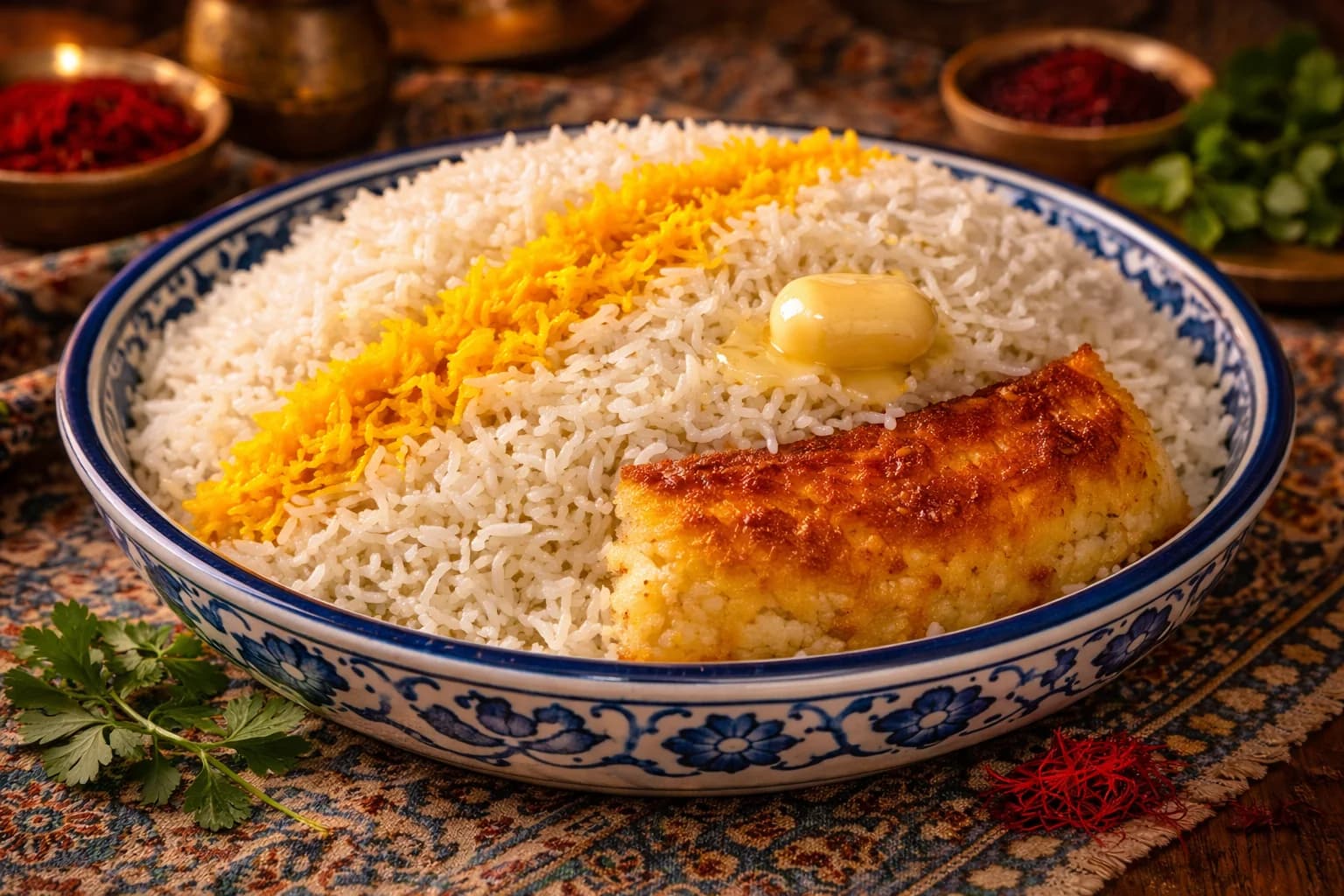
Verser un filet d'eau safranée restante pour des stries dorées sur le riz. Casser le tahdig en morceaux ou le servir entier à côté du riz. Selon la coutume persane, les meilleurs morceaux de tahdig sont offerts aux invités d'honneur.
Repos Requis
5 min - Pour que le tahdig se rétracte des parois pour un démoulage propre