
Moments Critiques
- •Ratio d'eau correct (1:1,5 riz/eau)
- •Reconnaître le stade des cratères
- •Feu le plus bas possible pour la phase de cuisson vapeur
- •Ne pas soulever le couvercle pendant la cuisson
Laver le riz
Placer le riz dans un saladier. Remplir d'eau froide, remuer avec la main et égoutter. Répéter trois à quatre fois jusqu'à ce que l'eau soit presque claire. Contrairement au polo, le riz pour le kateh n'a pas besoin d'être lavé aussi soigneusement : un peu d'amidon aide les grains à se tenir légèrement.
Facultatif : trempage rapide
Pour un kateh légèrement plus aérien, tremper le riz lavé dans de l'eau fraîche pendant 30 minutes. Égoutter avant la cuisson. Cette étape est facultative : le kateh traditionnel saute souvent le trempage entièrement.
Infuser le safran (si utilisé)
Moudre le safran avec une pincée de sucre. Laisser infuser dans de l'eau chaude au moins 15 minutes.
Assembler le riz, l'eau et les assaisonnements
Dans une marmite antiadhésive, réunir le riz égoutté, l'eau (qui doit couvrir le riz de 2 à 3 cm), le sel et l'huile (ou le beurre). Si le safran est utilisé, ajouter l'eau safranée. Remuer une fois pour répartir uniformément.
Étape Critique
Le ratio d'eau est crucial pour le kateh. Trop d'eau = riz pâteux. Trop peu = fond brûlé et dessus pas cuit. Le ratio 1:1,5 (riz/eau en volume) est le standard.
Porter à ébullition
Poser la marmite à feu vif. Porter à ébullition en remuant une ou deux fois pour éviter que ça colle. Laisser bouillir à découvert 3 à 5 minutes jusqu'à ce que la majeure partie de l'eau soit absorbée et que de petits trous (comme des cratères) se forment à la surface.
Étape Critique
Le stade des cratères indique que l'eau a été absorbée et qu'il est temps de baisser le feu. Rater ce moment entraîne du riz brûlé ou un dessus pas cuit.
Ajouter le reste d'huile pour le tahdig
Verser en filet le reste d'huile (et le reste d'eau safranée si utilisée) sur les bords et sur le dessus du riz. Cela favorise la formation du tahdig.
Envelopper le couvercle et cuire à la vapeur au feu le plus bas
Envelopper le couvercle dans un torchon propre (nouer les coins sur le dessus, à l'écart de la chaleur). Poser hermétiquement sur la marmite. Réduire le feu au minimum absolu. Cuire 35 à 45 minutes sans soulever le couvercle.
Étape Critique
Le feu doux permet au riz de cuire doucement à la vapeur tandis que le fond forme lentement un tahdig épais. Un feu trop fort brûle le fond avant que le dessus ne soit cuit. Le torchon absorbe la condensation.
Erreurs Courantes
- •Feu trop fort (brûle avant que le dessus ne cuise)
- •Soulever le couvercle (libère la vapeur)
- •Pas assez de temps (pas cuit, pas de tahdig)
Laisser reposer avant de servir
Retirer du feu. Garder le couvercle et laisser reposer 5 à 10 minutes. Cela permet au tahdig de se rétracter des parois de la marmite.
Servir avec le tahdig
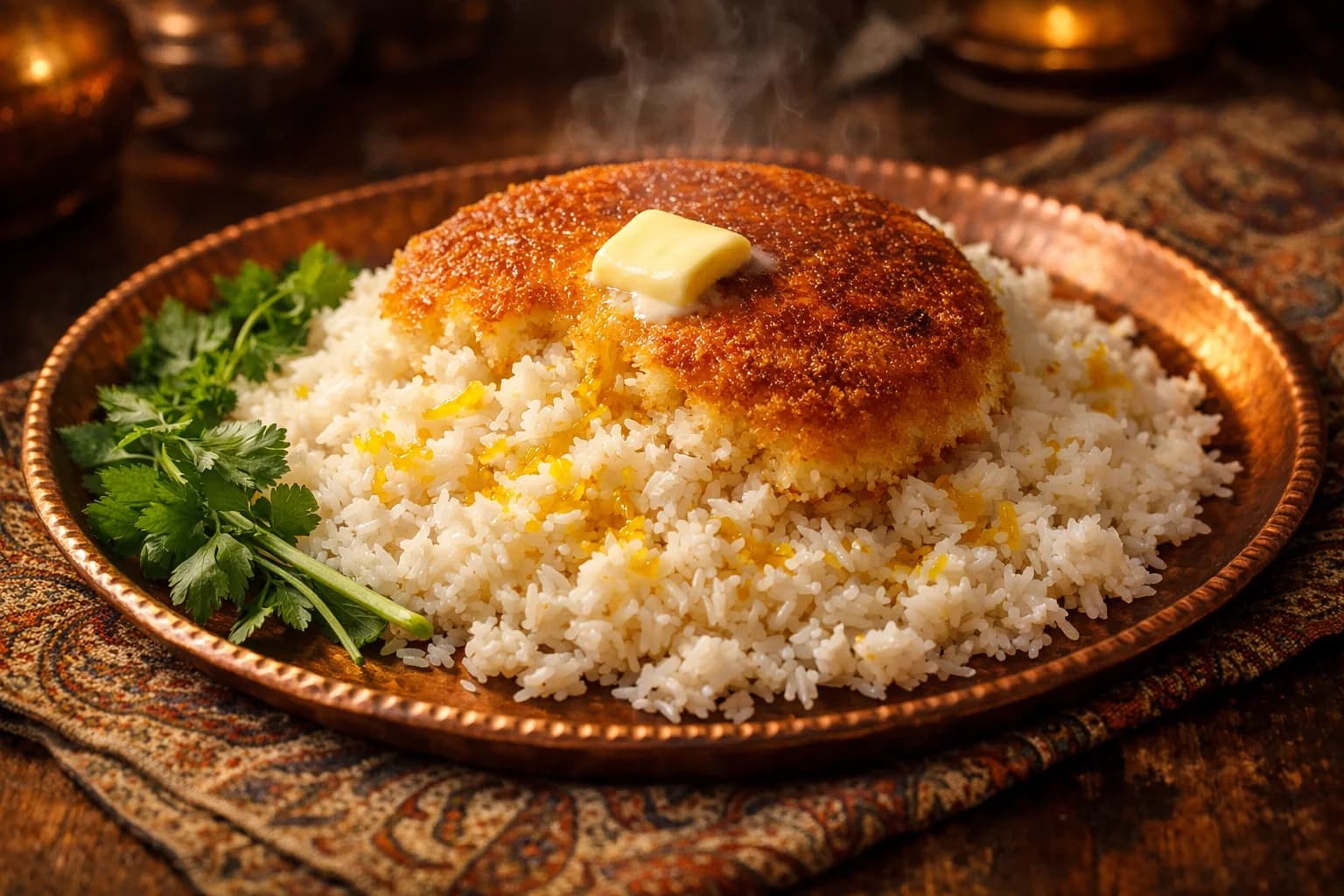
Retirer le couvercle. Le riz sera tendre et légèrement collant, pas aussi aérien que le chelow. Servir le riz dans les assiettes. Pour retirer le tahdig : passer une spatule le long des bords, puis retourner la marmite sur une assiette ou soulever le tahdig doré-brun épais en morceaux avec une spatule.
Repos Requis
7 min - Permet au tahdig de se rétracter pour un démoulage plus facile