
Moments Critiques
- •Remuer le yaourt constamment pendant le chauffage
- •Ne jamais laisser la sauce bouillir vigoureusement
- •Utiliser le safran généreusement pour la couleur et la saveur
- •Servir immédiatement — ne se conserve pas et ne se réchauffe pas bien
Faire infuser le safran
Moudre les filaments de safran avec une pincée de sucre dans un mortier jusqu'à obtenir une poudre. Transférer dans un petit bol, ajouter 4 c. à s. d'eau chaude (non bouillante), couvrir et laisser infuser au moins 30 minutes. Ce plat nécessite une quantité généreuse de safran — ne pas réduire la dose.
Étape Critique
Le safran n'est pas optionnel dans ce plat — il donne la couleur dorée caractéristique et la saveur inimitable. En mettre moins donne un ragoût pâle et fade qui rate son objectif.
Préparer le mélange des boulettes
Râper l'oignon sur une râpe à gros trous, puis presser fermement au-dessus de l'évier pour retirer l'excès de liquide. Dans un bol, combiner l'agneau haché, l'oignon râpé, le curcuma, la moitié de la cannelle (¼ c. à c.), ½ c. à c. de sel et une pincée de poivre blanc. Mélanger soigneusement à la main 2-3 minutes jusqu'à ce que le mélange soit homogène et légèrement collant.
Étape Critique
Presser le liquide de l'oignon évite des boulettes détrempées et fragiles. Un mélange minutieux développe les protéines de myosine qui aident les boulettes à tenir dans la sauce.
Erreurs Courantes
- •Ne pas presser l'oignon (boulettes aqueuses)
- •Mélanger insuffisamment (les boulettes se défont)
- •Viande trop maigre (boulettes sèches)
Former les boulettes
Avec les mains mouillées, former le mélange en petites boules d'environ 2,5 cm de diamètre — à peu près la taille d'une noix. Vous devriez obtenir environ 24-30 boules. Disposer sur une assiette, couvrir et réfrigérer 20 minutes pour les raffermir.
Préparer le mélange de yaourt stabilisé
Dans un grand bol, fouetter le yaourt, les jaunes d'œufs, la farine et l'eau jusqu'à obtenir un mélange homogène sans grumeaux. La farine et les jaunes d'œufs stabilisent le yaourt et empêchent le caillage. Ajouter le reste de la cannelle, la cardamome (si utilisée), 1 c. à c. de sel, le poivre blanc et le sucre. Fouetter à nouveau jusqu'à homogénéité.
Étape Critique
La farine et les jaunes d'œufs sont des stabilisateurs essentiels — ils empêchent le yaourt de cailler au chauffage. Des grumeaux de farine signifient une stabilisation inégale et un risque de caillage. Un fouettage minutieux est non négociable.
Erreurs Courantes
- •Omettre la farine (le yaourt caille)
- •Utiliser du yaourt grec (trop épais, texture différente)
- •Ne pas fouetter assez (grumeaux dans la sauce)
Chauffer la sauce au yaourt
Verser le mélange de yaourt dans une grande cocotte épaisse. Placer à feu moyen-doux. Remuer constamment et continuellement pendant que le mélange chauffe. C'est essentiel — arrêter de remuer provoque des dépôts au fond.
Étape Critique
C'est l'étape la plus critique. Le yaourt caille à la fois par une chaleur trop forte ET par un manque de remuage. Vous devez remuer constamment à feu doux. Dès que vous arrêtez ou que le feu est trop fort, la sauce peut tourner.
Erreurs Courantes
- •Feu trop fort (caille)
- •Arrêter de remuer (caille au fond)
- •Précipiter cette étape
- •Utiliser une casserole fine (les points chauds provoquent le caillage)
Porter à léger frémissement
Continuer à remuer pendant que le mélange chauffe. Après environ 10 minutes, il devrait atteindre un très léger frémissement — de petites bulles qui percent occasionnellement la surface. La sauce sera légèrement épaissie. Une fois ce point atteint, réduire le feu au minimum.
Étape Critique
Une fois stabilisée, la sauce peut mijoter doucement, mais une ébullition vigoureuse provoque tout de même la séparation. La sauce est stable mais pas indestructible.
Ajouter le safran et les boulettes
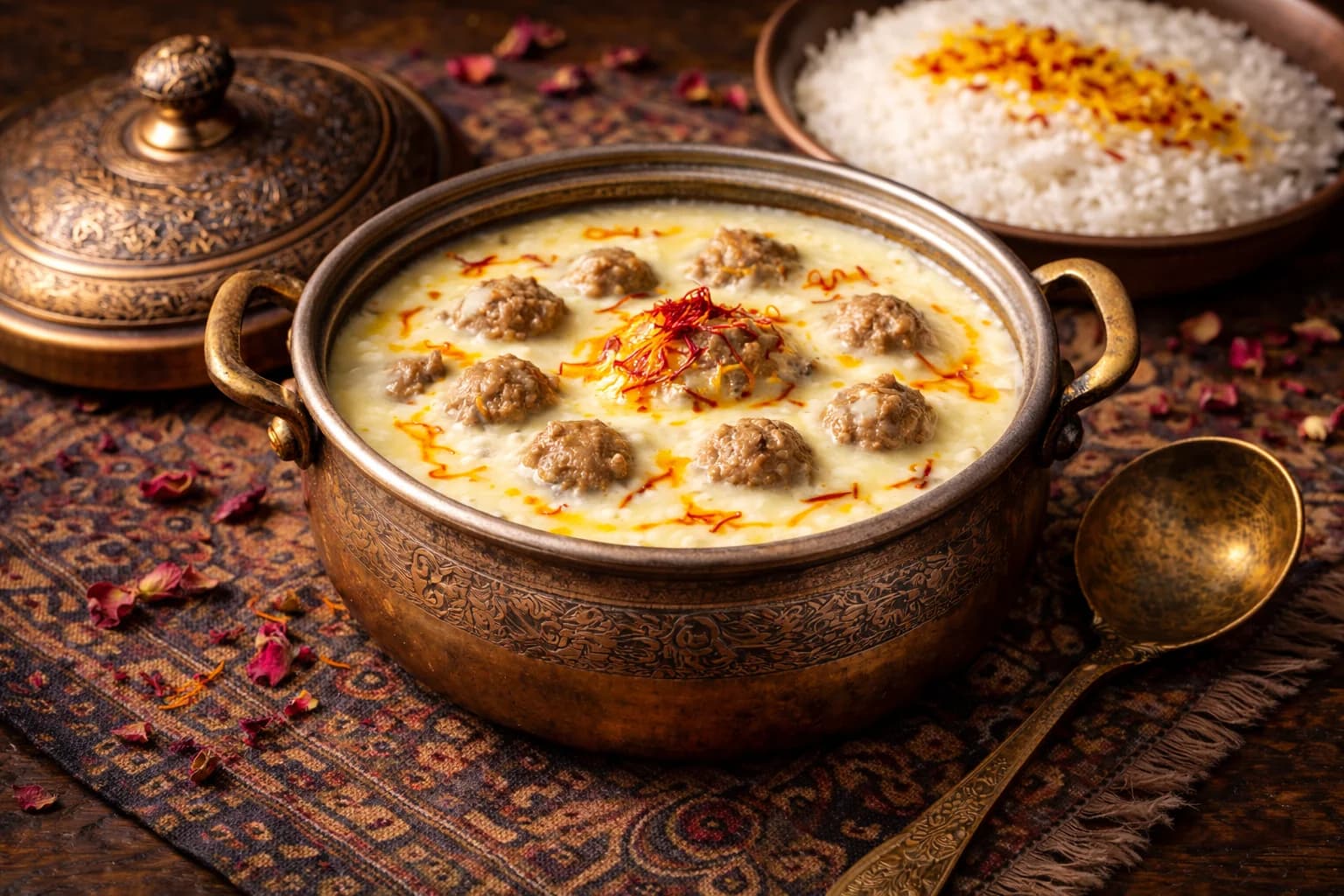
Incorporer le safran infusé — la sauce deviendra magnifiquement dorée. Faire glisser délicatement les boulettes une par une dans la sauce, en les répartissant uniformément. Ne pas remuer vigoureusement après l'ajout — juste faire tourner doucement la cocotte de temps en temps.
Erreurs Courantes
- •Remuer vigoureusement (émiette les boulettes)
- •Placer les boulettes trop serrées (ne cuisent pas uniformément)
Laisser mijoter les boulettes
Couvrir la cocotte avec le couvercle légèrement entrouvert. Laisser mijoter très doucement 30-35 minutes, en retournant délicatement les boulettes à mi-cuisson avec une écumoire. Les boulettes doivent être cuites à cœur et la sauce soyeuse.
Ajouter le beurre et les pétales de rose séchés
Ajouter le beurre et faire tourner doucement la cocotte pour l'incorporer en fondant. Si vous utilisez des pétales de rose séchés, les écraser légèrement et les ajouter maintenant. Goûter et ajuster le sel, le sucre (pour la douceur) et le poivre blanc. La sauce doit être subtilement sucrée avec des notes acidulées.
Laisser reposer et garnir
Retirer du feu et laisser reposer à couvert 5 minutes. Transférer délicatement dans un plat de service — la sauce dorée pâle doit se répartir joliment autour des boulettes. Garnir généreusement d'amandes effilées grillées, de pistaches et d'épine-vinette sautée si utilisée.
Servir
Servir immédiatement avec du chelow (riz persan) et tahdig. Ce ragoût doit être servi dès qu'il est prêt — il ne se conserve pas bien et ne se réchauffe pas bien à cause de la sauce au yaourt.
Erreurs Courantes
- •Préparer trop à l'avance (la sauce peut se séparer)
- •Réchauffer trop agressivement (la sauce caille)
Repos Requis
5 min - Un bref repos permet aux saveurs de s'harmoniser sans que la sauce ne refroidisse trop