
Moments Critiques
- •Accepter la pâte très humide (ne pas ajouter de farine)
- •Longue fermentation pour le développement des arômes
- •Four/galets extrêmement chauds
- •Façonnage fin et irrégulier (accepter le côté rustique)
- •Cuisson rapide avec carbonisation caractéristique
Mélanger la pâte
Dans un grand saladier ou au robot pâtissier, mélanger la farine de blé complet, la farine à pain, la levure et le sel. Ajouter l'eau tiède et mélanger jusqu'à obtenir une pâte très humide, collante, semblable à une pâte à gâteau épaisse. Cette pâte est beaucoup plus humide qu'une pâte à pain classique. Mélanger 3 à 4 minutes jusqu'à ce qu'elle soit relativement lisse, bien qu'elle reste collante.
Étape Critique
La pâte du sangak est intentionnellement très humide (haute hydratation) — c'est ce qui crée la mie ouverte et alvéolée et la texture distinctive. Ne pas ajouter de farine ; accepter le côté collant.
Erreurs Courantes
- •Ajouter de la farine parce que la pâte semble trop humide (ne pas le faire — elle doit être humide)
- •S'attendre à une pâte pétrissable (c'est plutôt comme une pâte à gâteau épaisse)
Longue fermentation
Couvrir le saladier de film alimentaire ou d'un linge humide. Laisser fermenter à température ambiante pendant au moins 3 à 4 heures, ou réfrigérer toute la nuit (jusqu'à 24 heures) pour plus de développement aromatique. La pâte doit au moins doubler de volume et devenir bulleuse et active.
Étape Critique
La longue fermentation développe l'arôme complexe, légèrement acide qui distingue le sangak. Une fermentation courte produit un pain fade. Ce n'est pas un pain rapide — l'attente est essentielle.
Préparer les galets (méthode traditionnelle)
Si on utilise des galets : laver soigneusement les galets de rivière et les sécher. Les étaler en une seule couche sur une plaque de cuisson à rebords. Placer dans le four et préchauffer à température maximale pendant au moins 45 minutes. Les galets doivent être extrêmement chauds.
Alternative : préchauffer la pierre à pizza
Sans galets : placer une pierre à pizza ou une plaque en acier sur la grille du milieu. Préchauffer le four à température maximale pendant au moins 45 minutes. Placer une petite casserole d'eau sur la grille du bas pour créer de la vapeur.
Préparer le façonnage
Huiler généreusement les mains et le plan de travail (ou utiliser des mains mouillées — les boulangers traditionnels utilisent de l'eau). Avoir un bol d'eau à proximité. Préparer une feuille de papier cuisson de la taille de la surface de cuisson. Avoir les graines de sésame prêtes à saupoudrer.
Façonner le sangak
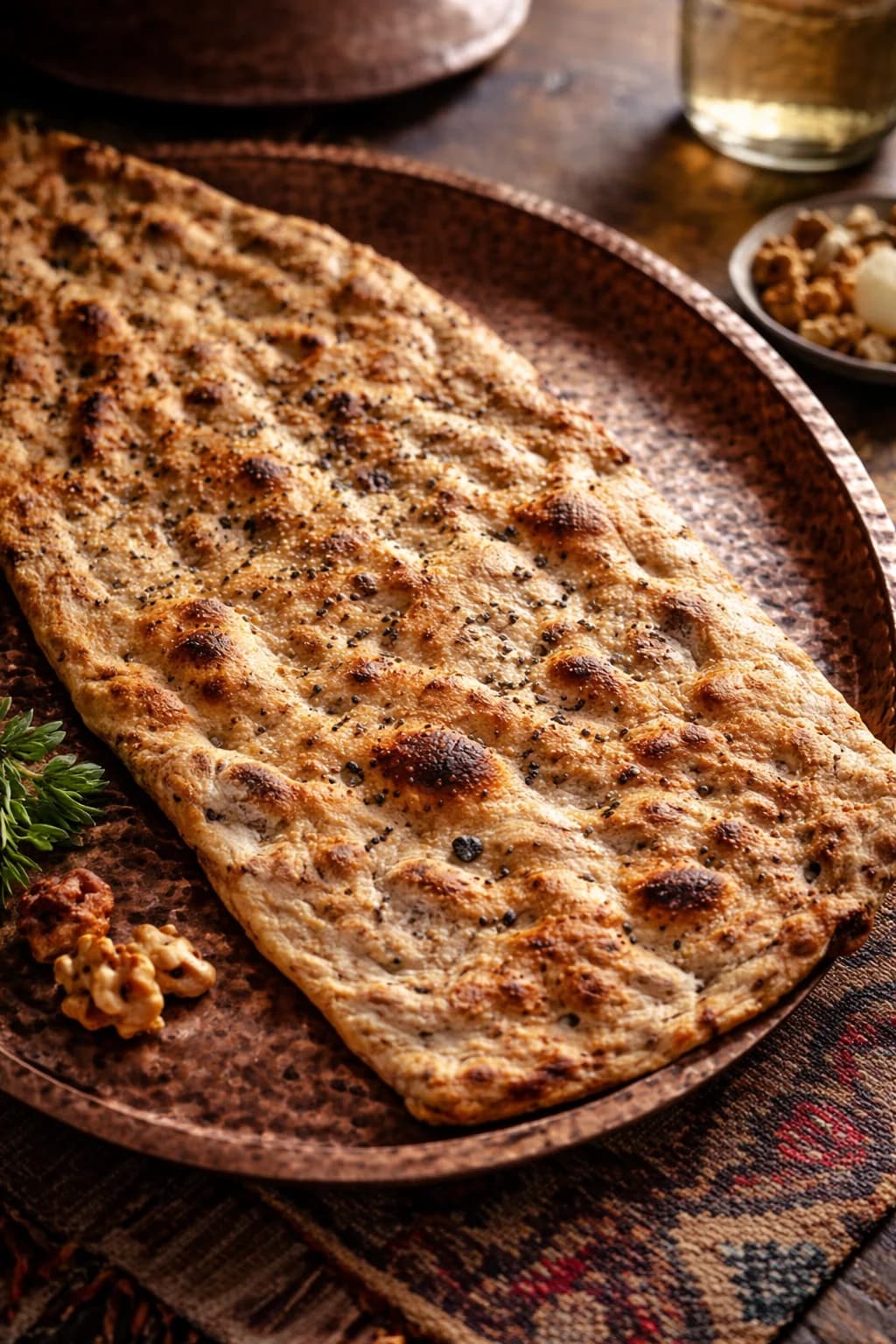
Avec les mains bien huilées, prélever environ un quart de la pâte (elle sera très collante). L'étirer délicatement en une forme ovale ou triangulaire grossière, en laissant la gravité aider. La pâte doit être fine mais aura des endroits épais et fins. Transférer sur le papier cuisson. La forme doit être rustique et irrégulière — c'est traditionnel.
Étape Critique
Le sangak est censé être fin et irrégulier. Les endroits épais et fins, les trous et les bords inégaux sont des qualités, pas des défauts. Ne pas essayer de le rendre uniforme — accepter la nature rustique.
Ajouter les garnitures
Parsemer les graines de sésame (et de pavot si utilisées) sur la pâte façonnée. Les presser doucement dans la surface. Piquer la surface du bout des doigts pour créer les marques caractéristiques.
Cuire sur les galets (traditionnel)
Si on utilise des galets : faire glisser délicatement la pâte façonnée (sur le papier cuisson) directement sur les galets chauds. La pâte s'enfoncera dans les galets, créant le dessous alvéolé caractéristique. Cuire jusqu'à ce que le pain gonfle, forme des cloques et soit carbonisé par endroits. Surveiller attentivement — cela va vite.
Étape Critique
Les galets créent le dessous alvéolé signature du sangak et sa texture unique. La haute température et le temps de cuisson court produisent les cloques et la carbonisation caractéristiques.
Cuire sur pierre (alternative)
Si on utilise une pierre à pizza : vaporiser légèrement la pâte façonnée avec de l'eau. Glisser la pâte (sur le papier cuisson) sur la pierre chaude. Cuire jusqu'à ce que le pain gonfle, forme des cloques et soit doré avec des taches plus foncées. Vaporiser à nouveau à mi-cuisson pour plus de vapeur.
Laisser refroidir et servir
Transférer le sangak cuit sur une grille. Il crépite et devient croustillant en refroidissant légèrement. Servir dans les quelques heures tant qu'il est encore frais — le sangak est meilleur le jour même. Déchirer en morceaux ; l'épaisseur variable crée des textures différentes à chaque bouchée.
Repos Requis
210 min - Longue fermentation indispensable pour les arômes ; minimum 3 heures, idéalement toute la nuit