
Ranginak (Persian Date and Walnut Dessert)

Ranginak (Persian Date and Walnut Dessert)

رنگینک

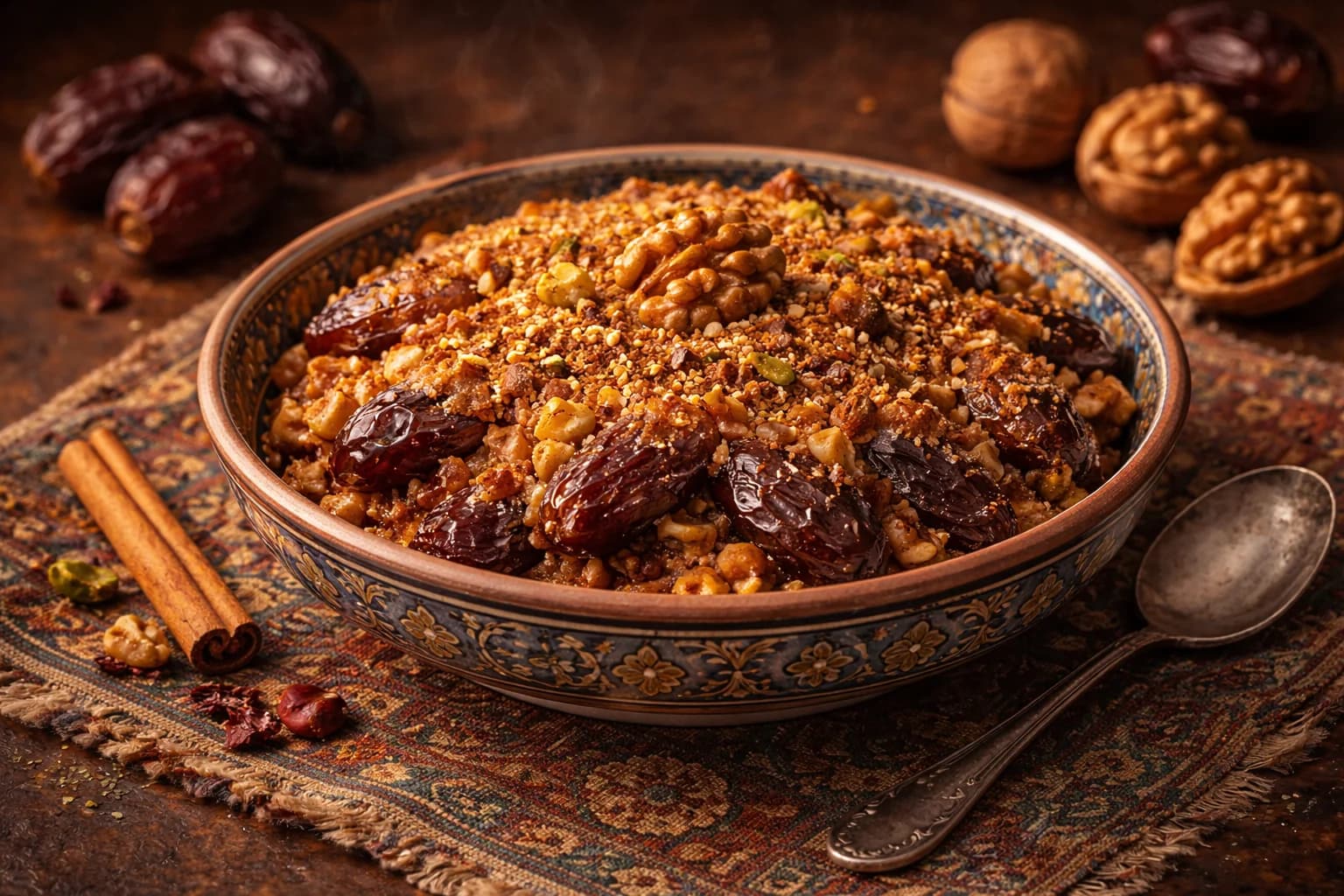
A luscious, no-bake dessert from the Persian Gulf coast—layers of sweet dates stuffed with walnuts, pressed together and blanketed with a golden, aromatic fried flour mixture fragrant with cardamom and cinnamon. This ancient delicacy from Bushehr province transforms humble dates into something extraordinary. The name means 'colorful' in Persian, though the dessert is actually a study in warm browns and golds. Rich, satisfying, and deeply flavored, ranginak is beloved throughout Iran, especially during Ramadan and religious occasions.

dessertVorbereitung: 40 MinKochen: 20 MineasyFür 12

Kultureller Hinweis- Bushehr

Ranginak originates from Bushehr province on the Persian Gulf coast, where date palms flourish in the hot climate. The name 'ranginak' means 'colorful,' though the dessert features warm earth tones—perhaps referring to the festive occasions when it's served. This is quintessential Ramadan food, offered to break the fast and shared with guests during the holy month. The combination of energy-dense dates and protein-rich walnuts makes it perfect for iftar (breaking the fast). The fried flour topping, similar to halva, transforms simple stuffed dates into something special. Ranginak is also popular at religious gatherings, memorial services, and Nowruz celebrations. Its long shelf life made it practical for sharing and gifting.

Kritische Momente

  • Using soft, pliable dates
  • Packing dates tightly with no gaps
  • Toasting flour long enough (golden-brown, nutty)
  • Spreading topping while still warm
  • Allowing to set completely before cutting
1
VORBEREITUNG25 Min

Stuff the dates with walnuts

If the dates still have pits, remove them by making a lengthwise slit and extracting the pit, keeping the date as intact as possible. Insert a walnut half into each date, pressing gently to close around the walnut. The walnut should be mostly enclosed but can peek out slightly. Repeat with all dates.

Dates plump with walnuts visible at the slit; uniform size
GeruchSweet dates and earthy walnuts
TexturDates are soft and pliable; walnuts firm
Use soft, sticky dates for best results—they press together well. If dates are dry, steam them briefly or spritz with water to soften. Medjool dates are ideal for their large size and soft texture.

Häufige Fehler

  • Using dry, hard dates (won't stick together)
  • Overstuffing (dates split open)
2
VORBEREITUNG5 Min

Arrange dates in dish

Lightly grease an 8x8 inch or 9x13 inch baking dish (or use a flat serving platter). Arrange the stuffed dates in a single layer, pressing them together tightly so they form a cohesive base with no gaps. The dates should be touching and slightly compressed.

Tightly packed layer of stuffed dates with no visible gaps
GeruchSweet dates
TexturFirm, compressed layer

Kritischer Schritt

The dates must be packed tightly so the topping adheres and the dessert can be cut into pieces. Gaps result in loose, crumbly ranginak.

Press down firmly with your palm to compress the dates into an even layer. They should stick together naturally due to their stickiness.
3
KOCHEN18 Min

Toast the flour in butter

In a large skillet, melt the butter over medium-low heat. Add the flour and stir constantly with a wooden spoon or spatula. Continue cooking and stirring for 15-20 minutes until the mixture turns golden-brown and smells nutty and fragrant—like toasted cookies. This is essentially making a sweet roux.

Golden-brown color throughout; no white flour visible; slightly darker than peanut butter
Medium-Low150°C / 300°F—low and slow
GeruchNutty, toasted, cookie-like—deeply aromatic
KlangGentle sizzling
TexturSmooth paste that moves easily in the pan

Kritischer Schritt

The flour must be toasted long enough to cook out the raw taste and develop the characteristic nutty flavor. Undercooked flour tastes pasty; overcooked burns and becomes bitter. Constant stirring prevents burning.

This is the most important step. Don't rush it—the color should develop slowly and evenly. The flour will continue to darken slightly after removing from heat.

Häufige Fehler

  • Heat too high (burns before cooking through)
  • Not stirring constantly (uneven cooking, burning)
  • Not cooking long enough (raw flour taste)
4
KOCHEN2 Min

Add spices and sugar

Remove the skillet from heat. Immediately stir in the cardamom, cinnamon, and powdered sugar (if using). Mix thoroughly until the spices are evenly distributed and fragrant. The mixture should be smooth and aromatic.

Evenly colored, fragrant mixture with visible spice specks
GeruchCardamom and cinnamon blooming in warm butter-flour—intoxicating
TexturSmooth, pourable while warm
Adding spices off heat prevents them from burning. The residual heat is enough to bloom their flavors. Work quickly while the mixture is still warm and pourable.
5
FERTIGSTELLEN5 Min

Spread topping over dates

While the flour mixture is still warm and pourable, spread it evenly over the layer of stuffed dates. Use a spatula or the back of a spoon to create an even layer that completely covers the dates. Work quickly before the mixture cools and hardens.

Even golden layer completely covering the dates; smooth or slightly textured surface
GeruchWarm spices over sweet dates
TexturSmooth, spreadable topping

Kritischer Schritt

The topping must be spread while warm—it hardens as it cools. An even layer ensures every piece has the proper ratio of topping to date.

If the mixture cools too much and becomes difficult to spread, warm it briefly over low heat. Press gently to ensure it adheres to the dates.
6
FERTIGSTELLEN120 Min

Garnish and set

While the topping is still slightly warm, sprinkle with slivered pistachios and sesame seeds (if using), pressing gently so they adhere. Let the ranginak cool completely at room temperature—at least 2 hours. The topping will firm up as it cools.

Golden topping studded with green pistachios and white sesame seeds; firm when touched
GeruchWarm spices, dates, nuts
TexturFirm topping that holds shape when pressed
Don't refrigerate—ranginak is best kept at room temperature. The topping becomes too hard when cold. It will set perfectly at room temperature.
7
FERTIGSTELLEN5 Min

Cut and serve

Once completely cool and set, cut the ranginak into diamond or square shapes using a sharp knife. Traditional diamonds are about 5cm across. The dessert should hold together when cut, with the date layer and topping staying connected.

Clean-cut diamond shapes with distinct layers visible—dark date bottom, golden topping, green pistachio garnish
GeruchDates, warm spices, nuts
KlangClean cutting sound
TexturFirm enough to pick up; soft date layer, crisp topping
For cleanest cuts, dip the knife in warm water between cuts. Traditional diamond shapes are made by cutting parallel lines, then diagonal lines across.

Ruhezeit Erforderlich

120 Min - Topping must set and firm up before cutting

Extras

Ausstattung

große Pfanne8x8 or 9x13 baking dishStandard

Im Voraus Zubereiten

  • Ranginak keeps at room temperature for 1-2 weeks in an airtight container.
  • Do not refrigerate—the topping becomes too hard.
  • Can be made several days ahead for gatherings.

N/A—served at room temperature.

If topping has hardened slightly, a few seconds in microwave softens it.

Servieren Mit

Beilagen

  • Served alone as dessert or sweet snack
  • With Persian tea

Getränke

  • Hot Persian tea (essential)
  • Coffee
  • Cardamom tea

Ersatzstoffe

datesMedjool dates are ideal—large, soft, and sweet. Deglet Noor work but are smaller. Any soft pitted date works. Avoid dried, hard dates.
walnutsPecans, almonds, or hazelnuts can substitute. Walnuts are traditional and provide the best texture contrast.
butterGhee is traditional in some regions and adds nuttier flavor. Can use coconut oil for dairy-free version.
powdered sugarOptional—dates provide plenty of sweetness. Some families omit it entirely.

Skalierung

Scales easily—the ratio of dates to walnuts to topping is flexible. Traditionally made in large batches and cut into diamond shapes for serving. Keeps well at room temperature for over a week, making it perfect for holidays and gatherings.

Quelle

Traditionell · Traditional cuisine of Bushehr and the Persian Gulf coast

A specialty of southern Iran where dates grow abundantly. The combination of local dates and the distinctive fried flour topping makes this one of the most beloved regional desserts, now popular throughout Iran.

Ähnliche Rezepte

Zoolbia va Bamieh (Persian Fried Pastries)

Zoolbia va Bamieh (Persian Fried Pastries)

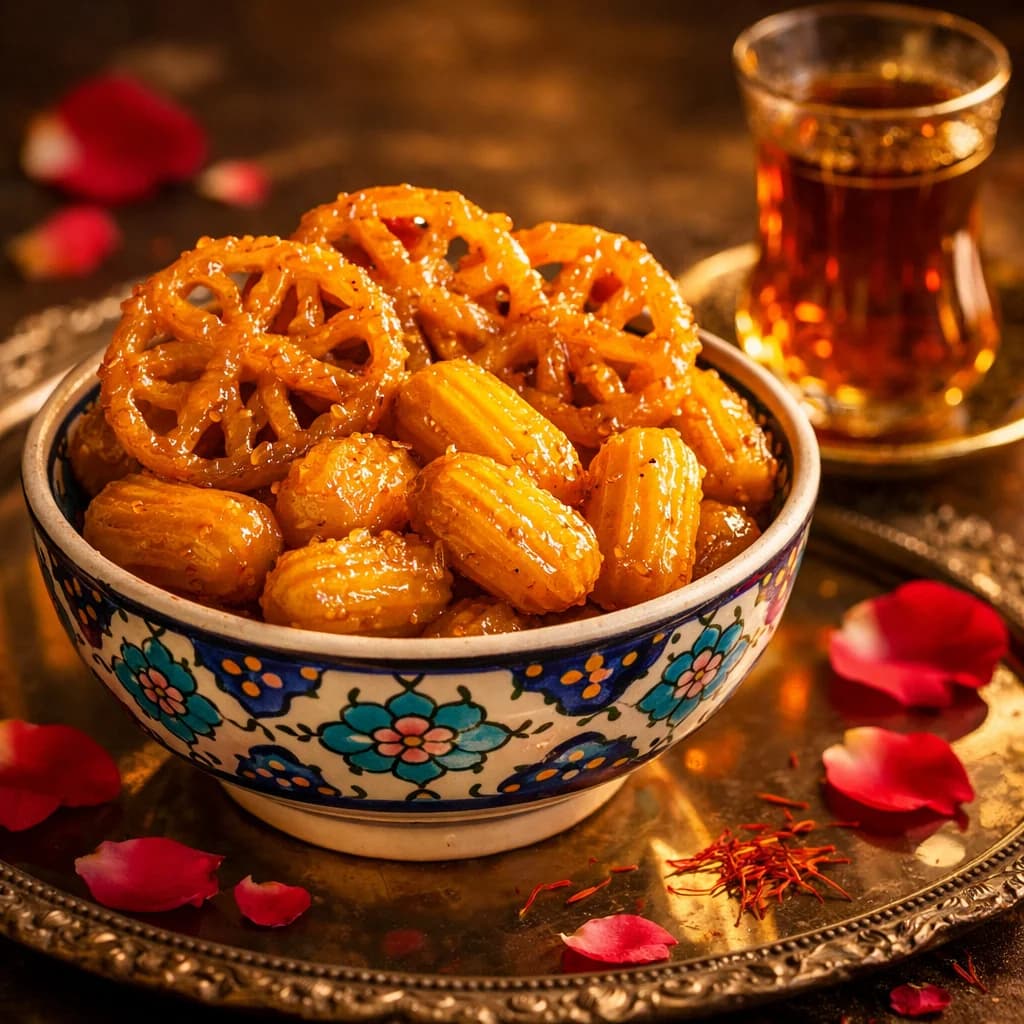
The iconic duo of Persian fried pastries, essential to Ramadan and religious celebrations. Zoolbia are lacy, pretzel-shaped fritters with a crispy exterior and soft interior, while bamieh are small, oblong puffs like elegant donut holes. Both are soaked in saffron-rosewater syrup until glistening and fragrant. Sold together from street vendors and sweet shops throughout Iran, these two pastries are inseparable—the crispy crunch of zoolbia perfectly complemented by the soft chew of bamieh. Together, they represent the taste of Ramadan evenings and Persian celebrations.

Baklava (Persian-Style Layered Nut Pastry)

Baklava (Persian-Style Layered Nut Pastry)

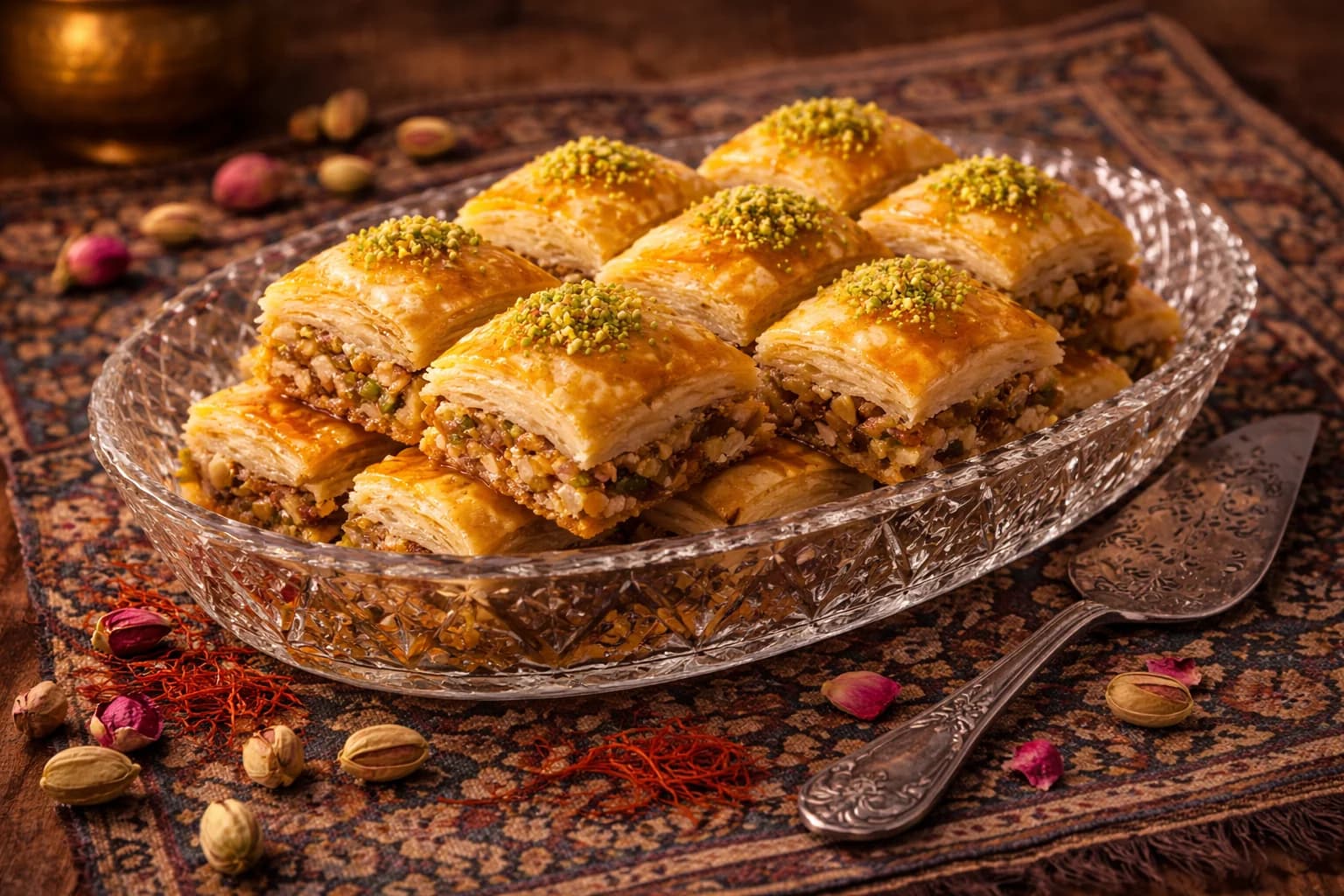
Delicate layers of paper-thin phyllo pastry filled with fragrant ground nuts, baked to golden crispness, and soaked in a saffron-rosewater syrup—Persian baklava is more refined and aromatic than its regional cousins. The Persian version distinguishes itself with generous saffron, rosewater, and cardamom, and often features a combination of pistachios and almonds rather than walnuts alone. Cut into elegant diamond shapes and decorated with ground pistachios, this is the jewel of Persian pastry-making, served at weddings, Nowruz, and whenever celebration calls for something extraordinary.

Bastani Sonnati (Persian Saffron Ice Cream)

Bastani Sonnati (Persian Saffron Ice Cream)

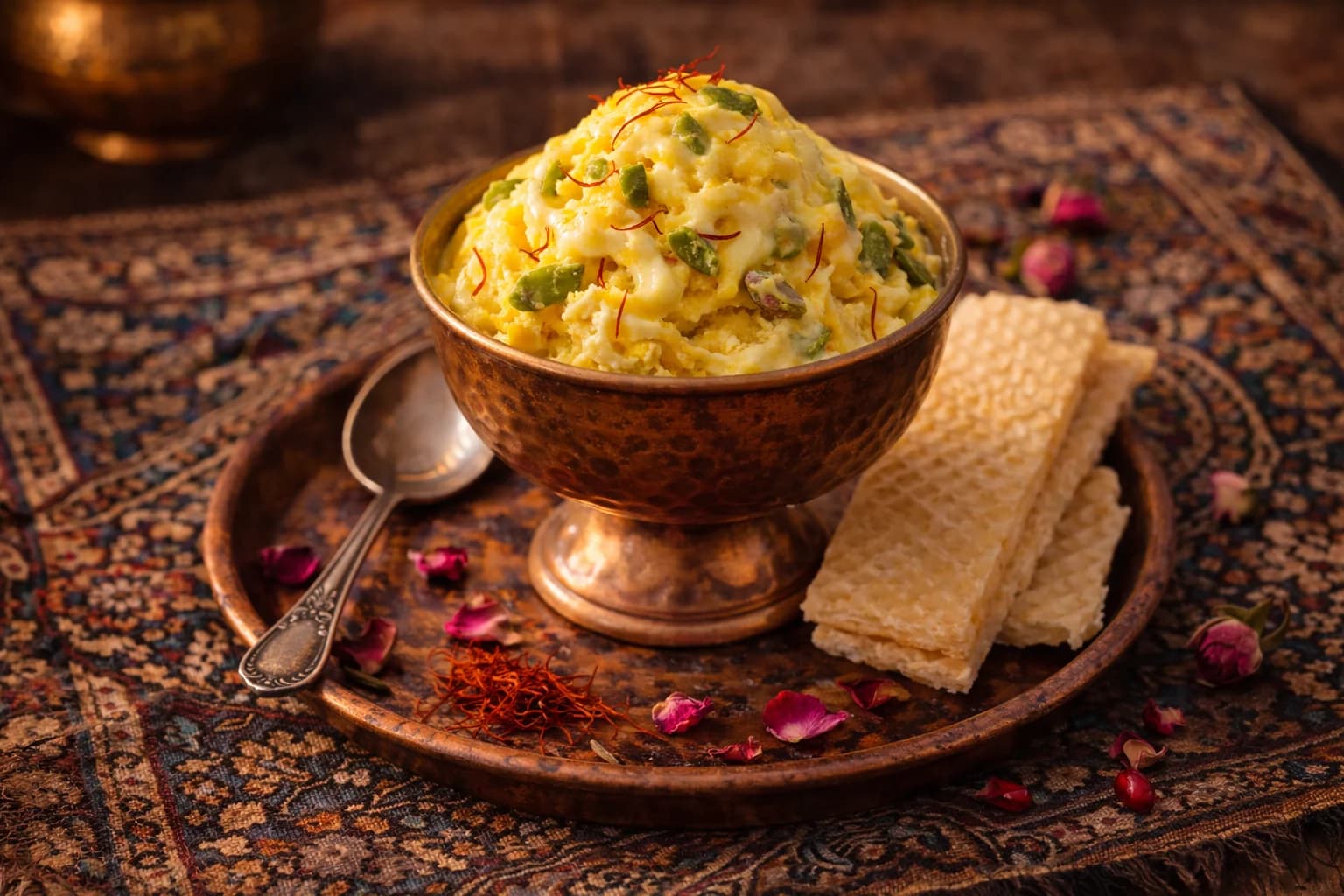
The legendary Persian ice cream—a luxurious frozen cream perfumed with saffron and rosewater, studded with pistachios, and threaded with frozen ribbons of clotted cream. Unlike any Western ice cream, bastani sonnati has a distinctive chewy, stretchy texture from salep (orchid root powder) and an intoxicating fragrance that captures the essence of Persian sweets. Traditionally served pressed between crispy wafers or alongside faloodeh, this golden ice cream is the crown jewel of Persian frozen desserts.