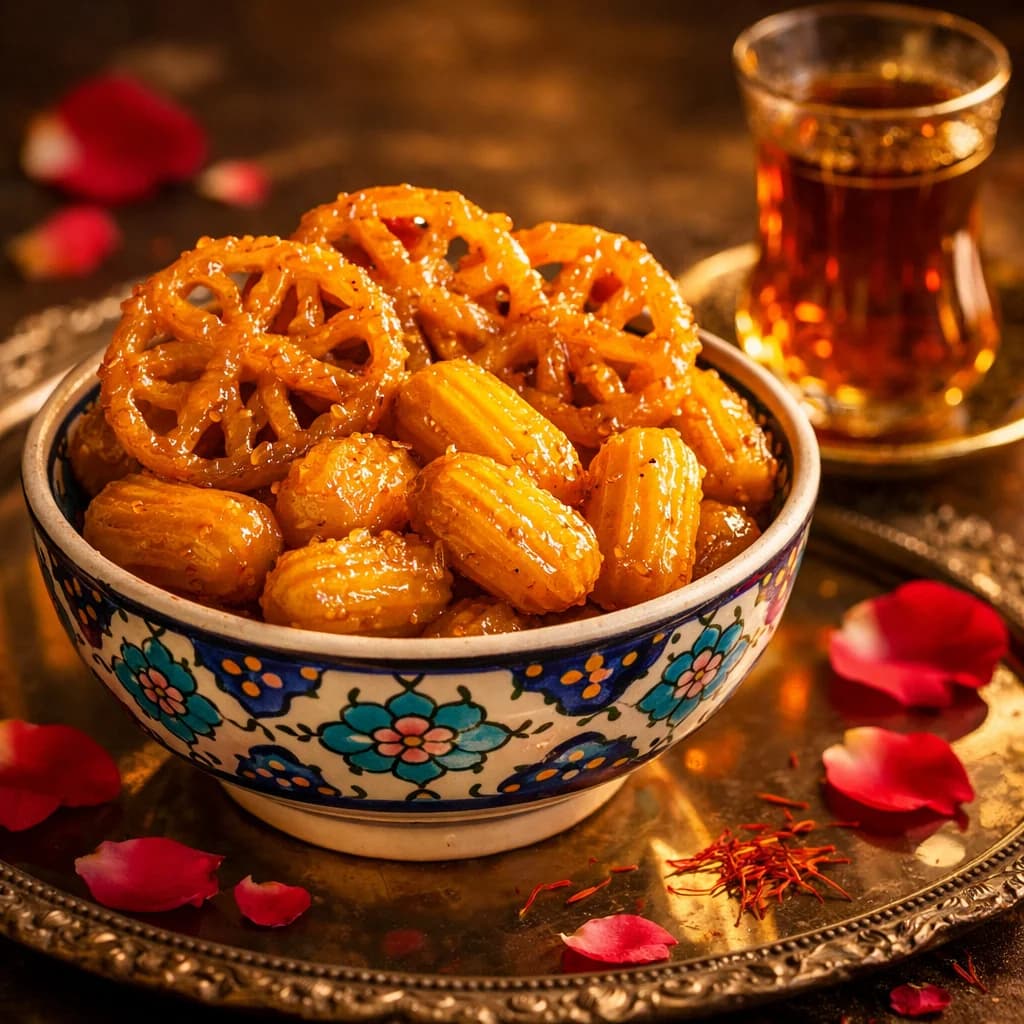
Zoolbia va Bamieh (Persian Fried Pastries)

Zoolbia va Bamieh (Persian Fried Pastries)

زولبیا و بامیه

The iconic duo of Persian fried pastries, essential to Ramadan and religious celebrations. Zoolbia are lacy, pretzel-shaped fritters with a crispy exterior and soft interior, while bamieh are small, oblong puffs like elegant donut holes. Both are soaked in saffron-rosewater syrup until glistening and fragrant. Sold together from street vendors and sweet shops throughout Iran, these two pastries are inseparable—the crispy crunch of zoolbia perfectly complemented by the soft chew of bamieh. Together, they represent the taste of Ramadan evenings and Persian celebrations.

dessertVorbereitung: 40 MinKochen: 45 MinintermediateFür 12

Kultureller Hinweis

Zoolbia va bamieh are as synonymous with Ramadan in Iran as dates and iftar. Throughout the holy month, sweet shops produce mountains of these golden pastries, and the distinctive aroma of frying dough and rosewater syrup fills the streets near sundown. Families break their fast with dates and water, then enjoy zoolbia and bamieh with tea. The two pastries are always sold together—never separately—and eaten together for the contrast of textures: zoolbia's lacy crunch against bamieh's pillowy chew. Beyond Ramadan, they appear at religious commemorations, weddings, and Nowruz. Zoolbia is related to jalebi (found across South Asia and the Middle East), while bamieh (meaning 'okra' for its shape) is distinctly Persian. The act of making these at home during Ramadan is itself an act of devotion and celebration.

Kritische Momente

  • Zoolbia batter must rest until bubbly (fermentation)
  • Bamieh dough is pâte à choux—proper technique essential
  • Oil temperature must be correct and maintained
  • Syrup must be warm (not hot, not cold) during soaking
  • Soaking time—enough to absorb but not become soggy
1
VORBEREITUNG20 Min

Make the saffron syrup

Bloom the saffron in 2 tablespoons hot water for 15 minutes. In a medium saucepan, combine 500g sugar, 350ml water, and lemon juice. Heat over medium, stirring until sugar dissolves. Bring to boil and simmer 10 minutes without stirring. Remove from heat, stir in bloomed saffron and rosewater. Keep warm (not hot) while frying.

Golden syrup from saffron; slightly thickened
MediumSimmer 10 minutes
GeruchSaffron and rosewater
KlangBubbling then quiet
TexturSyrupy, coats spoon lightly

Kritischer Schritt

The syrup should be warm (not hot, not cold) when pastries are dipped—this ensures proper absorption without making them soggy or preventing absorption.

Keep syrup warm throughout frying. If it cools too much, gently rewarm. If it thickens too much, add a splash of water.
2
VORBEREITUNG70 Min

Make the zoolbia batter

In a large bowl, whisk together 250g flour and cornstarch. In a small bowl, dissolve the yeast in warm water. Add the yogurt to the yeast mixture. Pour the wet ingredients into the flour and whisk until completely smooth—no lumps. The batter should be pourable like thin pancake batter. Cover and let rest at room temperature for 1 hour until bubbly and slightly fermented.

Smooth, pourable batter with bubbles on surface after resting
GeruchSlightly yeasty after resting
TexturThin batter consistency; flows easily

Kritischer Schritt

The batter must rest for fermentation—this creates the light, lacy texture. Without resting, zoolbia are dense and heavy. Bubbles indicate proper fermentation.

Batter should be thin enough to pipe easily but thick enough to hold its shape briefly in oil. Adjust with water or flour if needed after resting.
3
VORBEREITUNG8 Min

Make the bamieh dough (pâte à choux)

In a medium saucepan, combine 100g butter, 250ml water, and salt. Bring to a rolling boil over medium heat—the butter should be fully melted. Remove from heat and immediately add 200g flour all at once. Stir vigorously with a wooden spoon until the dough comes together and pulls away from the sides of the pan (about 1 minute).

Smooth dough ball that pulls cleanly from pan sides
MediumRolling boil for liquid
GeruchButter and flour cooking
KlangSizzling when flour added
TexturSmooth, cohesive ball; not sticky

Kritischer Schritt

This is pâte à choux (choux pastry)—the liquid must be at a rolling boil and the flour added all at once for proper gelatinization. This creates the structure for puffy bamieh.

Work quickly when adding flour. Beat vigorously to ensure no lumps. The dough should be smooth and come away from the pan cleanly.
4
VORBEREITUNG10 Min

Add eggs to bamieh dough

Let the dough cool for 5 minutes (hot dough will cook the eggs). Add eggs one at a time, beating well after each addition. The dough will look curdled at first but will come together smooth and glossy. After all eggs, the dough should be thick but pipe-able, holding a soft peak when lifted.

Smooth, glossy dough that holds soft peaks; falls in thick ribbons
GeruchEggy, buttery
TexturThick, glossy, pipe-able; not runny

Kritischer Schritt

Eggs must be added one at a time and fully incorporated—this creates the structure for puffing. Too many eggs = runny; too few = dense. The texture should be thick but not stiff.

Use room temperature eggs for easier incorporation. If dough seems too stiff after 4 eggs, beat another egg and add gradually until proper consistency.
5
KOCHEN10 Min

Heat the oil

Pour oil into a deep, heavy pot or deep fryer to a depth of 7-8cm. Heat to 175°C (350°F) for zoolbia, then adjust to 165°C (325°F) for bamieh. Use a candy thermometer for accuracy. Maintain steady temperature throughout frying.

Oil shimmering; a drop of batter sizzles and rises immediately
Medium-High175°C / 350°F for zoolbia; 165°C / 325°F for bamieh
GeruchHot oil
KlangQuiet; will sizzle when batter added

Kritischer Schritt

Oil temperature is crucial. Too hot = brown outside, raw inside. Too cool = greasy, absorbs too much oil. Zoolbia need slightly hotter oil for crispness; bamieh need lower for even cooking.

Test oil with a drop of batter—it should sizzle and rise immediately. Maintain temperature by adjusting heat as needed during frying.
6
KOCHEN15 Min

Fry the zoolbia

Transfer zoolbia batter to a squeeze bottle or piping bag with a small round tip (about 5mm). Working in batches, squeeze the batter into the hot oil (175°C/350°F) in a circular, pretzel-like, or figure-8 pattern—the traditional shape is lacy and interconnected. Fry for 2-3 minutes, flipping once, until golden and crispy on both sides. Remove with a slotted spoon.

Golden, lacy fritters with crispy exterior; multiple interconnected loops
Medium-High175°C / 350°F
GeruchFrying batter
KlangActive sizzling
TexturCrispy exterior, soft interior

Kritischer Schritt

The lacy, interconnected pattern is traditional—it creates maximum surface area for syrup absorption and crispy texture. Practice makes perfect; even imperfect shapes taste delicious.

Work quickly but carefully over hot oil. Squeeze in continuous motion to create connected loops. Don't overcrowd—fry 2-3 at a time. Flip when bottom is golden.

Häufige Fehler

  • Oil too hot (burns before cooking through)
  • Batter too thick (won't pipe smoothly)
  • Overcrowding (temperature drops, greasy result)
7
KOCHEN5 Min

Soak zoolbia in syrup

Immediately transfer hot zoolbia to the warm syrup. Let soak for 30-60 seconds, turning once to coat both sides. The zoolbia should absorb syrup but remain crispy. Transfer to a wire rack set over a tray to drain.

Glistening, golden zoolbia coated in syrup
GeruchSaffron-rosewater syrup on hot fritter
KlangSizzle when entering syrup
TexturSyrup-coated but still crisp

Kritischer Schritt

Soaking time is crucial—too short and the syrup doesn't penetrate; too long and zoolbia become soggy. The warm (not hot) syrup allows absorption without dissolving the crispy exterior.

Work in batches matching your frying—hot fritters into warm syrup. If syrup cools, rewarm gently.
8
KOCHEN20 Min

Fry the bamieh

Reduce oil temperature to 165°C (325°F). Transfer bamieh dough to a piping bag with a medium round tip (about 1cm). Pipe 3-4cm lengths directly into the oil, cutting with scissors or a knife at the tip. The dough will puff as it fries. Fry for 4-5 minutes, turning occasionally, until evenly golden brown and puffed—they should double in size.

Puffed, golden-brown ovals; doubled in size; even color
Medium165°C / 325°F
GeruchFrying choux pastry
KlangSteady sizzling
TexturPuffy, light; golden crust

Kritischer Schritt

Lower temperature allows bamieh to puff and cook through without browning too quickly. They need longer frying time than zoolbia. Underdone bamieh are raw inside; overdone are too dark.

Bamieh should be named for their okra-like shape—oblong with slightly pointed ends. Cut with wet scissors for clean release. Fry in small batches.

Häufige Fehler

  • Oil too hot (browns before cooking through)
  • Not frying long enough (raw doughy interior)
  • Piping pieces too large (won't cook through)
9
KOCHEN5 Min

Soak bamieh in syrup

Transfer hot bamieh to the warm syrup. Let soak for 1-2 minutes—slightly longer than zoolbia as they absorb more slowly. Turn to coat all sides. The bamieh should become glossy and absorb syrup into their interior. Transfer to wire rack to drain.

Glossy, syrup-soaked bamieh; slightly translucent appearance
GeruchSaffron-rosewater
KlangBubbling as syrup absorbs
TexturSyrup-saturated but holding shape
Bamieh are more absorbent than zoolbia—they should be well-soaked but not falling apart.
10
FERTIGSTELLEN5 Min

Arrange and garnish

Arrange zoolbia and bamieh together on a serving platter—the traditional presentation shows both pastries together. Sprinkle with ground pistachios if desired. Serve at room temperature within a few hours for best texture.

Golden platter with lacy zoolbia and puffy bamieh; green pistachio garnish
GeruchSaffron, rosewater, fried dough
TexturCrispy zoolbia; soft bamieh
These are best eaten the same day—zoolbia lose their crispness and bamieh become too soft over time. In Iran, they're always sold freshly made.

Ruhezeit Erforderlich

60 Min - Zoolbia batter must ferment for 1 hour

Extras

Ausstattung

deep fryer or heavy potpiping bag or squeeze bottlecandy thermometermedium saucepanStandard

Servieren Mit

Beilagen

  • Always served together as a pair
  • Dates and other Ramadan sweets
  • Fresh fruit

Getränke

  • Hot Persian tea (essential)
  • Cold water

Ersatzstoffe

yogurtFor zoolbia batter—plain Greek yogurt or even sour cream works. The acidity helps with fermentation and texture.
saffronEssential for authentic color and flavor. Can omit for simpler version, but loses the characteristic golden color and perfume.
rosewaterEssential for authentic flavor. No substitute—the floral note defines these pastries.
piping equipmentA squeeze bottle (like for condiments) works well for zoolbia. For bamieh, a zip-lock bag with corner cut works in a pinch.

Skalierung

This recipe makes both zoolbia and bamieh together (the traditional pairing). The batters are different but the syrup is shared. Can scale up for large gatherings—during Ramadan, families often make large batches. Best eaten the same day for optimal texture.

Quelle

Traditionell · Traditional Persian cuisine

Zoolbia is related to jalebi found throughout South Asia and the Middle East, while bamieh (named for its okra-like shape) is distinctly Persian. The two are always sold and served together in Iran, particularly during Ramadan when demand is at its peak.

Ähnliche Rezepte

Ranginak (Persian Date and Walnut Dessert)

Ranginak (Persian Date and Walnut Dessert)

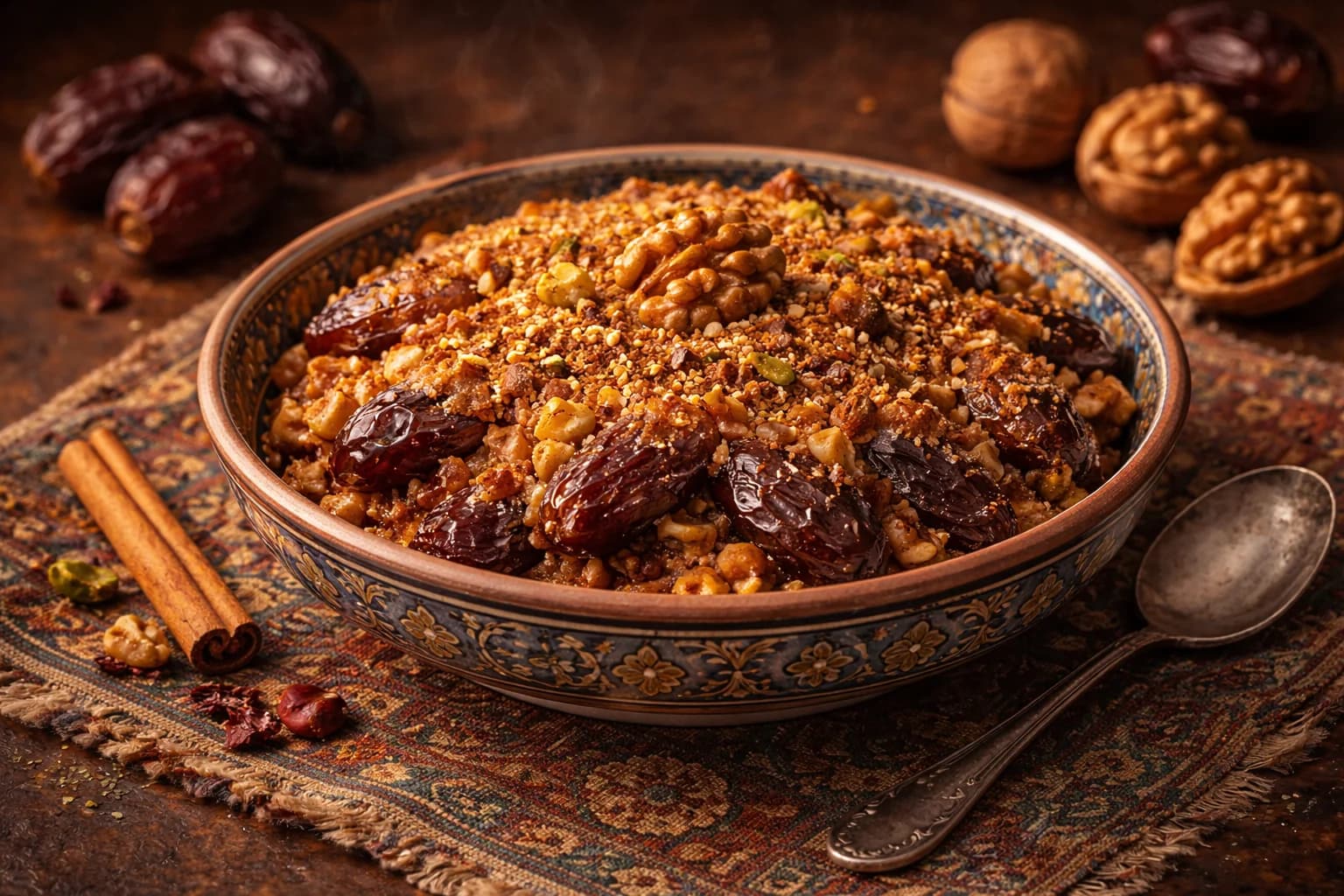
A luscious, no-bake dessert from the Persian Gulf coast—layers of sweet dates stuffed with walnuts, pressed together and blanketed with a golden, aromatic fried flour mixture fragrant with cardamom and cinnamon. This ancient delicacy from Bushehr province transforms humble dates into something extraordinary. The name means 'colorful' in Persian, though the dessert is actually a study in warm browns and golds. Rich, satisfying, and deeply flavored, ranginak is beloved throughout Iran, especially during Ramadan and religious occasions.

Baklava (Persian-Style Layered Nut Pastry)

Baklava (Persian-Style Layered Nut Pastry)

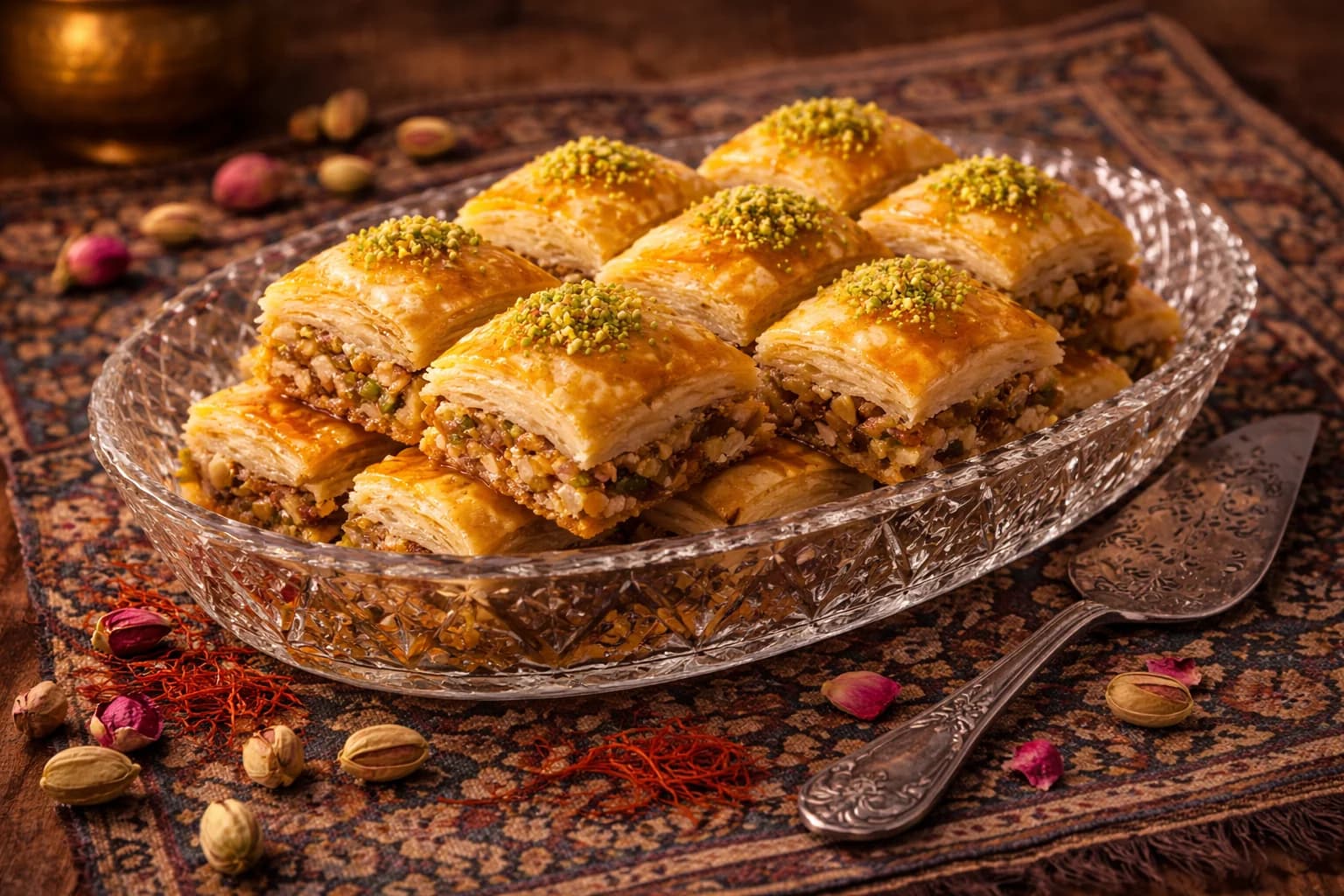
Delicate layers of paper-thin phyllo pastry filled with fragrant ground nuts, baked to golden crispness, and soaked in a saffron-rosewater syrup—Persian baklava is more refined and aromatic than its regional cousins. The Persian version distinguishes itself with generous saffron, rosewater, and cardamom, and often features a combination of pistachios and almonds rather than walnuts alone. Cut into elegant diamond shapes and decorated with ground pistachios, this is the jewel of Persian pastry-making, served at weddings, Nowruz, and whenever celebration calls for something extraordinary.

Bastani Sonnati (Persian Saffron Ice Cream)

Bastani Sonnati (Persian Saffron Ice Cream)

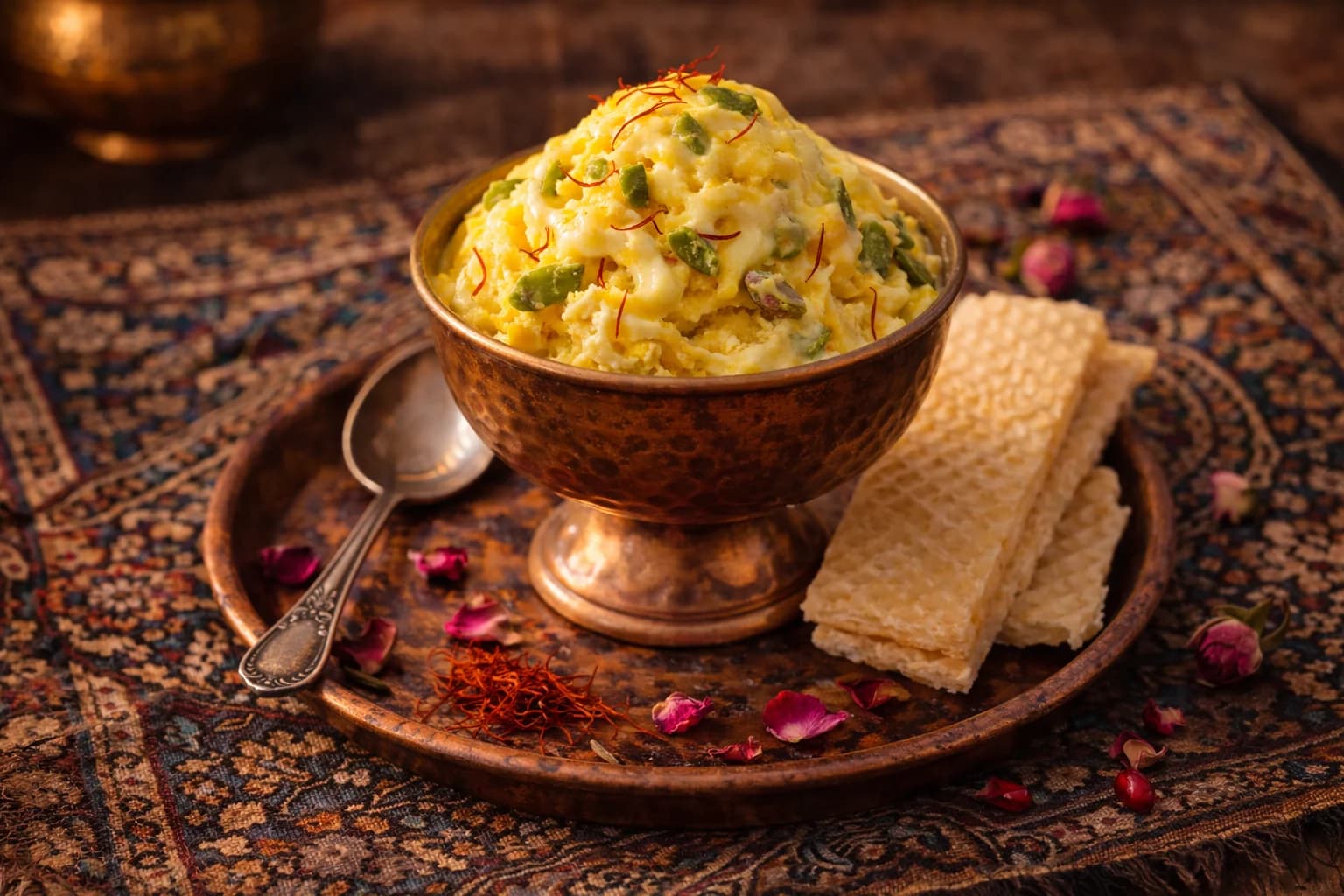
The legendary Persian ice cream—a luxurious frozen cream perfumed with saffron and rosewater, studded with pistachios, and threaded with frozen ribbons of clotted cream. Unlike any Western ice cream, bastani sonnati has a distinctive chewy, stretchy texture from salep (orchid root powder) and an intoxicating fragrance that captures the essence of Persian sweets. Traditionally served pressed between crispy wafers or alongside faloodeh, this golden ice cream is the crown jewel of Persian frozen desserts.