
Sabzi Polo ba Mahi (Persian Herb Rice with Fried Fish)

Sabzi Polo ba Mahi (Persian Herb Rice with Fried Fish)

سبزی پلو با ماهی

The essential dish of the Persian Nowruz table—vibrant green herb rice fragrant with dill, parsley, cilantro, chives, and fenugreek, served alongside crispy golden fried fish. The fresh herbs symbolize renewal and rebirth, while the fish represents life and prosperity for the new year. This is Persian New Year on a plate.

riceVorbereitung: 40 MinKochen: 75 MinintermediateFür 6

Kultureller Hinweis

Sabzi polo ba mahi is THE dish of Nowruz, served on the eve of the Persian New Year as families gather to welcome spring. The green herbs (sabzi) symbolize rebirth and renewal—the essence of Nowruz, which coincides with the spring equinox. The fish (mahi) represents life and the Zoroastrian reverence for water. Together, they embody hope for a fruitful year ahead. No Nowruz table is complete without this dish.

Kritische Momente

  • Herbs must be completely dry before chopping
  • Rice parboiled correctly (al dente)
  • Fish fried at proper temperature for crispy exterior
  • Never lifting rice lid during steaming
1
VORBEREITUNG15 Min

Wash and soak the rice

Place rice in a large bowl. Fill with cold water, swirl vigorously, and drain. Repeat 5-6 times until water runs mostly clear. Dissolve 2 tbsp salt in 2L lukewarm water, add rice, and soak for at least 1 hour.

Water progresses from cloudy to nearly clear; soaked grains appear elongated
TexturSoaked rice is fragile
Währenddessen: Prepare herbs while rice soaks
2
VORBEREITUNG3 Min

Bloom the saffron

Grind saffron with a pinch of sugar using mortar and pestle. Transfer to a small bowl, add 3 tbsp hot water. Cover and steep for at least 20 minutes.

Ruby-red liquid
GeruchHoney-floral saffron aroma
3
VORBEREITUNG25 Min

Wash and prepare the herbs

Wash all fresh herbs thoroughly in several changes of cold water. Spin dry in a salad spinner or spread on clean towels and pat completely dry. The herbs must be very dry. Finely chop all herbs separately, then combine in a large bowl.

Vibrant green herbs, completely dry, uniformly chopped
GeruchIntensely aromatic—fresh dill and herbs fill the kitchen
TexturHerbs feel dry, not damp or clumpy

Kritischer Schritt

Wet herbs will steam instead of incorporating properly, resulting in clumpy, discolored rice with a 'cooked spinach' texture instead of fluffy herb-studded rice. Thorough drying is essential.

Wash herbs the night before and refrigerate wrapped in paper towels to dry overnight. This is the most time-consuming part—do it ahead.

Häufige Fehler

  • Not drying herbs enough (soggy, clumped rice)
  • Chopping too coarse (herbs don't distribute)
  • Using wilted herbs (dull flavor and color)
4
VORBEREITUNG5 Min

Prepare the fish

Pat fish fillets completely dry with paper towels. Season both sides with salt, pepper, and turmeric. Let sit at room temperature for 15-20 minutes while you prepare the rice. The fish will be fried just before serving.

Fish fillets evenly coated in golden turmeric
GeruchFresh fish with earthy turmeric
TexturFish surface is dry, not wet
Room temperature fish cooks more evenly. Dry fish = crispy skin. Wet fish = splatter and steaming.
Kontrollpunkt: Fish should be dry before dredging and frying
5
KOCHEN7 Min

Sauté the herbs (optional but recommended)

Heat 30ml oil in a large skillet over medium heat. Add the combined chopped herbs and sauté for 5-7 minutes, stirring frequently, until herbs darken slightly and become fragrant. This step mellows raw herb flavor and intensifies the green color. If using dried fenugreek, add it here.

Herbs have darkened from bright to deeper green; reduced slightly in volume
Medium175°C / 350°F
GeruchIntensified herb aroma—slightly toasted, deeply aromatic
KlangGentle sizzling
TexturHerbs are wilted but not wet
This step is traditional and creates deeper flavor, but can be skipped for a fresher taste. If skipping, the raw herbs will cook during rice steaming.
6
KOCHEN7 Min

Parboil the rice

Bring 3L water with 2 tbsp salt to a rolling boil. Drain soaked rice and add to boiling water. Boil for 5-7 minutes until al dente—soft outside with a tiny firm core. Test frequently.

Rice grains elongated; water is starchy
HighRolling boil
GeruchClean rice aroma
KlangActive boiling
TexturAl dente when bitten—soft exterior, tiny chalky core

Kritischer Schritt

Proper parboiling determines final rice texture. With the herbs adding extra moisture, err slightly on the underdone side.

7
KOCHEN3 Min

Drain and mix rice with herbs

Immediately drain rice into a fine-mesh strainer. Rinse briefly with lukewarm water. Gently fold the sautéed (or raw) herb mixture into the rice until evenly distributed. The rice should be uniformly green-flecked.

White rice evenly studded with green herbs throughout
GeruchFresh herbs and rice
TexturLight mixture, herbs distributed evenly
Fold gently—the rice grains and herbs are delicate. Stirring aggressively breaks the rice.
8
KOCHEN5 Min

Prepare tahdig and layer rice

In a non-stick pot, combine 60ml oil with 2 tbsp saffron water. Take 2 cups of the herb-rice mixture and spread on the bottom for tahdig, pressing gently. Add remaining herb rice, building into a pyramid. Poke 5-6 steam vents to the bottom.

Green-flecked rice in pyramid shape with golden saffron oil beneath tahdig layer
GeruchSaffron and fresh herbs
The tahdig layer will be green from herbs—this is correct and beautiful
9
KOCHEN50 Min

Steam the rice

Drizzle melted butter over the rice. Place pot over medium-high heat uncovered for 3-4 minutes until steam rises. Wrap lid with a clean kitchen towel, place tightly on pot. Reduce heat to lowest setting. Steam for 45-50 minutes.

Steam rising initially; then covered—trust the process
Initial high heat 3-4 min, then lowest setting
GeruchAromatic herbs steaming; slight toasting of tahdig
KlangInitial sizzle, then very quiet

Kritischer Schritt

Proper steaming ensures fluffy rice and crispy tahdig. Don't lift the lid.

Währenddessen: Fry the fish during the last 15-20 minutes of steaming
10
KOCHEN5 Min

Dredge the fish

Place flour on a plate. Dredge each fish fillet in flour, shaking off excess. The coating should be light and even. Set aside on a clean plate.

Fish lightly coated in flour with no clumps
TexturThin, even flour coating
Dredge just before frying—flour coating becomes gummy if it sits too long
11
KOCHEN12 Min

Fry the fish

Heat 90ml oil in a large skillet over medium-high heat until shimmering (about 180°C/350°F). Carefully add fish fillets—don't crowd the pan. Fry for 3-4 minutes per side until golden brown and crispy. The fish should be cooked through and flake easily. If using garlic, add to the pan in the last minute of cooking.

Deep golden-brown crust; fish is opaque and flakes easily
Medium-High180°C / 350°F oil temperature
GeruchCrispy fried fish—appetizing, not 'fishy'
KlangSteady sizzling; quiets slightly when fish is turned
TexturCrispy exterior; fish flakes when pressed

Kritischer Schritt

Properly fried fish is the perfect companion to the herb rice. It should be crispy and golden, not soft or greasy. Temperature control is key.

Test oil temperature by dropping a small piece of flour—it should sizzle immediately

Häufige Fehler

  • Oil not hot enough (greasy, soggy fish)
  • Oil too hot (burns outside, raw inside)
  • Crowding pan (temperature drops, fish steams)
  • Moving fish too soon (crust tears)
12
FERTIGSTELLEN2 Min

Drain the fish

Remove fried fish to a paper towel-lined plate to drain briefly. Season with a final pinch of salt while hot. Keep warm while you finish the rice.

Golden, crispy fish resting on paper towels
GeruchCrispy fried fish
TexturCrispy crust
Fish can be kept warm in a 100°C/200°F oven for up to 15 minutes
13
FERTIGSTELLEN8 Min

Rest and unmold rice

Remove rice pot from heat and let rest 5 minutes. Remove lid. Gently fluff rice with a fork. Spoon onto a large serving platter. Unmold tahdig by flipping pot onto a plate—it will be green-flecked and golden.

Fluffy green-studded rice; golden tahdig with green herb flecks
GeruchIntensely aromatic herb rice
KlangTahdig releasing
TexturFluffy rice; crispy tahdig
14
FERTIGSTELLEN

Assemble and serve

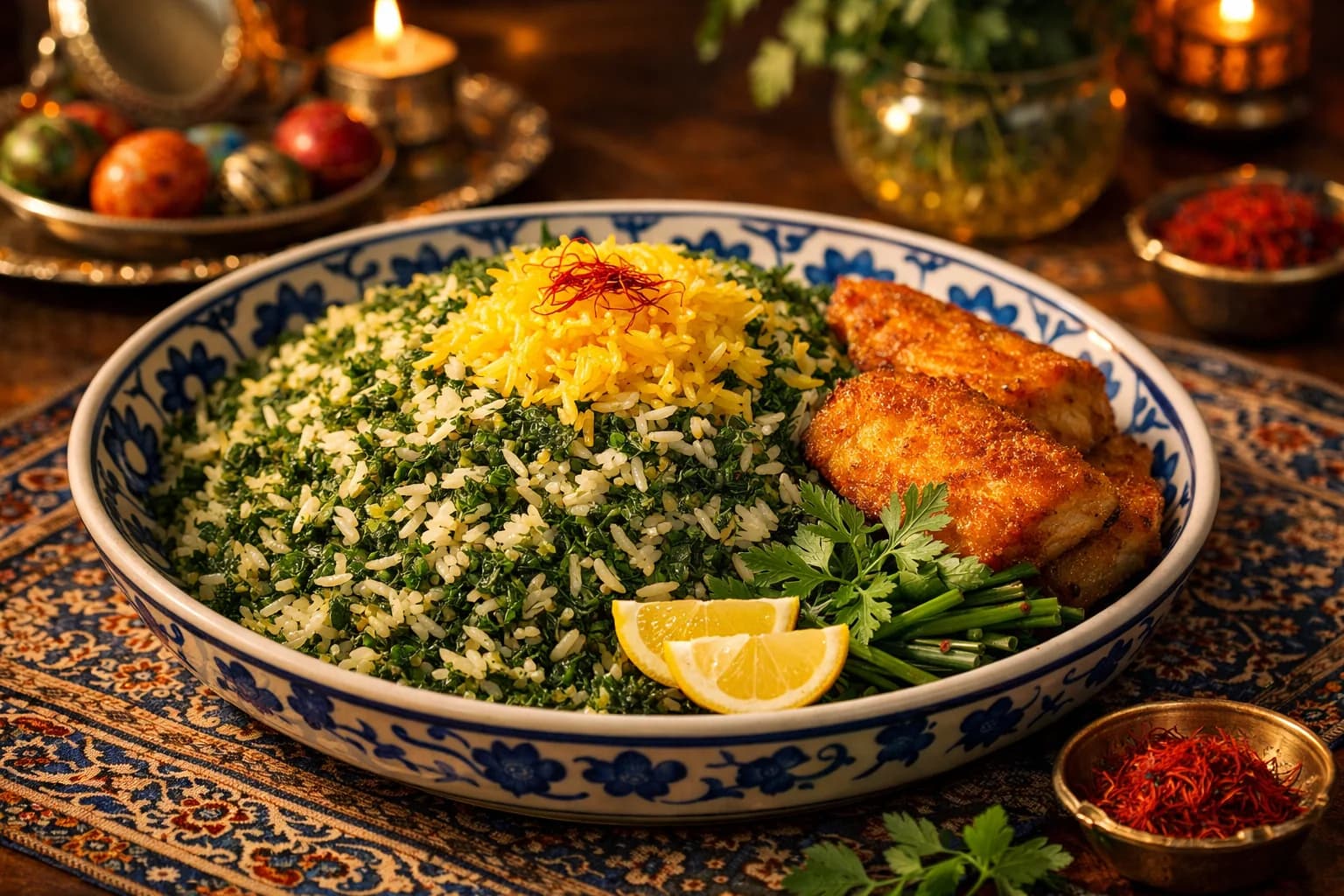
Arrange the herb rice on a large platter. Place fried fish alongside or on top. Drizzle remaining saffron water over the rice for golden streaks. Arrange tahdig pieces around the platter. Serve immediately with lemon wedges for squeezing over the fish.

Vibrant green herb rice, golden fried fish, crispy tahdig, bright lemon wedges—a Nowruz feast
This is a celebration dish—present it beautifully. The colors should be vivid: green rice, golden fish, yellow saffron streaks.

Ruhezeit Erforderlich

5 Min - Allows tahdig to release cleanly

Extras

Ausstattung

großer TopfAntihaft-Topfgroße Pfannefeines SiebGeschirrtuchStandard

Im Voraus Zubereiten

  • Herbs can be washed and dried 1-2 days ahead.
  • Herb mixture (sautéed) can be frozen for months—a common practice for having Nowruz sabzi ready.
  • Fish should be fried fresh.
  • Rice must be made fresh.

Rice reheats reasonably in a covered pan with butter.

Fish is best fresh but can be briefly reheated in a hot oven (loses some crispiness).

Servieren Mit

Beilagen

  • Kuku sabzi (herb frittata—also a Nowruz essential)
  • Mast-o-khiar
  • Sabzi khordan
  • Torshi
  • Ash reshteh

Getränke

  • Doogh
  • Black tea
  • Sharbat-e sekanjabin

Ersatzstoffe

fresh herbsFrozen herb mix (sabzi polo) is excellent—thaw and squeeze dry. Dried herb mix works but fresh is far superior for Nowruz.
fenugreekDried fenugreek (kasuri methi) from Indian stores. Use 2 tbsp dried per 50g fresh. No true substitute—important for authentic flavor.
white fishSalmon, trout, sea bass, branzino, or even tilapia work. Smoked fish is traditional in northern Iran. Avoid oily fish like mackerel.
saffronCan reduce amount for everyday cooking but essential for Nowruz presentation.

Skalierung

Rice and herbs scale proportionally. Fish is typically one piece per person. For large gatherings, fry fish in batches and keep warm in a low oven. The herb mixture can be prepared in large quantities and frozen for future use.

Quelle

Traditionell · Nowruz traditional cuisine

Served on the eve of Nowruz (Persian New Year) as the centerpiece of the holiday meal. Every Iranian family has this dish on their Nowruz table.

Ähnliche Rezepte