
Moments Critiques
- •Blanchir les écorces d'orange plusieurs fois pour éliminer l'amertume
- •Confire les écorces jusqu'à translucidité sans caraméliser le sirop
- •Faire sauter les épine-vinette très brièvement à feu doux
- •Superposer correctement les éléments de joyaux
Laver et faire tremper le riz
Mettre le riz dans un grand saladier. Remplir d'eau froide, remuer vigoureusement et égoutter. Répéter 5 à 6 fois jusqu'à ce que l'eau soit presque claire. Dissoudre le sel dans de l'eau tiède, ajouter le riz et laisser tremper au moins 1 heure (jusqu'à 3 heures).
Infuser le safran
Moudre les filaments de safran avec une pincée de sucre au mortier. Transférer dans un petit bol, ajouter l'eau chaude. Couvrir et laisser infuser au moins 30 minutes.
Préparer les écorces d'orange
Avec un éplucheur ou un couteau bien aiguisé, retirer le zeste des oranges en lanières en évitant au maximum la partie blanche. Couper le zeste en très fines julienne.
Étape Critique
La partie blanche est amère et gâcherait le goût des écorces confites. Prendre le temps de la retirer, ou couper assez finement pour en inclure un minimum.
Erreurs Courantes
- •Trop de partie blanche (écorces confites amères)
- •Lanières trop épaisses (caoutchouteuses, ne confisent pas correctement)
- •Découpe inégale (texture inconsistante)
Blanchir les écorces d'orange
Placer les lanières d'écorce d'orange dans une petite casserole, couvrir d'eau froide. Porter à ébullition, puis égoutter. Répéter ce processus de blanchiment encore 2 fois (3 fois au total). Cela élimine l'amertume des écorces.
Étape Critique
Le blanchiment multiple élimine les composés amers de l'écorce. Sauter des blanchiments donne des écorces confites amères qui ruinent la douceur délicate du plat.
Erreurs Courantes
- •Ne blanchir qu'une seule fois (encore amer)
- •Ne pas égoutter complètement entre les blanchiments
Confire les écorces d'orange
Dans la même casserole, mélanger le sucre avec l'eau. Porter à ébullition en remuant pour dissoudre le sucre. Ajouter les écorces d'orange blanchies. Réduire le feu au minimum et laisser mijoter 25 à 30 minutes en remuant de temps en temps, jusqu'à ce que les écorces soient translucides et que le sirop ait épaissi.
Étape Critique
Un confisage correct transforme les écorces en lanières sucrées et brillantes comme des bijoux. Une cuisson insuffisante les laisse coriaces ; une cuisson excessive les rend dures et caramélisées.
Finir les écorces confites
Retirer les écorces confites du sirop avec une écumoire et les étaler sur du papier sulfurisé pour refroidir. Réserver le sirop d'orange — il servira à parfumer le riz. Les écorces deviendront légèrement plus fermes en refroidissant.
Préparer les carottes (si utilisées)
Éplucher les carottes et les couper en fins bâtonnets similaires aux écorces d'orange. Dans une petite poêle, faire fondre le beurre, ajouter les carottes et le sucre. Faire sauter à feu doux-moyen 8 à 10 minutes jusqu'à ce que les carottes soient tendres et légèrement caramélisées.
Griller les noix
Dans une poêle sèche à feu doux-moyen, griller les amandes effilées 3 à 4 minutes en remuant constamment, jusqu'à ce qu'elles soient dorées. Verser dans une assiette. Griller les pistaches séparément 2 à 3 minutes (elles brûlent plus vite). Réserver.
Erreurs Courantes
- •Feu trop fort (les noix brûlent vite)
- •Ne pas remuer (grillage inégal)
- •Griller ensemble (les pistaches brûlent avant que les amandes soient prêtes)
Préparer les épine-vinette
Nettoyer les épine-vinette des tiges. Rincer brièvement et secouer pour sécher. Dans une petite poêle, faire fondre le beurre à feu doux-moyen. Ajouter les épine-vinette et faire sauter délicatement 2 minutes jusqu'à ce qu'elles gonflent. Ajouter le sucre, remuer jusqu'à dissolution. Retirer du feu immédiatement.
Étape Critique
Les épine-vinette brûlent extrêmement facilement dès que le sucre est ajouté. Feu doux et attention constante sont essentiels. Des épine-vinette brûlées sont amères et ruinent le plat.
Erreurs Courantes
- •Feu trop fort (brûlage instantané)
- •S'éloigner (brûle en quelques secondes)
- •Trop de sucre (trop sucré, masque l'acidité)
Précuire le riz
Porter l'eau salée à ébullition vive. Égoutter le riz trempé et le verser dans l'eau bouillante. Cuire 5 à 7 minutes al dente — extérieur tendre avec un petit cœur ferme.
Étape Critique
La précuisson correcte est la base d'un riz persan aéré. Tester fréquemment.
Égoutter le riz
Égoutter immédiatement le riz dans une passoire fine. Rincer brièvement à l'eau tiède. Secouer délicatement pour égoutter.
Préparer le tahdig et superposer le riz
Dans une cocotte antiadhésive, mélanger l'huile avec l'eau safranée. Mélanger le riz précuit avec l'eau safranée et l'étaler au fond pour le tahdig. Ajouter des couches de riz blanc en alternant avec les garnitures de joyaux : répartir écorces d'orange confites, carottes, épine-vinette et noix entre les couches. Arroser de sirop d'orange réservé entre les couches. Former une pyramide. Percer 5 à 6 trous de vapeur.
Étape Critique
La superposition répartit les éléments de joyaux uniformément et crée l'apparence spectaculaire au service. Réserver un peu de chaque garniture pour la décoration finale.
Ajouter les aromates et le beurre
Dissoudre la cardamome (et la cannelle, si utilisée) dans l'eau de rose et l'eau de fleur d'oranger. Arroser le riz. Faire fondre le reste du beurre et l'arroser par-dessus. Les eaux aromatiques parfumeront le riz pendant la cuisson vapeur.
Cuire le riz à la vapeur
Placer la cocotte à feu moyen-vif sans couvercle 3 à 4 minutes jusqu'à ce que de la vapeur s'élève. Envelopper le couvercle d'un torchon propre, poser fermement sur la cocotte. Réduire le feu au minimum. Cuire à la vapeur 45 à 50 minutes.
Étape Critique
Une cuisson vapeur correcte garantit un riz aéré et un tahdig croustillant. Le torchon absorbe la condensation. Ne pas soulever le couvercle.
Laisser reposer et démouler
Retirer du feu et laisser reposer 5 minutes. Retirer le couvercle. Égrener délicatement le riz à la fourchette, en mélangeant légèrement les couches de joyaux. Dresser sur un grand plat de service en conservant une apparence en couches. Démouler le tahdig et le casser en morceaux.
Garniture finale
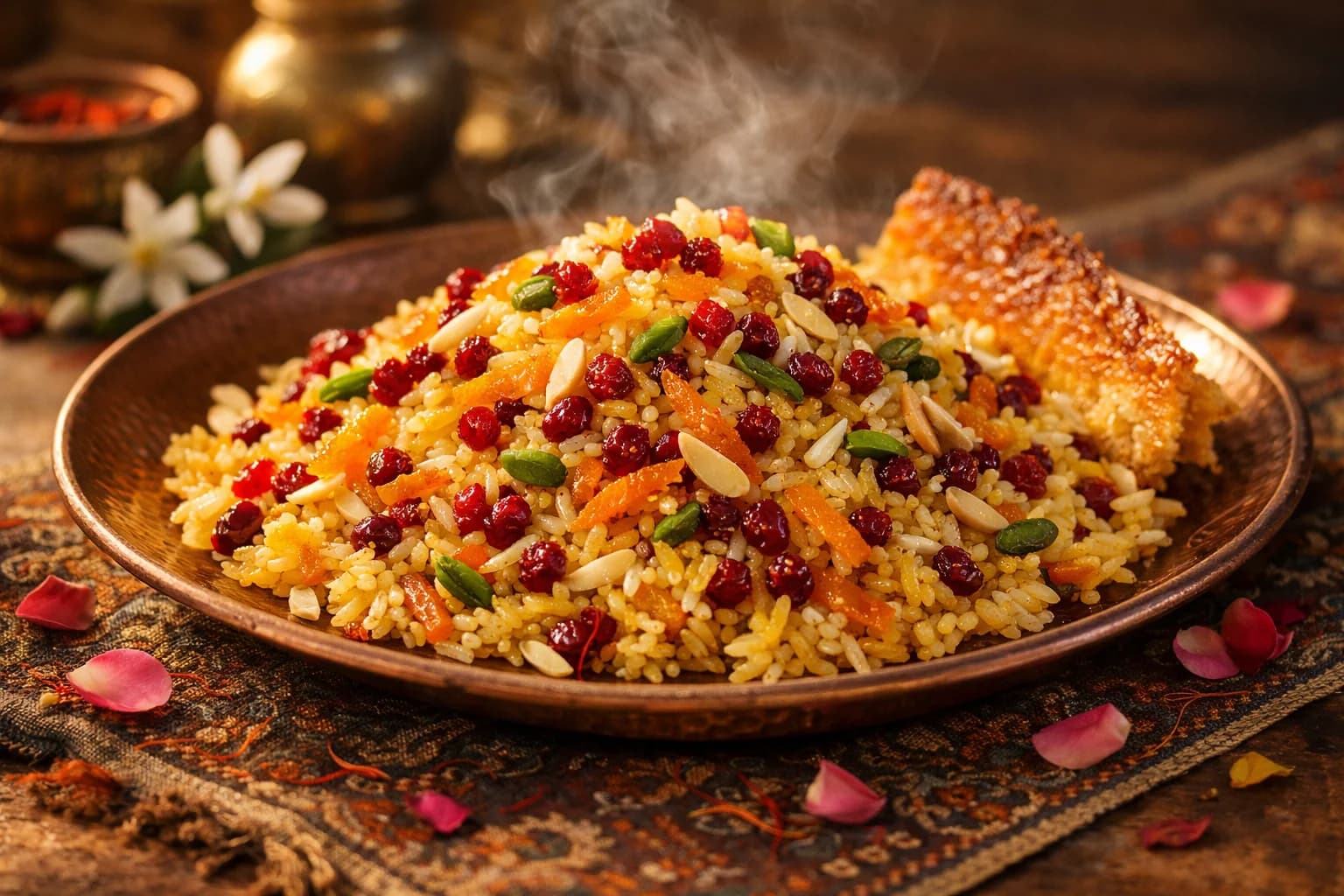
Disposer les écorces d'orange confites, épine-vinette, amandes et pistaches réservées de manière décorative sur le riz. Arroser du reste d'eau safranée en traînées pour la couleur. La garniture doit être abondante et belle — c'est un plat de fête. Disposer les morceaux de tahdig autour du plat.
Repos Requis
5 min - Permet au tahdig de se décoller proprement